Port Authority Bus Terminal Renovation Stalls Over Funding Gaps
Contract disputes and budget shortfalls have delayed the ambitious redesign that was meant to unclog Midtown West traffic.
By Olivia Park · December 28, 2025 · 4 min read
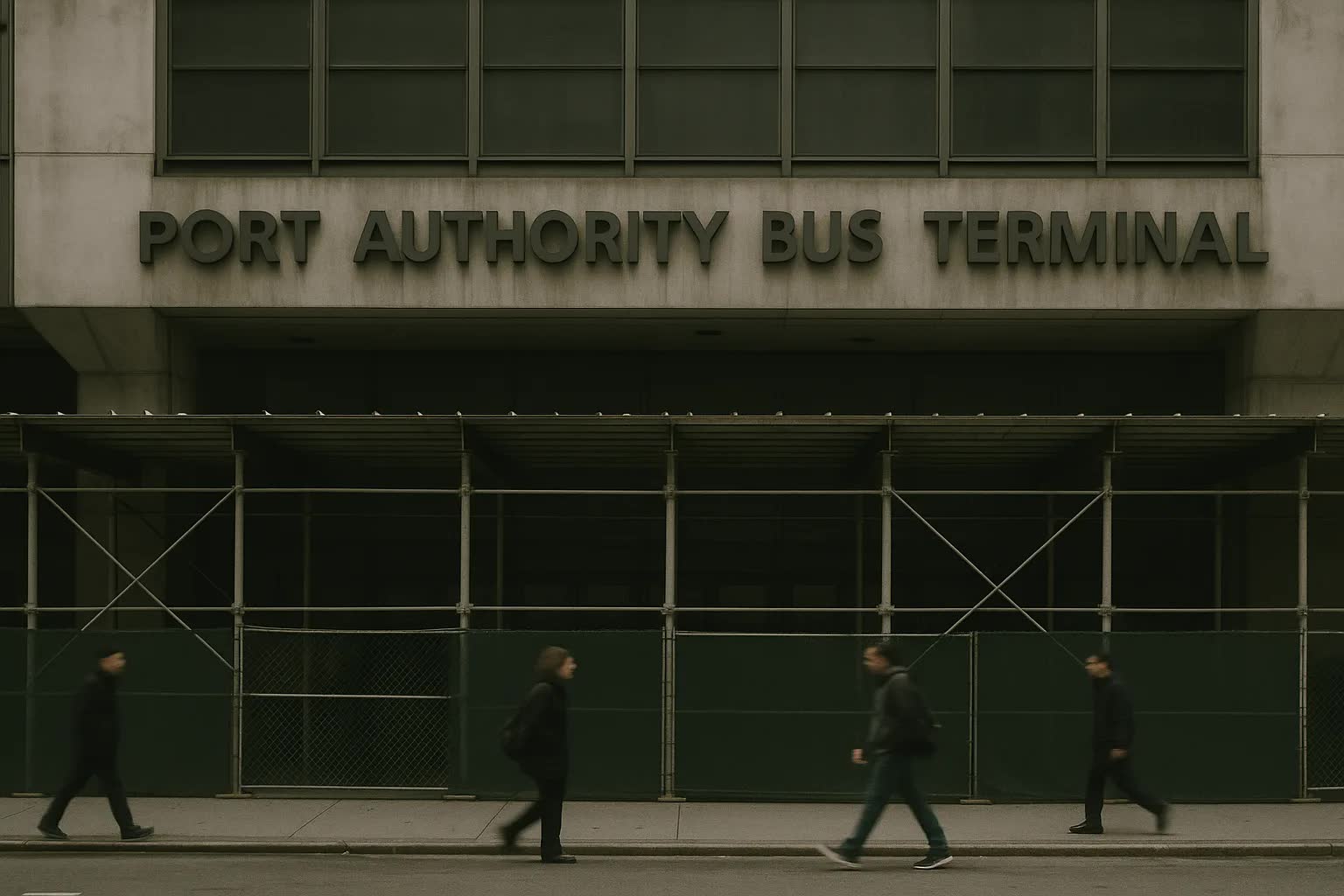
NEW YORK — The long-promised overhaul of the Port Authority Bus Terminal that was supposed to unclog Midtown West has come to a halt, leaving scaffolding along Eighth Avenue and adding to morning gridlock around 42nd Street and Times Square as contract fights and large funding gaps force crews to stop work on key ramps and concourses.
City planners and transit officials had billed the ambitious redesign as a fix for a facility that has choked Midtown for decades, replacing cramped waiting rooms with a new multi-level concourse, modern ventilation, safer pedestrian flows and room for retail that would activate the blocks between Eighth and Ninth avenues in Hell’s Kitchen. The scope, first announced in a 2022 plan, was meant to dovetail with new bus lanes, subway accessibility upgrades and improvements tied to nearby development at Hudson Yards and the Javits Center.
The halt followed a cascade of disputes between the Port Authority of New York and New Jersey and two lead contractors, Midtown Transit Constructors and Hudson BuildCo, both of which say change orders and unpaid invoices have ballooned. "We are at an impasse, and that is a failure for commuters who use this terminal every day," said Maria Chen, deputy director for capital projects at the Port Authority, in an interview. Chen said the authority has withheld some payments while it investigates alleged defective work on a newly poured ramp, but acknowledged that a clear funding path is needed to resume construction.
The numbers underline the scale of the problem: the original construction contract and related program costs were estimated at $3.1 billion; additional change orders and unanticipated remediation work have pushed projected needs toward $3.9 billion, leaving a roughly $800 million shortfall that neither the state nor the city has formally committed to close. The Port Authority says the program will be roughly 16 months behind its most recent schedule if an infusion is not secured. Officials report the terminal handles about 200,000 passengers and an estimated 6,500 bus movements a day, and some 120 construction jobs tied directly to the stalled work were put on temporary layoff this month.
"If we don't close the gap soon, the whole sequencing of transit improvements in the corridor will unravel," said Daniel Ruiz, a senior planner at the Metropolitan Transportation Authority, stressing that subway and bus operations are interdependent. Ruiz said the MTA has contingency plans for bus tie-ins and subway connections but that those plans assume the Port Authority’s work proceeds on a predictable timetable, which is no longer the case.
Commuters and neighborhood businesses in Hell’s Kitchen and Midtown West said the delays are already reverberating down the block. Riders report longer lineups spilling onto sidewalks outside the terminal and buses staging on Ninth Avenue, blocking deliveries and choking intersections around Restaurant Row and the theater district. "I've seen people miss multiple connections because buses get held up at the curb or diverted away from the terminal entirely," said Laura Mendoza, president of Riders United NY, a commuter advocacy group. Mendoza added that elderly and disabled riders have borne the brunt of the disruption.
The stall has prompted political flare-ups that cross municipal and state lines. Members of the Port Authority board have traded public statements blaming contractors for sudden cost increases and blaming the board’s partners for not identifying contingency funds earlier. City Council members representing the neighborhood have demanded an independent audit and a public timetable. "This is a classic example of good intentions running headlong into poor execution and unclear accountability," said Councilman Rafael Gutierrez, whose district includes parts of Midtown West; he called for an emergency briefing from the authority.
Financing discussions are now focused on a handful of options: tapping unused bond capacity at the Port Authority, carving out money from the city’s capital plan, seeking a state appropriation or applying for a federal infrastructure grant. Authority officials are also studying revenue-backed proposals that would accelerate retail and concession leases in a scaled-back interim plan. Legal proceedings add complexity — Midtown Transit Constructors has filed a demand for arbitration over disputed change orders while Hudson BuildCo has a pending claim for retained payments tied to its ramp work.
On the ground, the work that did proceed has left a visible footprint: temporary ramps and scaffolding that block narrow sidewalks along 41st Street between Eighth and Ninth avenues, an unfinished ventilation shaft that prevents closure of a key pedestrian tunnel and partially completed bus gates that cannot be commissioned until structural remediation is finished. Inspectors cited hairline cracks in a concrete pour on Ramp 3, which engineers say can be fixed but will require additional time and money and has become a central point in the contractor disputes.
Port Authority officials have scheduled a special board meeting for Jan. 20, 2026, and said they will present a revised budget and timeline; contractors and municipal leaders are preparing to press for a solution that avoids full-scale redesign or further escalation into litigation. If the board secures a bridge loan or agreement with the city and state, a phased restart could allow critical ventilation and safety upgrades to be completed first, with a goal of restoring core terminal operations within two years, though officials cautioned that firm commitments must be in place to meet even that constrained timetable.