Port Authority Proposes Battery Swap Depot for New Jersey Electric Buses
A planned modular swap station could cut charging downtime and keep regional bus routes on schedule as fleets electrify.
By Ezekiel Harris · January 13, 2026 · 4 min read
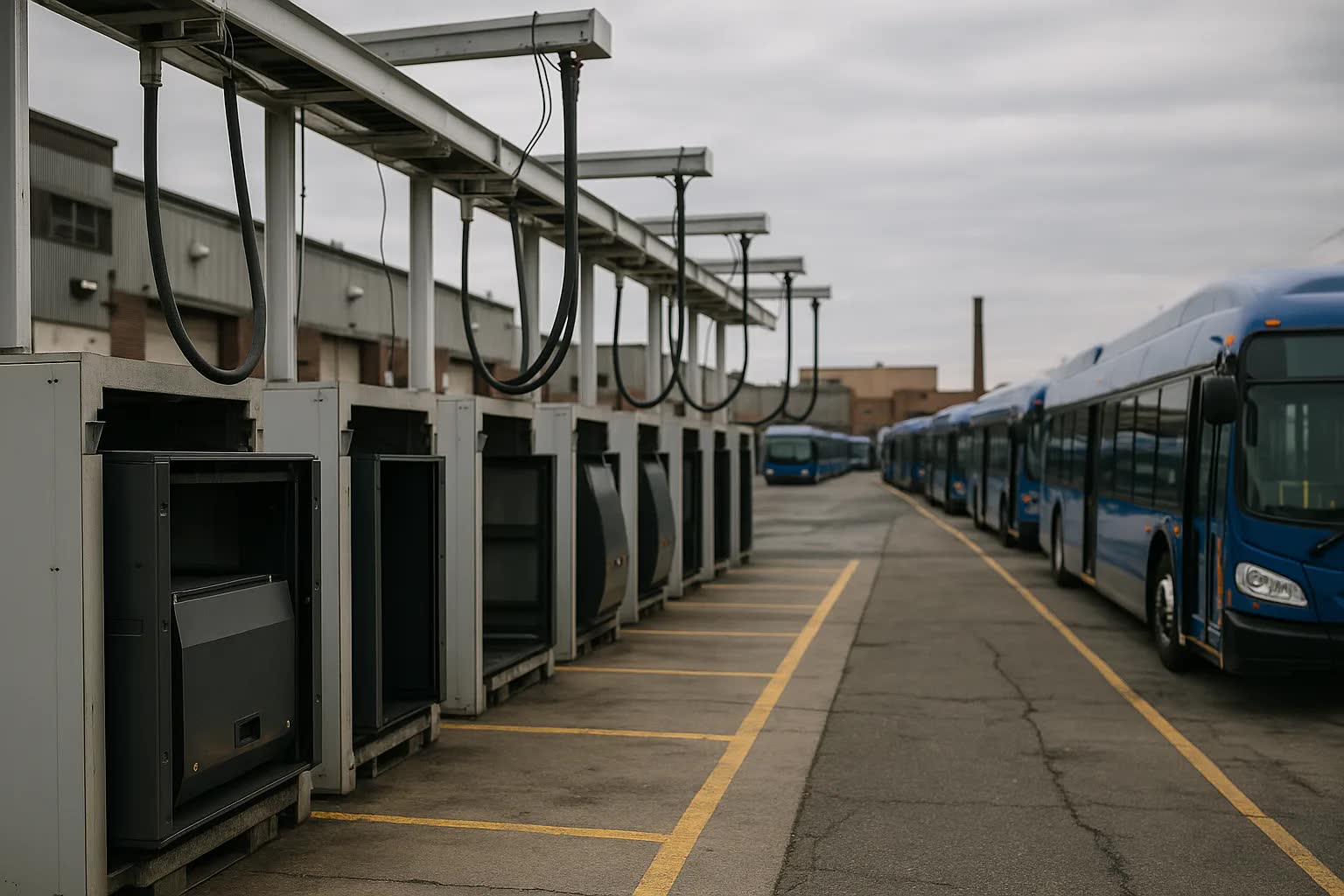
NEW YORK — The Port Authority of New York and New Jersey unveiled plans this week for a modular battery swap depot in Secaucus that officials say could keep New Jersey-bound buses running on schedule and ease effects of longer charging times as public transit fleets electrify, a development that would ripple across Midtown Manhattan at the Port Authority Bus Terminal and on feeder routes into Hell's Kitchen and Chelsea where riders have felt delays during peak hours.
The proposed facility would stand on a four-acre industrial lot just off Meadowlands Parkway, adjacent to an existing maintenance yard used by several private carriers, and would be linked by dedicated bus lanes to the Lincoln Tunnel approaches. Port Authority staff described the depot as a collection of containerized swap bays that can be expanded as fleets grow, allowing a bus to exchange a depleted battery pack for a fully charged unit in a few minutes rather than waiting for opportunity charging between runs.
“This is about reliability for commuters,” said Marisol Vega, director of transit electrification at the Port Authority. “When a bus serving Journal Square or Hoboken is delayed for a half-hour of charging, that delay cascades across the system. A swap depot gives operators options to restore schedules without mass overtime or service cancellations.”
Under the Port Authority's preliminary analysis, a swap depot could reduce in-service charging downtime by roughly 80 to 90 percent compared with current mid-day charging strategies; the documents recommend a single-phase build that would handle up to 120 swaps per hour and service as many as 400 buses on a typical weekday. The initial price tag is estimated at $42 million for site preparation, robotics, battery inventory and grid upgrades, with an expected life-cycle cost roughly 15 percent lower than a large fixed high-speed charging yard over 15 years. The authority projects an annual greenhouse gas reduction of about 12,000 metric tons compared with diesel operation and anticipates the site could be expanded to two additional four-acre modules if demand increases.
“From an operator standpoint, swappable packs remove a lot of the scheduling headaches,” said Aaron Bloom, general manager of Hudson Shuttle Lines, a private carrier that runs commuter routes from Hoboken and Weehawken. “We can keep buses on tight Midtown schedules and reduce deadhead runs to remote depots — that’s money back into the service.”
Not everyone is convinced, however. “Interoperability and standardization remain major hurdles,” said a senior MTA planner who requested anonymity because the agency is still in talks with the Port Authority. “If manufacturers use different pack designs or vendors fail to agree on charging protocols, depot operators will face stranded assets. We need binding specs, not just pilot projects.”
Labor groups and local officials are already weighing in. The Regional Transit Workers Alliance called for guarantees that the swap technology would not lead to job losses for maintenance crews, while the Hoboken mayor’s office praised the plan for potentially improving air quality along the waterfront. Jersey City’s planning board has asked for a community benefits package that includes noise mitigation for nearby residential blocks, and representatives for bus drivers have sought assurances that swap operations will not shorten turnaround times to the point of safety risk for operators.
The choice of Secaucus as a site reflects operational logic as well as political compromise: it sits at the confluence of routes that feed into the Lincoln Tunnel and the Port Authority Bus Terminal, and it offers enough industrial land to stage battery inventory without displacing residential blocks in Journal Square or downtown Hoboken. Port Authority staff said buses could travel from Journal Square to the swap depot and return to Manhattan without adding more than 10 to 12 minutes of travel, roughly offset by the time saved through the faster swap process, and that the site could be connected to Secaucus Junction by a short shuttle for technicians and parts deliveries.
The proposal now moves into formal review. Port Authority officials plan to present environmental and traffic studies to their board in March, with a request for construction authorization if the analyses show no significant community impacts. The authority is seeking a combination of state clean-transit grants and federal infrastructure funds to cover about 60 percent of the cost, with carriers and local governments expected to cover the remainder. Officials say the procurement timeline calls for vendor selection by late summer and staged construction beginning in early 2027, assuming approvals and funding fall into place.
If approved, the Secaucus depot could serve as a model for additional swap stations along the Hudson waterfront and in northern New Jersey, lowering barriers to electrification while raising new questions about standards, land use and labor protections; planners, operators and communities now face a compressed window to align on technical standards and community safeguards so that the depot delivers both faster trips for commuters and long-term sustainability gains for the region.