Port Newark Expansion Plan Draws New Opposition Over Truck Traffic and Air Quality
Municipal leaders in neighboring Jersey City and Bayonne warn that a proposed terminal expansion will worsen pollution in frontline communities.
By Isabella Morales · March 13, 2026 · 4 min read
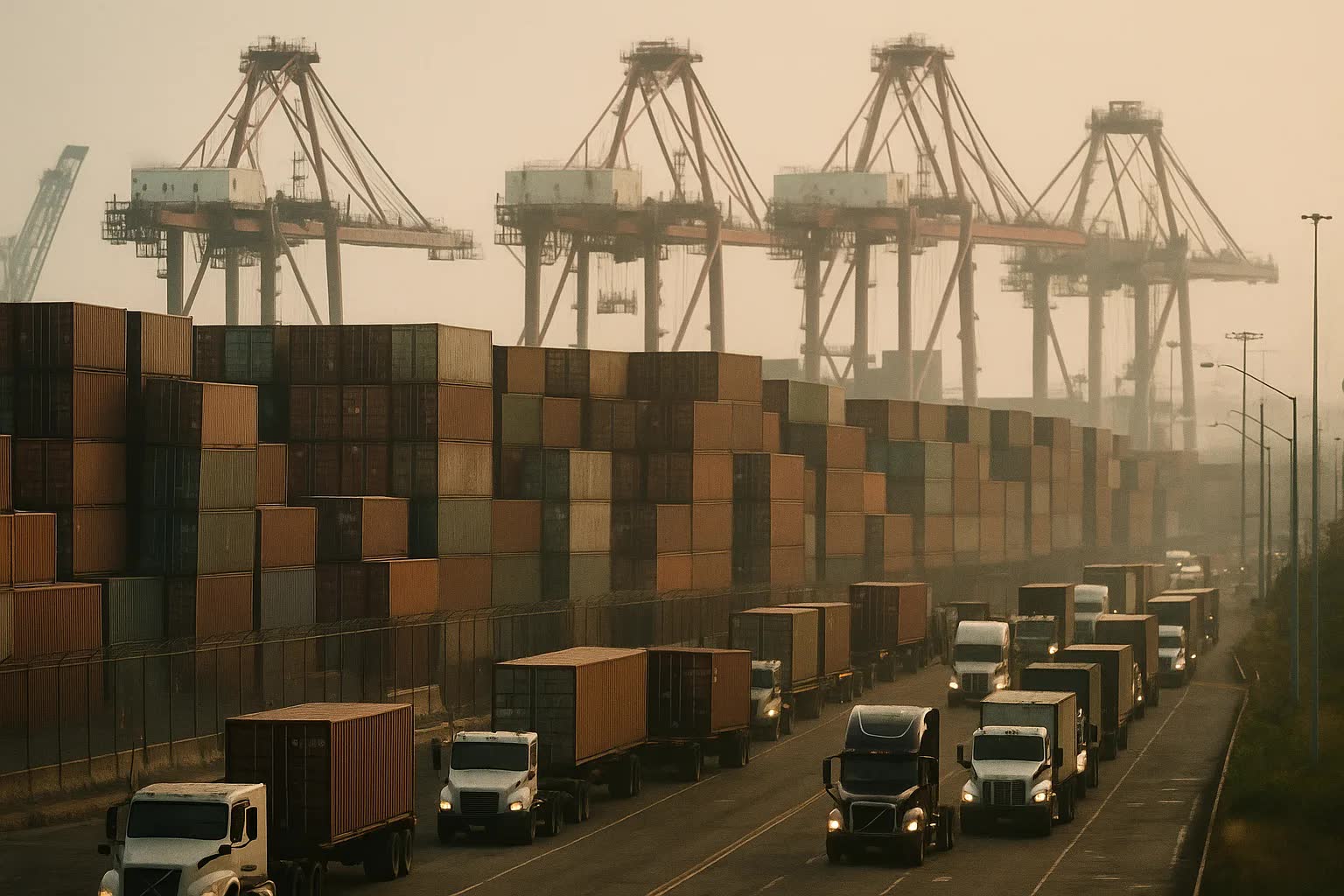
NEW YORK — A proposal to expand a major container terminal at Port Newark has revived long-simmering fears across the Hudson about diesel fumes, congested truck routes and uneven burdens on frontline neighborhoods from Red Hook and Sunset Park to Jersey City's Greenville and Bayonne's Bergen Point, municipal leaders and community organizers said Friday. The plan, advanced by a private consortium in partnership with the regional port authority, would enlarge berths and stacking yards to move more cargo through the same roadways that already funnel heavy truck traffic past schools, parks and low-income housing in both New Jersey and New York.
HarborPoint Terminal Partners, the consortium leading the project, says the expansion would modernize aging infrastructure and create jobs. Under its proposal the terminal would add two deep-water berths, expand container yards by roughly 60 acres and install new ship-to-shore cranes designed for larger vessels. The Tri-State Port Authority, which must approve lease changes and environmental reviews, is expected to take up the proposal this spring, setting off weeks of community meetings and potentially years of permitting battles.
Opposition has been immediate and coordinated. Municipal leaders from Jersey City and Bayonne convened a joint press conference Thursday, and neighborhood groups across Brooklyn plan to bring formal comments to the authority's scoping hearings. "Frontline communities have borne the external costs of freight for decades," said Maria Alvarez, executive director of Hudson Communities United. "We need equity in who benefits and who breathes the pollution. This expansion, as currently framed, doubles down on already dangerous patterns and ignores the health of our children on Pulaski Avenue and the playgrounds along the Bayonne waterfront."
The project summary prepared by HarborPoint projects a 35 percent increase in container throughput at the terminal, adding roughly 1.1 million TEUs — 20-foot equivalent units — per year to an existing baseline of about 3.2 million TEUs currently handled across the Port Newark terminals. HarborPoint estimates the expansion would bring an additional 6,500 heavy-duty truck trips per weekday at peak operations, and the environmental appendix forecasts a net increase in diesel particulate emissions of approximately 85 tons per year unless mitigations are adopted. The plan cites potential creation of 1,200 construction jobs and 750 permanent positions tied to the expanded operations.
Local officials said those numbers understate the local effects because they do not account for secondary truck traffic that diverts to municipal streets or increased idling at chokepoints such as the Pulaski Skyway, Route 440 and the approaches to the Bayonne Bridge. "We worry about trucks cutting through residential blocks on Ocean Avenue in Jersey City and Route 440 in Bayonne during peak hours," said Lena Ortiz, mayor of Bayonne. "Our emergency responders and public-health teams are already stretched. We cannot allow an expansion that makes our air less safe and our streets more dangerous without hard mitigation and real funding for monitoring and enforcement."
HarborPoint executives have argued that the expansion would be greener than critics suggest because it includes plans for on-dock electrification, shore power for vessels and a promise to increase on-dock rail to reduce truck moves. "This project is designed to be the most modern and efficient terminal on the East Coast," said Daniel Mercer, director of operations for HarborPoint Terminal Partners. "By shifting container moves onto rail and installing shore power, we reduce emissions and congestion while preserving the port's capacity to support regional jobs and supply chains."
Public-health researchers who study urban air quality cautioned that promises of future electrification often lag behind immediate impacts. A 2024 synthesis of regional air monitoring — conducted by independent researchers with funding from a set of community foundations — found neighborhoods downwind of New Jersey ports, including Brooklyn's Sunset Park, had asthma admission rates up to 40 percent higher than city averages. Clinics on Bay Street in Jersey City and the Bergen Point neighborhood of Bayonne report that pediatric asthma visits spike on high-traffic days and during summer heat events when ozone levels climb.
Environmental reviews and potential lawsuits are already being lined up. Jersey City announced it will seek party status in the environmental impact statement process and is preparing a legal challenge to the authority's scheduling if the public-comment period is curtailed. Bayonne's city council voted unanimously to contract with outside counsel to assess possible claims under state air-quality statutes. Community groups have demanded an independent health impact assessment, binding community benefits agreements, and timetables for truck electrification tied to the lease terms.
"Our traffic models show significant spillover onto local arterials if routing controls aren't enforced," said a senior MTA planner who requested anonymity because the agency is not a formal party to the port review. "Even modest increases in heavy-duty truck volumes change intersection performance, bus reliability and pedestrian exposure on corridors from Columbia Street in Red Hook up to the Gowanus and the BQE approaches. Without coordinated, enforceable routing and funding for infrastructure upgrades, neighborhoods will bear the cost."
The weeks ahead will determine whether the expansion proceeds with concessions or becomes the latest high-profile clash between port economics and environmental justice advocates. The Tri-State Port Authority is scheduled to open the formal scoping period next month, with public hearings across Hudson County and a session slated in Brooklyn near Industry City. Legal filings, independent monitoring proposals and political pressure from municipal leaders will shape negotiations; community organizers said their goal is to secure binding mitigation measures, a timeline for full truck electrification and dedicated air monitoring before any permits are granted.