Port of New York and New Jersey Tests Automated Cranes, Raising Job and Safety Questions
A technology trial at a Hudson River terminal aims to speed cargo handling but has dockworkers watching closely.
By Omar Haddad · April 8, 2026 · 4 min read
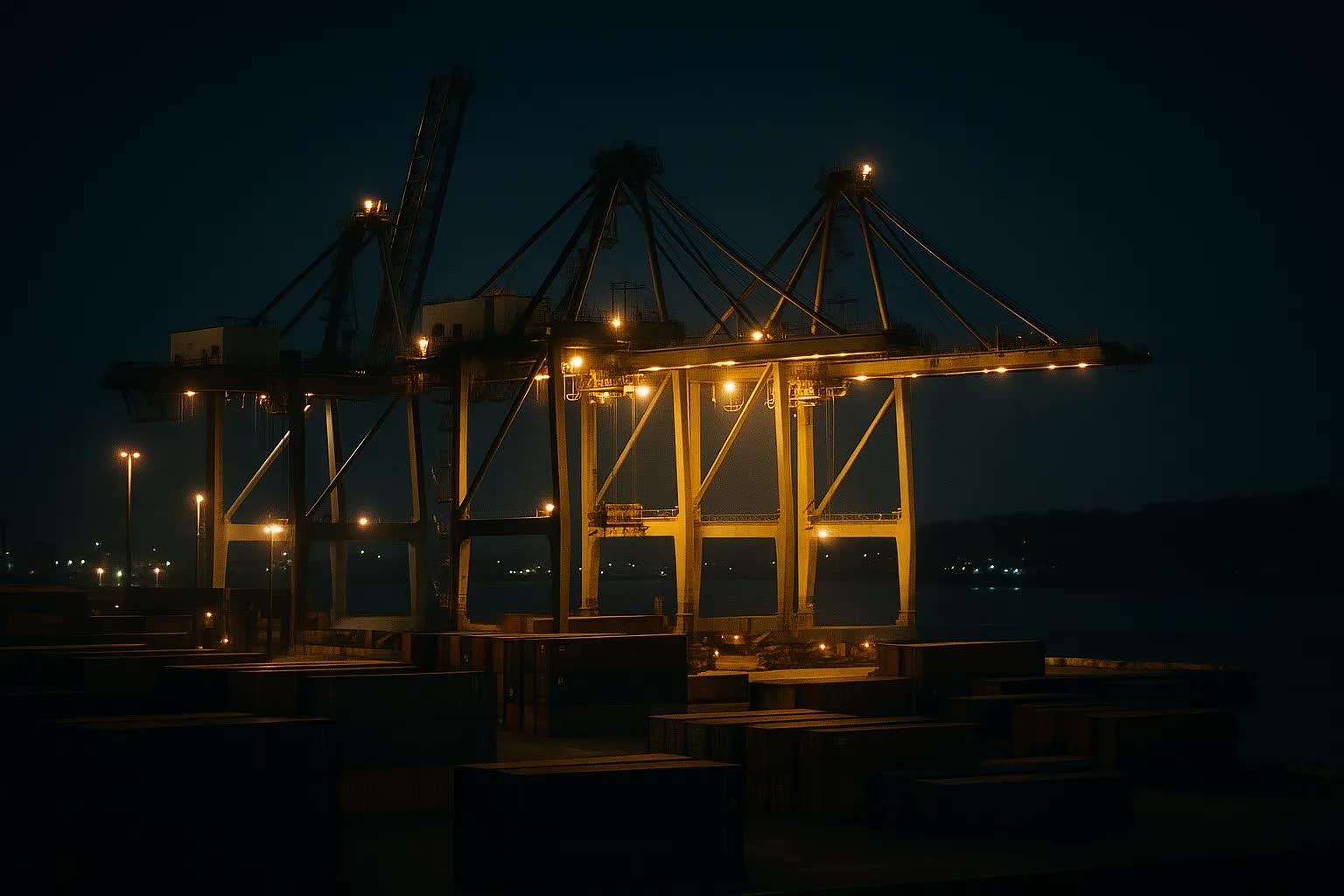
NEW YORK — On a wind-scoured stretch of the Hudson River near West 30th Street, the Port of New York and New Jersey this month began testing a fleet of automated ship-to-shore cranes in a trial that promises faster container moves but has dockworkers and neighborhood leaders watching closely for the ripple effects through Sunset Park, Red Hook and the industrial corridors that feed the city’s retail and restaurant supply chains.
The pilot, conducted at a retrofitted facility the Port Authority calls Pier 30 Logistic Hub, pairs four towering gantry cranes with an array of cameras, LIDAR sensors and machine-learning software supplied by a private firm, Seine Robotics. Operators sit in a remote control center on the pier and oversee the robots’ cycles, intervening when the system flags anomalies. Port officials say the goal is to shave hours off ship turns and reduce truck congestion on adjacent streets like 11th Avenue.
“This technology has the potential to make terminals safer and more productive, but it must not be a lever to displace trained people who keep our ports running,” said Maria Delgado, vice president for safety at the Port Authority, during a tour last week. “We are running the systems under strict supervision and logging every intervention so we can compare human and automated performance under the same conditions.”
On the docks, the mood is cautious. “We’re not against better tools, but this is our livelihood,” said Terrence O’Neill, 48, a crane mechanic who lives in Bay Ridge and has worked at several Hudson River terminals for 26 years. “When they say remote operations, what they often mean is fewer jobs here. We want guarantees that people will be retrained and rehired, not pushed out.” He spoke as a union member watching cranes lower containers onto a barge bound for Red Hook’s distribution yards.
Safety advocates have also pressed for detailed incident data. The Port Authority said the trial includes a mandatory third-party safety review and a live-feed data log open to federal Occupational Safety and Health Administration investigators. “We’re not experimenting with lives,” said Dr. Lian Zhou, chief engineer for PierTech Labs, the contractor that integrated the sensor suite. “Every motion is redundantly checked; AI suggestions are subject to human override. We’re tracking both near misses and normal operations to build a robust safety profile.”
The numbers driving the debate are concrete: the trial will run for eight weeks with four automated cranes and two hybrid cranes that can switch between manual and autonomous modes, handling an estimated 7,200 container moves during the period. Port Authority modeling projects a 12 to 18 percent increase in moves per hour under fully automated cycles and an average ship turnaround reduction from 36 hours to about 30. The initial capital investment for the retrofit is roughly $5.6 million, according to Port documents, while operators say the automated setup can reduce the number of dockside crane operators needed at peak by up to 20 percent — a figure that union leaders dispute.
Local businesses and neighborhoods are already feeling operational effects. Trucking firms that operate out of Sunset Park and the Bayonne terminal reported a temporary shift in dispatch patterns, sending more rigs to the Pier 30 hub to capitalize on faster unloads. On Monday morning, a line of tractor-trailers snaked along 11th Avenue and clogged cross streets near West 33rd as drivers waited for electronic slot allocations from the terminal’s new scheduling system. Residents of nearby Clinton and Hell’s Kitchen have expressed concerns about noise and air emissions during night moves.
Union officials have signaled they will seek protections in upcoming bargaining talks. “We will fight to protect members’ jobs and insist on strong retraining programs,” said Jamal Moreno, president of the fictional Local 1175 Dockworkers Union. “Automation should mean better, safer work for dockworkers, not an excuse to strip bargaining units down to skeleton crews. We want legally binding commitments before any permanent changes are made.” The union has already requested daily reports and the right to station representatives in the Pier 30 control center during the trial.
Industry groups and shippers largely welcome the pilot as part of a broader effort to reduce bottlenecks. “In a region that moves millions of tons of goods annually, incremental gains in terminal efficiency have an outsized impact on delivery times and consumer prices,” said Anja Reddy, director of research at the Northeast Shipping Association, a trade group. Reddy cited modeling that suggests a sustained 10 percent improvement in terminal throughput across the harbor complex could cut average delivery delays to grocery stores and manufacturing warehouses in the metropolitan area by several days during peak seasons.
The trial is also a test of governance: how the Port Authority, federal regulators, terminal operators and unions will reconcile productivity gains with jobs and neighborhood impacts. The Authority said it will publish a full report within 60 days of the test’s completion and convene public sessions in Sunset Park and Hudson River Park to review findings. For dockworkers like O’Neill and residents who rely on the steady hum of the harbor economy, the coming weeks will determine whether the machines become tools that supplement human skill or a wedge that reshapes an industry. Port officials say more tests are already scheduled in Sunset Park and at a New Jersey terminal later this year as part of a phased evaluation that could inform a broader rollout in 2027.