Public Chess Tables Reignite Park Life Across Brooklyn
From neighborhood squares to waterfront promenades, accessible chess setups are drawing cross-generational players back outdoors.
By Ezekiel Harris · February 5, 2026 · 4 min read
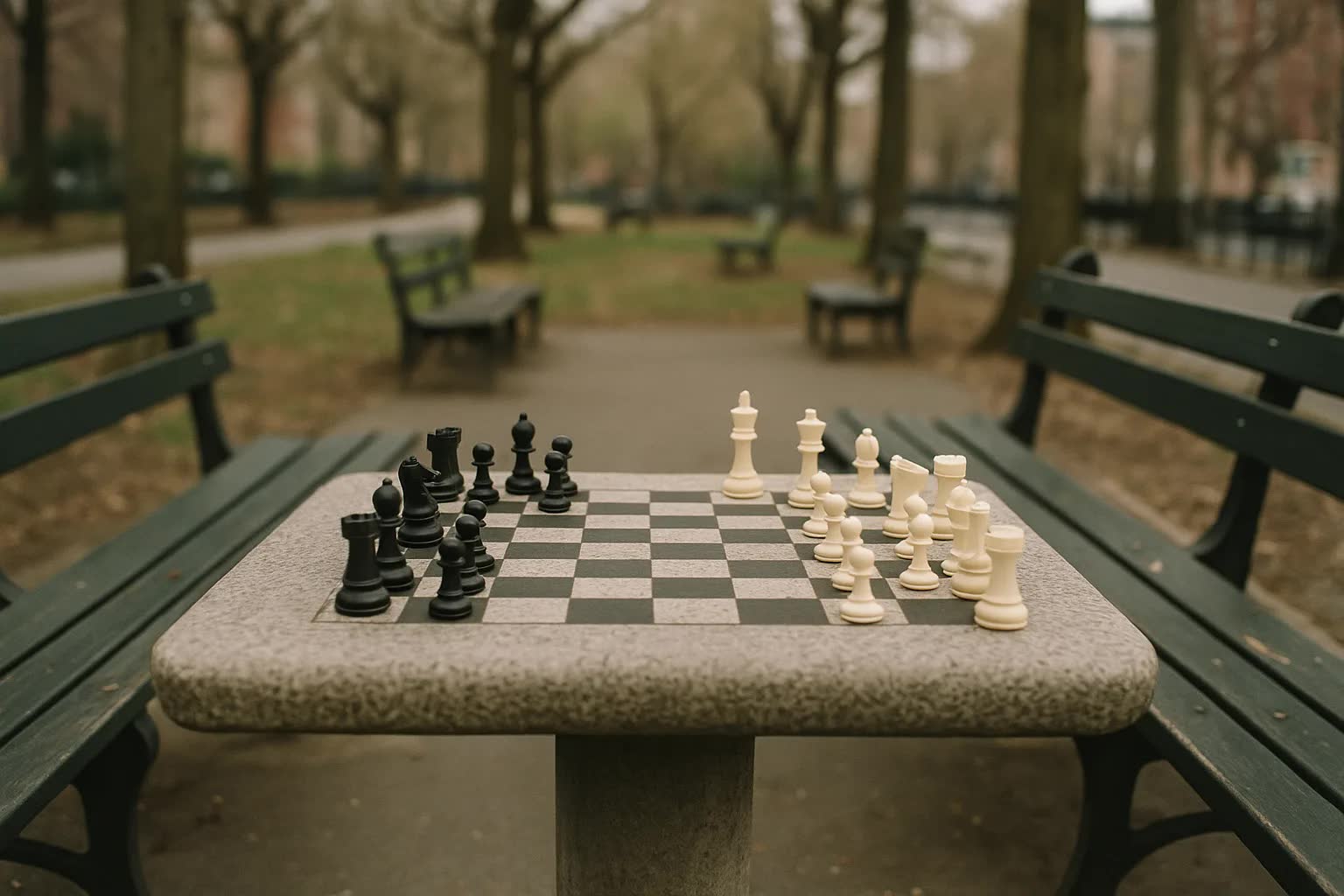
NEW YORK — On a gray February afternoon in Brooklyn, a cluster of players circled a concrete chess table under the elm trees at Grand Army Plaza, trading elbows against the cold and reanimated small talk, a scene that has become increasingly common across the borough as public chess installations quietly seed sidewalk life from Park Slope to Red Hook.
The city-backed program, rolled out over the last 18 months by Brooklyn Parks & Rec in partnership with three community nonprofits, has placed roughly 180 fixed chess tables in neighborhood squares, promenades and waterfront plazas, turning formerly dormant benches into competitive, conversational hubs. Miriam Cohen, director of Parks Programming at Brooklyn Parks & Rec, said the tables were deliberately routed to knit together high-traffic corridors — Atlantic Avenue, the pedestrian spine along the Brooklyn Heights Promenade and the Manhattan Bridge approaches in DUMBO — with residential pockets that had struggled to attract foot traffic on weekdays.
"We wanted to build places where a 70-year-old who grew up across the street and a 15-year-old getting off the G train could meet for a meaningful reason," Cohen said. "Chess does that without a lot of overhead: a board, a clock, a little shade. It’s civic furniture that invites people to stay and talk, not just pass through."
In Park Slope on Seventh Avenue, a Baruch Street high school student, a retired electrician from Bensonhurst, and a new diner owner from Prospect Lefferts Gardens can be seen sharing the same board, often passing the pieces between them rather than keeping score. "It feels like the park is back," said Diego Morales, founder of the Brooklyn Kings & Queens Chess League, which runs weekly beginners’ classes at Fort Greene Park. "Kids who used to sit on stoops are getting tutored by folks who have been playing their whole lives. You’re getting real intergenerational mentorship here, not just a game."
The city provided specific targets and some hard numbers when it announced the expansion in late 2024: 180 chess tables across 52 Brooklyn parks, distributed across 12 council districts, supported by a $3.2 million capital and programming budget. Parks & Rec reports a boroughwide 27 percent increase in average weekend visits at parks with chess tables compared with the same period in 2023, and site counts show an average of 45 daily users per table on weekends, with peak counts in Brooklyn Bridge Park and McCarren Park approaching 120 people during tournament days.
Local businesses have noticed the uptick. On a recent Saturday in Prospect Heights, Lina Patel, owner of Corner Bean on 9th Street, described an increase in foot traffic she attributes to the chess players who spill onto the sidewalk between matches. "Our pastry sales on tournament days are up 18 percent," Patel said. "People park themselves at the tables for an hour or more; they buy coffee, they ask for heaters in winter. It’s a tiny economic boost, but it’s real for a small shop."
Accessibility has been a key selling point for planners: the tables are bolted to concrete pads with knee clearance for wheelchairs, contain tactile pieces and have raised-contrast boards for low-vision players, and signage in English, Spanish and Mandarin explains basic rules. Programs targeted at schools have been launched in Sunset Park and Bay Ridge, where after-school clubs funnel students to nearby public tables. "We wanted this to be more than decorative park furniture," said Hana Feldman, deputy commissioner for Urban Recreation. "That meant designing for inclusion from the start and partnering with local schools and community centers."
Not everyone is unreservedly enthusiastic. Some residents and parks advocates have raised concerns about maintenance budgets, the potential for tables to attract loitering and the displacement of less structured park uses. "We love the idea, but the city needs a long-term maintenance plan," said Elliot Brenner, president of Friends of Brooklyn Parks, noting that some early pilots suffered chipped pieces and graffiti. Parks & Rec said it has a two-tier staff training program underway and a $400,000 contingency fund earmarked for repairs through 2026.
Public chess in Brooklyn is part of a larger national trend toward reimagining parks as active civic rooms rather than passive green space, city planners said, a shift accelerated by pandemic-era demand for outdoor activity. Organizers compare the new tables to the sustained success of public ping-pong tables in other cities but emphasize chess’s low-cost, low-footprint profile. A senior parks maintenance supervisor who requested anonymity praised the durability of the concrete-and-metal installations but warned that winter salt and dog traffic will require vigilant upkeep if the program is to sustain its early momentum.
Looking ahead, Parks & Rec plans to add 60 more chess tables in Brooklyn by the end of 2026, with pilots slated for Greenpoint’s Transmitter Park and an expanded waterfront cluster at Coney Island’s Boardwalk; the department is also negotiating with library branches to run co-located beginner courses and hopes to host a borough-wide open tournament in late summer. If the early months are any indication, the modest squares and waterfront parcels dotted with chess players will continue to stitch neighborhoods together as Brooklyn seeks a quieter, friendlier rhythm for public space.