Public Housing Goes Solar: Rooftop Panels Roll Out Across Two Bronx Buildings
A city pilot could cut energy bills and provide workforce training for residents through solar installation contracts.
By Mateo Ruiz · February 2, 2026 · 4 min read
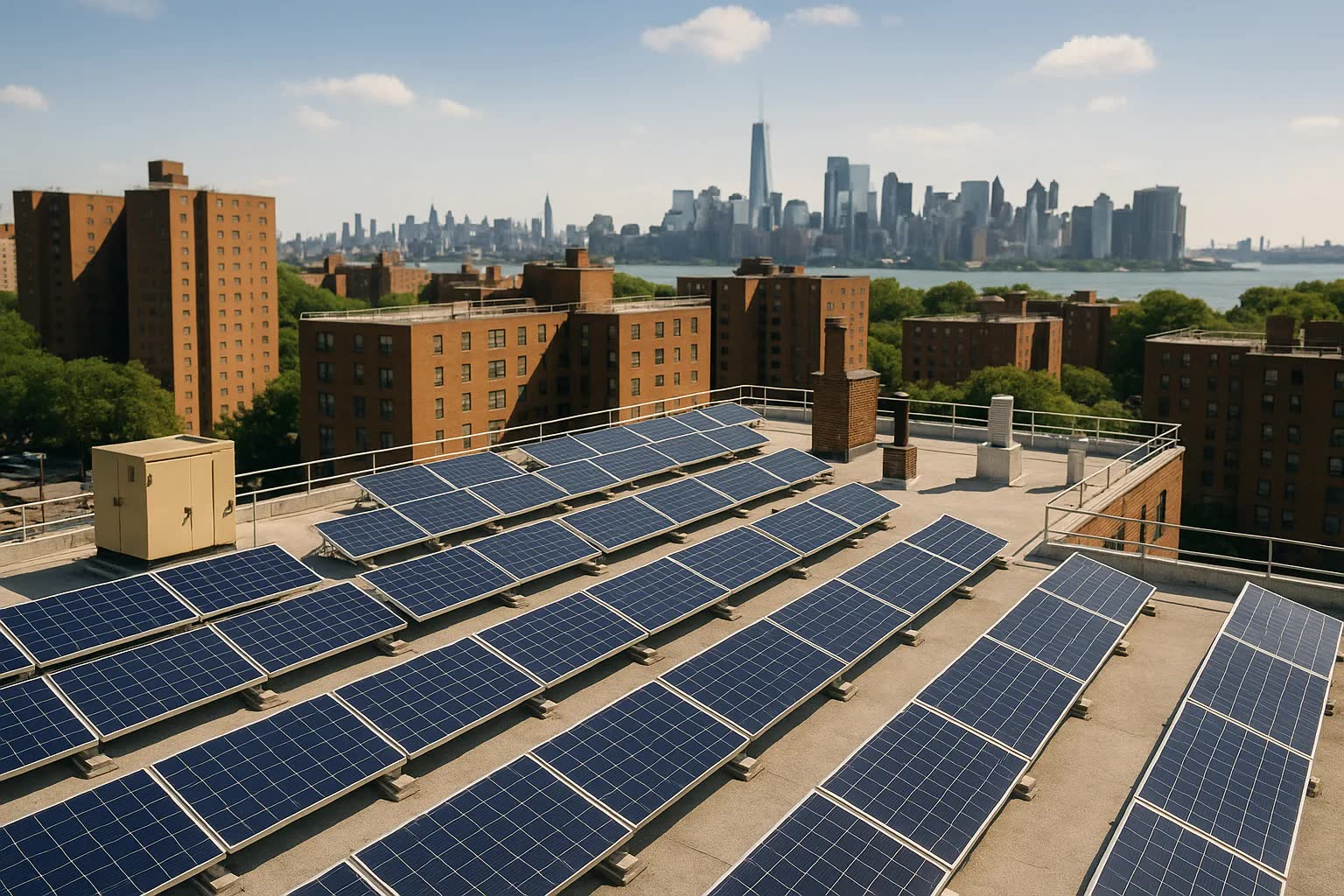
NEW YORK — February 2, 2026 — In a pilot that city officials say could reshape how low-income New Yorkers pay for power, rooftop solar panels began to rise this week on two public housing buildings in the Bronx, with crews installing arrays above the Bayard Houses in Mott Haven and the Trevor Houses near Crotona Park East, a few blocks from the Grand Concourse. The small rollout is meant to trim energy costs for residents, test new contracting models that require local hires, and create a blueprint for broader adoption across the New York City Housing Authority portfolio.
The project is being managed by the newly created New York City Office of Energy and Sustainability in partnership with Bronx Solar Works, a neighborhood nonprofit, and GreenWave Energy, a private contractor based in Long Island City. City officials say the pilot grew out of community requests during last year’s round of public housing town halls on East 138th Street and was prioritized because both rooftops were structurally suitable and near transit hubs, including the 6 train and several Bx bus lines.
Workers in bright vests set up racks and bolted aluminum frames to flat roofs this week, while an on-site crew from Bronx Horizons Technical Institute ran a day-long training session for a class of residents who will serve as paid solar apprentices. The training is part of a contract clause that reserves at least 30 percent of on-site labor hours for building residents or Bronx-based hires and guarantees apprenticeship credentials recognized by local electrical unions, according to project documents reviewed by this paper.
The financial and energy math behind the pilot is straightforward enough to sway skeptical tenants: the two arrays total 196 photovoltaic modules with a combined capacity of 150 kilowatts, expected to produce roughly 180,000 kilowatt-hours annually — about a quarter of these buildings’ demand. City estimates project annual utility savings of approximately $120,000 shared between reduced building operating costs and a resident benefit fund; the pilot required an upfront public and private investment of $4.5 million and is projected to reach payback in seven to nine years under current electricity rate forecasts. Thirty residents are enrolled in the academy this cycle; GreenWave has committed to hiring 12 of them as full-time technicians if they complete certification.
For Bayard Houses tenant leader Marisol Alvarez, the panels are cause for cautious optimism after a winter of heat complaints and high bills. “We’ve been paying more and getting less for months — the lights flicker, the boiler bills jump — so seeing those panels go up feels like something real,” Alvarez said. “If my neighbor can learn a trade and stay local, that’s doubly important. This isn’t charity; it’s opportunity.” Alvarez, a single mother of two who leads her building’s tenant association, says meetings with city planners on East 140th Street helped shape expectations about how savings will be split.
Daniel Cortez, director of Bronx Solar Works, emphasized the workforce angle as central to the program’s promise. “We designed this pilot so the community gets three things at once: cleaner energy, lower utility costs, and living-wage jobs for people who actually live here,” Cortez said. “The procurement requires local hiring, we’re doing pre-apprenticeship training at no cost, and GreenWave agreed to a first-refusal hiring model for certified graduates.” Bronx Solar Works will manage the resident outreach and monitor the training outcomes, Cortez said, and will publish a report at the pilot’s 12-month mark.
Not everyone is sold. Local building engineers and tenant advocates have flagged potential challenges, including aging roof membranes, the need for structural reinforcement, and delays in interconnection approvals from Consolidated Utility Services, the city’s grid operator. Talia Greene, an energy policy analyst at the Urban Climate Institute, said the success of the pilot will hinge on bureaucratic coordination. “Technically it’s doable, but scaling this across NYCHA will require predictable financing, faster grid interconnections and clear pathways to permanent jobs,” Greene said. “Too often pilots stall because the paperwork and utility rules don’t move at the same speed as construction crews.”
City officials say they learned from those pitfalls in prior, smaller projects and built contingencies into the Bayard-Trevor contract. The agreement stipulates a two-stage payment schedule tied to system commissioning and one-year performance guarantees; it also sets aside $250,000 in a resident benefit fund to be spent on energy-efficiency upgrades, emergency generator maintenance and digital literacy sessions on how to manage smart meters. Officials expect the pilot to generate enough operational savings to fund those programs while the panels come online and produce power for the community.
The pilot arrives as part of a broader push to meet the city’s 2040 climate targets while addressing economic inequities in neighborhoods still recovering from pandemic job losses. Similar programs in other U.S. cities have used a mix of public grants, philanthropic capital and private investment to overcome upfront costs; the New York pilot’s blend of a $2 million city grant, a $1.2 million philanthropic commitment and $1.3 million of private capital was designed to keep risk off tenants’ backs, according to procurement memos. If metrics — including energy production, resident hires and maintenance costs — meet targets, the Office of Energy and Sustainability says it will propose a phased expansion to 12 additional developments across the Bronx, Brooklyn and Manhattan next fiscal year.
In coming weeks crews will finish wiring and tie the arrays into building meters, and the city expects the first kilowatt-hours to flow in April. Officials plan a community ceremony at the Trevor Houses' playground off Fulton Avenue in late March, and Bronx Solar Works will begin outreach for the pilot’s next training cohort. If the initial results match projections, the rooftop panels above two Bronx rooftops could become a familiar sight across public housing while offering a model for cities that want clean energy and local jobs to rise in tandem.