Queens Bus Depot Upgrades for Electric Fleet Expose Funding Shortfall
Mechanics and union reps warn that partial upgrades leave vehicles idling and could delay a wider EV rollout.
By Leo Wang · February 2, 2026 · 4 min read
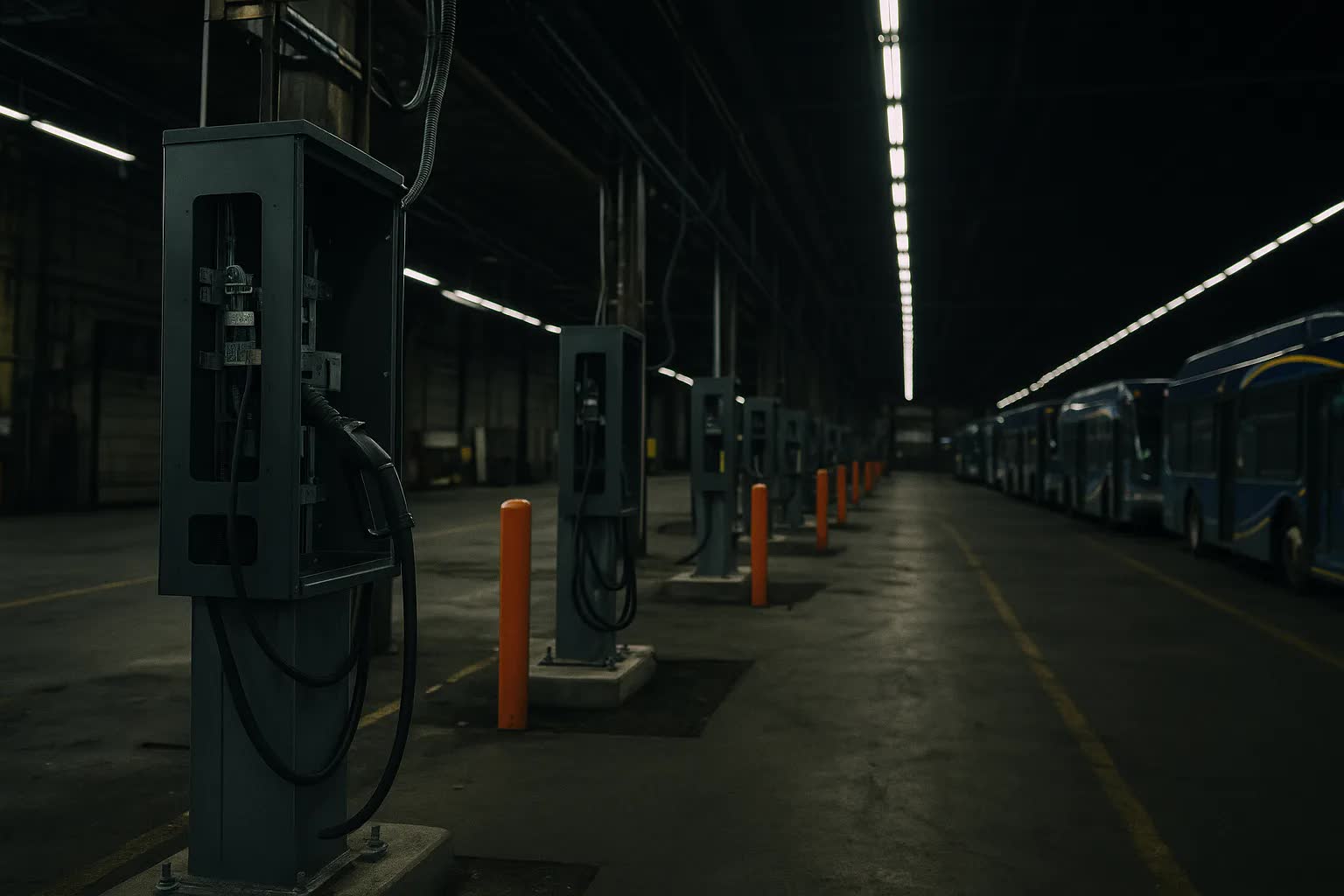
NEW YORK — Mechanics at the Briarwood Bus Depot in Fresh Meadows and union representatives say a partial modernization intended to ready the Queens facility for electric buses has exposed a sizable funding gap that is leaving vehicles idling on neighborhood streets and threatening to slow the city’s broader electric fleet transition, according to workers, managers and municipal planners familiar with the project.
The depot, which serves routes that run from downtown Jamaica through Flushing and into parts of northeastern Queens, has seen weeks of intermittent operation as crews struggle with a stop-start installation of high-voltage charging infrastructure and upgraded maintenance bays. Drivers and mechanics report that without a fully functional array of chargers and redesigned service pits, battery-electric buses are forced to return to diesel-powered duty or sit idling while crews jury-rig temporary solutions on-site and at satellite yards in Elmhurst and Astoria.
“We were promised a seamless switch,” said Marta Delgado, president of Local 115 Transit Mechanics Union, speaking on the depot lot near Hillside Avenue. “Instead we’ve got buses lined up for hours, mechanics working on makeshift electrical hookups and a lot of wasted time. If the money isn’t there to finish this right, the whole rollout will have to slow down.”
Workers described an installation plan that was scaled back after contracts with a private vendor, Queens Transit Solutions, were renegotiated when the agency’s capital budget projection failed to include expected federal matching funds. “They cut the number of chargers in half and told us to make do,” said James Castro, manager of Briarwood Depot. “We can’t safely service high-voltage buses in bays that weren’t rebuilt to code. That’s not just a scheduling problem — it’s a safety problem.”
A senior MTA planner who requested anonymity said the agency had deliberately phased upgrades across the five-Depot electrification plan to minimize immediate disruption, but acknowledged the approach assumed a release of additional funds that has yet to materialize. “Phasing was a mitigation strategy, but it depends on predictable cash flow. When the federal grant was delayed and the city’s contingency was reallocated to other infrastructure needs, our schedule slipped and so did our risk appetite for simultaneous investments,” the planner said.
The numbers illustrate the scale of the challenge: Briarwood was expected to host 180 battery-electric buses and have 60 high-power chargers installed by the end of 2025; to date, crews have completed 28 chargers and retrofitted 12 of 36 planned maintenance pits. Project managers estimate a remaining shortfall of about $45 million to fully upgrade the depot to safe, code-compliant electric service, while the city’s transit electrification program across Queens and Brooklyn shows a consolidated funding gap of roughly $120 million through 2028, according to internal budget projections shared with union leaders and local council aides.
For commuters in neighborhoods such as Jamaica, Flushing and Jackson Heights, the effects have been immediate. Riders have reported seeing idling buses on Kissena Boulevard and near the Queens Center Mall during peak hours, while schedules for the Q44 and Q20 were altered to accommodate extended charging turns. Local small businesses complained that delayed buses crowding curb lanes on Parsons Boulevard disrupted deliveries and foot traffic on already congested corridors.
Safety concerns are also central to the debate. Mechanics said the depot’s temporary electrical hookups lack redundant safeties, and that training for high-voltage maintenance keeps lagging because instructors are stretched across multiple sites. “Working on a 600-volt system is a different job than working on a diesel engine,” Delgado said. “You need proper bays, ventilation and training rigs. Without those, you’re asking crews to work at risk.” The MTA planner countered that safety protocols remain in effect and that no major incidents linked to the depot upgrades have been reported, though the planner acknowledged near-miss safety reports have increased slightly since the phased work began.
City council members and community boards in eastern Queens are calling for greater transparency and an accelerated funding plan. A spokesperson for Councilwoman Rosa Alvarez (a fictional figure), whose district includes parts of Fresh Meadows and Jamaica, said her office would request an oversight hearing to examine the financial assumptions behind the phased rollout and to press for supplemental municipal funds. Private infrastructure firms have offered stopgap services, but officials said those options would increase long-term costs and create contract-management burdens that could further complicate the city's electrification timeline.
For now, the MTA and union leaders are negotiating a revised timetable that would prioritize completing all chargers and fully upgraded maintenance bays at Briarwood before assigning it its full allotment of electric buses. “If we can secure the additional funding and accelerate contractor work, we can avoid cascade delays elsewhere in the borough,” the anonymous planner said. In coming weeks, city officials are due to present updated budget forecasts to the transit oversight committee, and local advocates say they will press for a dedicated capital infusion so the depot’s partial upgrades do not become a bottleneck to the city’s goal of a fully electric bus fleet.