Queens Immigrant Theater Troupes Stage Multilingual Community Work
Neighborhood theaters in Queens are mounting plays in multiple languages to reflect the borough's shifting demographics and draw broader audiences.
By Rashid Karim · January 24, 2026 · 4 min read
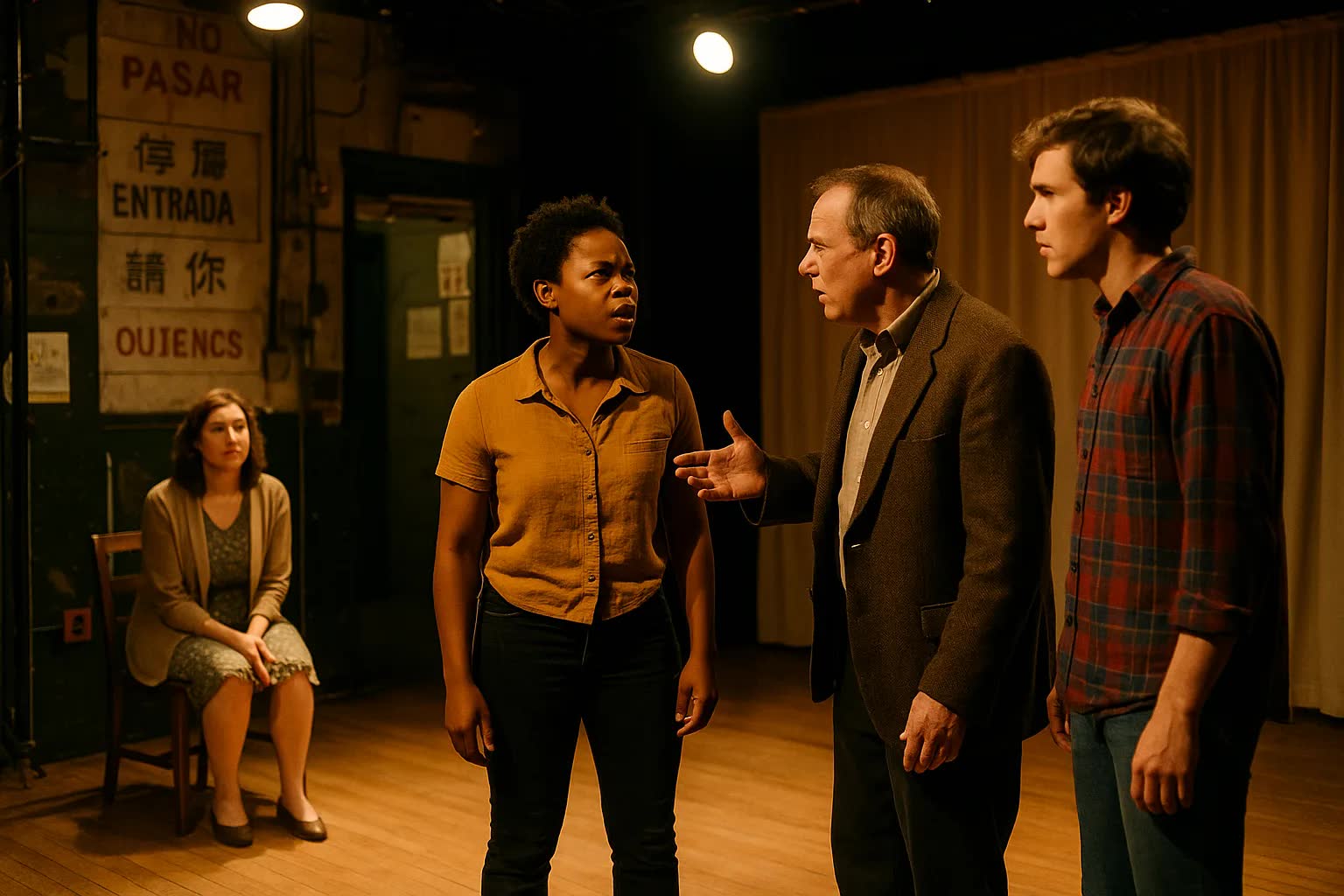
NEW YORK — On a chilly January evening, a storefront theater on Roosevelt Avenue in Jackson Heights filled with applause as an audience clapped through scenes delivered in Spanish, Bengali and English, a signal of a broader shift: neighborhood theaters across Queens are mounting multilingual productions to mirror the borough’s changing demographics and to pull in new audiences who have long been left out of the pageant of downtown stages.
Across Queens, from a converted bank near Steinway Street in Astoria to a tiny black box on Main Street in Flushing, ensembles are rethinking language as a production tool rather than a barrier. Teatro Nueva Queens in Jackson Heights staged a bilingual Spanish-Bengali adaptation of a family drama last month, while the Flushing Bridge Players opened a Mandarin-English version of a contemporary immigrant tale on 39th Avenue. ‘‘Language is part of the set now,’’ said Mariana Alvarez, artistic director of Teatro Nueva Queens. ‘‘We want the neighborhood to hear itself onstage.’’
Producers say the move is less about novelty and more about necessity. Directors are casting actors who can move between tongues, hiring translators and surtitlers, and scheduling talkbacks in multiple languages so older patrons and recent arrivals can both participate. ‘‘When my mother came to see the show and understood half the lines in Bengali, she cried and clapped and said she finally felt seen,’’ said David Chen, executive director of Flushing Bridge Players. ‘‘That's the point — it’s not translation alone, it’s recognition.’’
The scale of the shift can be measured. A recent survey by the Queens Neighborhood Arts Collective — a coalition of 48 small troupes and venues created in 2024 — found that 42 companies staged work last year in at least one non-English language; productions featured 14 different languages across the borough. Combined ticket sales for those productions topped approximately $380,000 in 2025, up 18 percent from the prior year, and collective annual operating budgets for the groups in the survey totaled about $3.1 million. Average single-ticket prices ranged from $12 for community nights to $28 for weekend performances.
Multilingual programming brings creative rewards and logistical headaches. Directors wrestle with cadence and meaning: a phrase that lands in Spanish may not carry the same cultural weight in Nepali or Urdu. Translation costs eat into already thin budgets; hiring professional translators and engineers for surtitles can add $1,500 to $3,000 per production. ‘‘You cannot ask community volunteers to do every job,’’ said Aisha Rahman, co-founder of the Jackson Heights Arts Coalition, who has helped produce surtitled readings in Bengali and Haitian Creole. ‘‘Quality costs, and without it, audiences notice.’’
Space and rent pressures are immediate practical obstacles. Several companies report that rehearsal rooms around Long Island City and Sunnyside have doubled rents in three years, pushing troupes to find cheaper space in Elmhurst or to rehearse in school auditoriums for limited hours. Fundraising remains patchwork: a handful of troupes secured small grants from the city’s cultural affairs programs and private foundations, but many still rely on month-to-month venue deals and door sales to stay afloat.
Community response, organizers say, has been encouraging. Schools bring students for matinees where bilingual surtitles and post-show workshops tie classroom curricula to lived experience. Older immigrants — shopkeepers on Roosevelt Avenue or home-care workers in Corona — have become vocal supporters, volunteering as dialect coaches and hosting cast rehearsals in living rooms. Neighborhood churches and mosques have started offering space for rehearsals, and a recent partnership between Elmhurst Stageworks and PS 78 drew more than 400 students to a bilingual staging of a local history play.
Critical reaction has been mixed but mostly positive. Local reviewers praised productions that used language to deepen character rather than as decorative flourish. ‘‘The best work I saw last fall was not multilingual for showmanship; it was multilingual because the story demanded truth,’’ wrote Lena Morales, theater critic at the Queens Arts Review. Some critics noted uneven technical execution — inconsistent surtitles or muffled projection — but acknowledged that the conviction of performers often bridged technical gaps.
City officials and local funders have taken notice. The Department of Cultural Affairs in recent months announced a pilot grant program aimed at supporting translation, surtitling and community outreach, and several borough-based foundations earmarked microgrants for arts organizations serving immigrant communities. Councilwoman Maria Torres announced a partnership between her office and the Queens Arts Collective to map vacant storefronts that could be converted to low-rent rehearsal spaces, though details on financing remain preliminary.
Organizers say the real test will be sustainability: turning a season of multilingual experiments into an ongoing feature of Queens’ cultural life. Several groups have plans for the spring — a multilingual short-play festival in Sunnyside, a touring program of neighborhood histories in Elmhurst and a collaborative residency between Queens College and local troupes to train surtitlers — each aimed at locking in audiences and building technical capacity. ‘‘We’re not simply translating lines, we’re translating audiences into participants,’’ Mariana Alvarez said. ‘‘Next season, we want to prove that multilingual theater is not a project but a pillar.’’