Queens Landlord Installs Broadband in a Public Housing Tower — What Tenants Are Saying
A pilot program promises high-speed internet to hundreds of NYCHA units but faces questions about affordability and maintenance.
By Priyanka Rao · March 14, 2026 · 4 min read
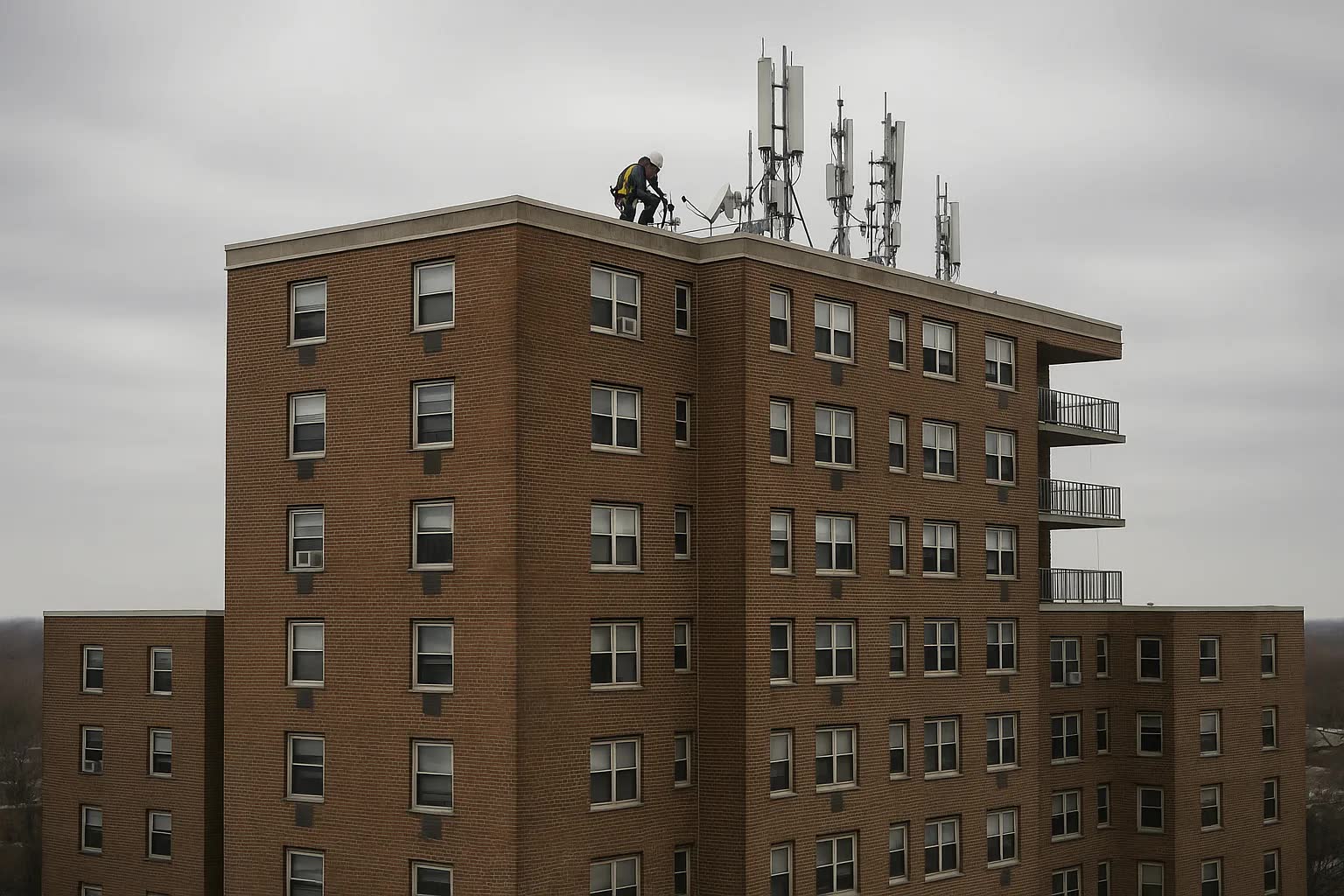
NEW YORK — In a narrow courtyard off Hillside Avenue in Jamaica, Queens, tenants of a 20-story public housing tower woke last month to newly installed fiber optic boxes lining the basement corridor, a visible sign of a pilot program that promises high-speed internet for hundreds of units but has already raised questions about cost, control and long-term upkeep in a community that has long lagged behind in connectivity.
The installation was carried out by Harborstone Properties under a yearlong agreement with the NYCHA Office of Resident Digital Services and QueensConnect, a local nonprofit, the companies said, bringing so-called gigabit-capable service directly to apartments at 1770 Hillside Tower, a development of roughly 320 units three blocks from the Parsons Boulevard subway stop. Proponents say the work — which included running fiber to building risers and installing wireless access points in common spaces — could be a model to close persistent digital gaps across the borough.
For residents, the new network has been a relief and a source of skepticism in equal measure. "For my kids, this means they can finally do schoolwork without fighting over my phone hotspot," said Maria Alvarez, president of the Hillside Tenants Association, who lives on the 14th floor. "But people are asking: what happens when the trial ends? Will the price jump? Who fixes it when the hallway lights go out and the cables get wet?"
Harborstone spokesman Evan Knight framed the pilot as pragmatic. "We saw an opportunity to deliver infrastructure faster than large municipal procurements have historically allowed," he said. "Our model is to install and maintain the plumbing of the network, while partnering with subsidized service tiers so affordability is part of the rollout." Knight declined to disclose the precise terms of the contract with NYCHA but said the firm will manage maintenance for the duration of the pilot.
Digital equity advocates welcomed the hardware but urged vigilance about terms. "Access is not just about speed; it's about reliability, privacy and transparent pricing," said Dr. Jonas Patel, director of digital equity at the Center for Urban Technology. "We need clear, enforceable commitments: uptime guarantees, caps on data throttling, and protections so landlords cannot use network control to monitor tenants' online activity. Otherwise you end up replacing one barrier with another."
The numbers driving the pilot are concrete: Harborstone and QueensConnect say the initial build connects 320 apartments in the Hillside tower and the adjacent five-story community center, delivering up to 1 Gbps symmetrical speeds to the building's distribution point, with an initial subsidized residential plan offered at $19.95 per month for qualifying households. The pilot is set to run 18 months; contract documents provided to NYDailyWatch show Harborstone committing $450,000 in capital buildout and a $75,000 annual maintenance reserve during that period, while QueensConnect will administer up to 200 enrollment subsidies funded by a separate philanthropic grant.
Tenants described a spectrum of experiences since the lights went on. On the ground floor, 68-year-old retired school custodian Samuel Osei said he can now stream medical appointments without lag, a change he called "liberating." Upstairs, college sophomore Amina Yusuf said the promise of cheap, fast internet was tempered by paperwork and résumés: "They made us sign a consent form to get the discounted rate, and I don't know if that form ties me into something later. My mom's worried about a surprise bill."
Maintenance concerns underpin much of the anxiety: residents recalled years of slow repairs for plumbing and elevators, and worry the same patterns could apply to the network. Neighborhood organizer Luis Mendoza pointed to past deals where contractors departed after initial work, leaving a web of orphaned equipment. "We've seen infrastructure appear and then vanish," he said. "If the landlord controls the network, tenants need enforceable recourse when service degrades."
City officials have been watching closely. The NYCHA Office of Resident Digital Services issued a statement saying the pilot "seeks to expand access in Queens while safeguarding tenant protections," and that all contracts include clauses on privacy and non-discrimination. QueensConnect said it will collect monthly usage and satisfaction metrics and release a public report at the nine-month mark. Advocates, however, want those benchmarks to include not only speed and enrollment but also a mechanism for tenants to lodge service complaints that are adjudicated independently.
The pilot in Jamaica could be the first of several experiments across Queens and the outer boroughs if it meets the goals laid out by partners: lower latency and higher enrollment for low-income households, transparent pricing plans and demonstrable maintenance capacity. Officials plan a community forum at the nearby Jamaica Library next month to present interim findings and discuss possible expansions to neighboring developments such as Rochdale and South Jamaica, while Harborstone says it is in talks to build similar systems in other NYCHA-managed properties if the model proves sustainable. Tenants and advocates said they will be watching those meetings closely, intent on ensuring that fast internet in Queens does not come at the cost of long-term control of essential services.