Queens Night Markets Expand But Struggle With Permits
Vendors applaud growing crowds while city bureaucracy and inconsistent enforcement threaten weekend operations in Astoria and Flushing.
By Maya Singh · January 24, 2026 · 4 min read
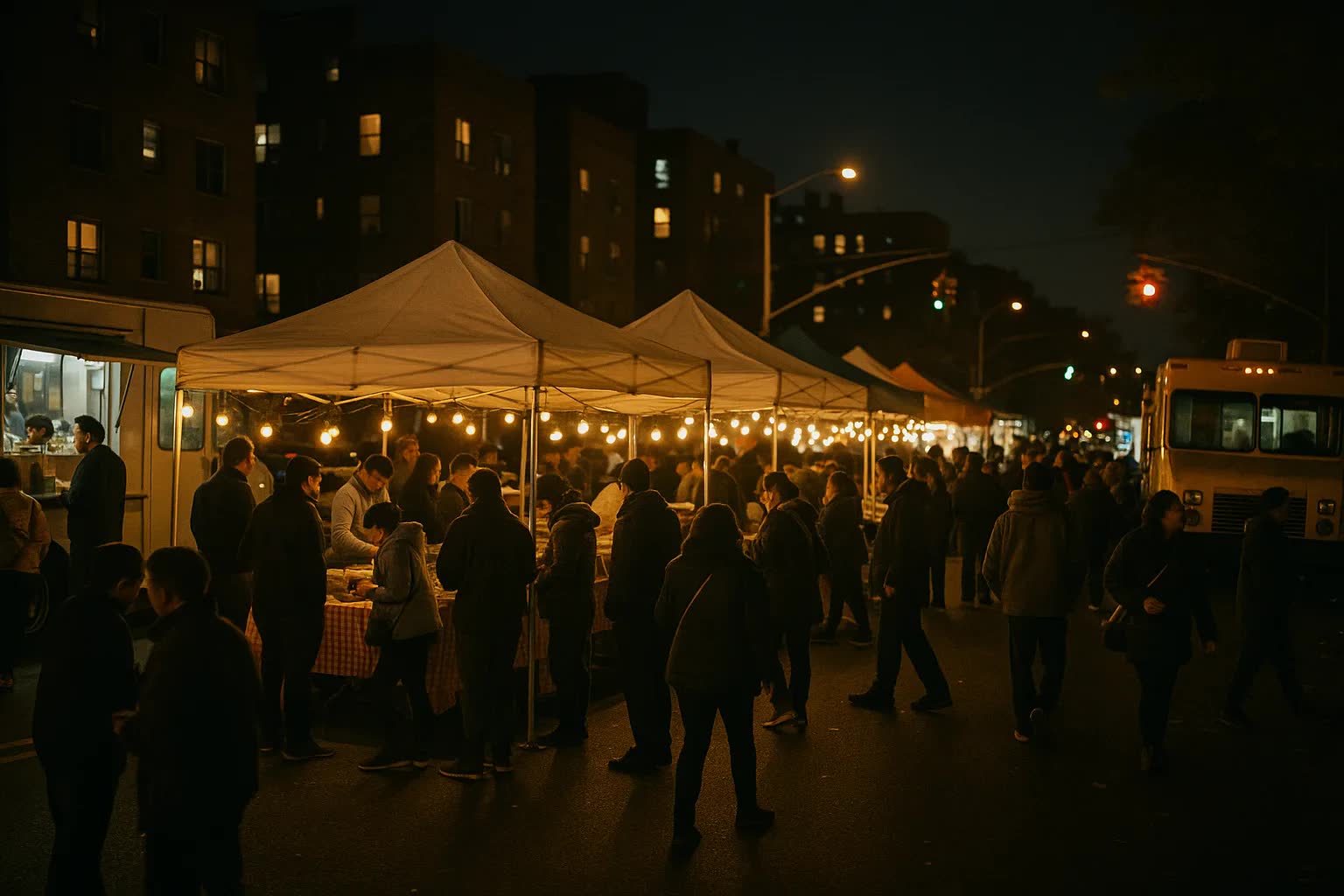
NEW YORK — Long a fixture of late-night curiosity and immigrant entrepreneurship, Queens’ weekend night markets have mushroomed from summer pop-ups into near-weekly destinations in neighborhoods such as Astoria and Flushing, but vendors and organizers say a maze of city permits and spotty enforcement are threatening the very momentum that has drawn thousands to Steinway Street and Main Street after dark.
What began five years ago as a handful of food carts clustered around Socrates Sculpture Park and Brower Park has evolved into organized markets on Vernon Boulevard near Astoria Park and along the retail corridor by the Flushing-Main Street subway complex, with operators booking bands, hiring security and selling out dinners by 9 p.m. on Fridays and Saturdays. The new scale has forced organizers to confront city agencies that were not built to process the volume of weekend, late-night retail.
For small-business owners, the markets have been a lifeline. "We sold three times our usual weekend take the first month we tried Astoria," said Sonia Delgado, owner of Tita's Arepas, who moved her stall from a permanent Jackson Heights storefront to a weekend pitch near 30th Avenue in June. "Customers come for the food and stay for the atmosphere; it feels like the neighborhood at its best. But when a permit gets pulled at the last minute, it doesn’t just cost us a night — it can wipe out payroll and rent."
Organizers say the problem is not the city’s interest in vibrant public life but the sheer number of agencies involved. "We interact with DOT, FDNY, the Department of Health, the Licensing Division and three different community boards depending on block lines," said Amir Khan, co-founder of Queens Night Markets, which runs markets in Astoria and a pilot series in downtown Flushing. "There’s no single point of contact, and when enforcement varies by precinct or inspector, the markets cannot plan with the certainty businesses need."
Traces of that inconsistency have become visible. In late October, a generator that powered lighting for vendors on 31st Street in Astoria was shut down by FDNY inspectors citing attachment and venting rules; two weeks earlier, a Flushing market on Kissena Boulevard received a notice from the Department of Consumer Affairs for operating beyond an approved footprint. Vendors reported differing instructions from NYPD community-affairs officers at the 109th and 110th Precincts — one permitting a live-music setup, the other demanding it be curtailed for noise complaints within minutes of each other.
The numbers underline both the growth and the strain: markets that ran an average of 18 vendor stalls per night in 2022 expanded to a median of 62 stalls by 2025; estimated weekly attendance across Astoria and Flushing markets hit roughly 8,400 people on peak weekends last fall. Organizers say the permit backlog has grown to more than 120 pending special-event applications in the borough office, average processing time for a new vendor permit now stretches 10 to 12 weeks, typical weekend permit fees range from $150 to $600 depending on services requested, and fines for serious violations can exceed $1,200 — enough to wipe out several nights of revenue for an independent operator.
Those numbers translate into difficult choices. Some vendors delayed investing in insulated carts or generators that would allow them to operate year-round; others have shrunk staff or shortened menus to meet shifting rules. "I had to let go of my prep cook because I couldn’t predict my run of shows," said Carlos Rivera, proprietor of Baba’s Bosnian Burek, who has split weekends between Flushing and Sunnyside. "We want to be part of the neighborhood, but we need the city to tell us clearly what’s expected and stick to it."
Residents and brick-and-mortar merchants in both neighborhoods have offered mixed reactions. In Astoria, a group of storefront owners on Broadway near 34th Avenue praised the spillover foot traffic but warned of blocked sidewalks and late-night trash on Saturdays; in Flushing, the Main Street Business Improvement District called the markets "a boon for small entrepreneurs," while urging tighter coordination with sanitation services and transit to avoid clogged platforms at the Flushing-Main Street station after headline bands break down.
City officials acknowledge the challenge and say they are working on paperwork and technology that could ease the burden. Evelyn Park, permit coordinator for the city’s Special Events Office, said the agency is piloting a consolidated digital portal to route applications to the appropriate departments and flag conflicts before approvals are issued. "We want these markets to succeed," Park said. "Our plan is to reduce duplication, create clearer timelines and increase inspector training so that compliance looks the same whether you’re in Astoria or Flushing."
As the spring season approaches, market operators and vendors are preparing for another round of weekend slots and negotiations. Organizers are petitioning for micro-permits that cover a block for consecutive weekends, vendor groups are documenting enforcement discrepancies for city hearings, and merchants associations are convening to align sanitation and transit plans. For many small entrepreneurs — and for neighborhoods that have embraced the markets as a new kind of public square — the coming months will determine whether Queen’s weekend nights become a steady, regulated part of city life or a series of fragile experiments whose fate depends on the next inspector’s judgment.