Queens Library Tests an Overnight Branch for the City That Actually Doesn't Sleep
A six-month pilot in Elmhurst keeps one branch open until 2 a.m. four nights a week, aimed at late-shift workers, students, and neighbors with nowhere quiet to go.
By Grace Ng · July 7, 2026 · 5 min read
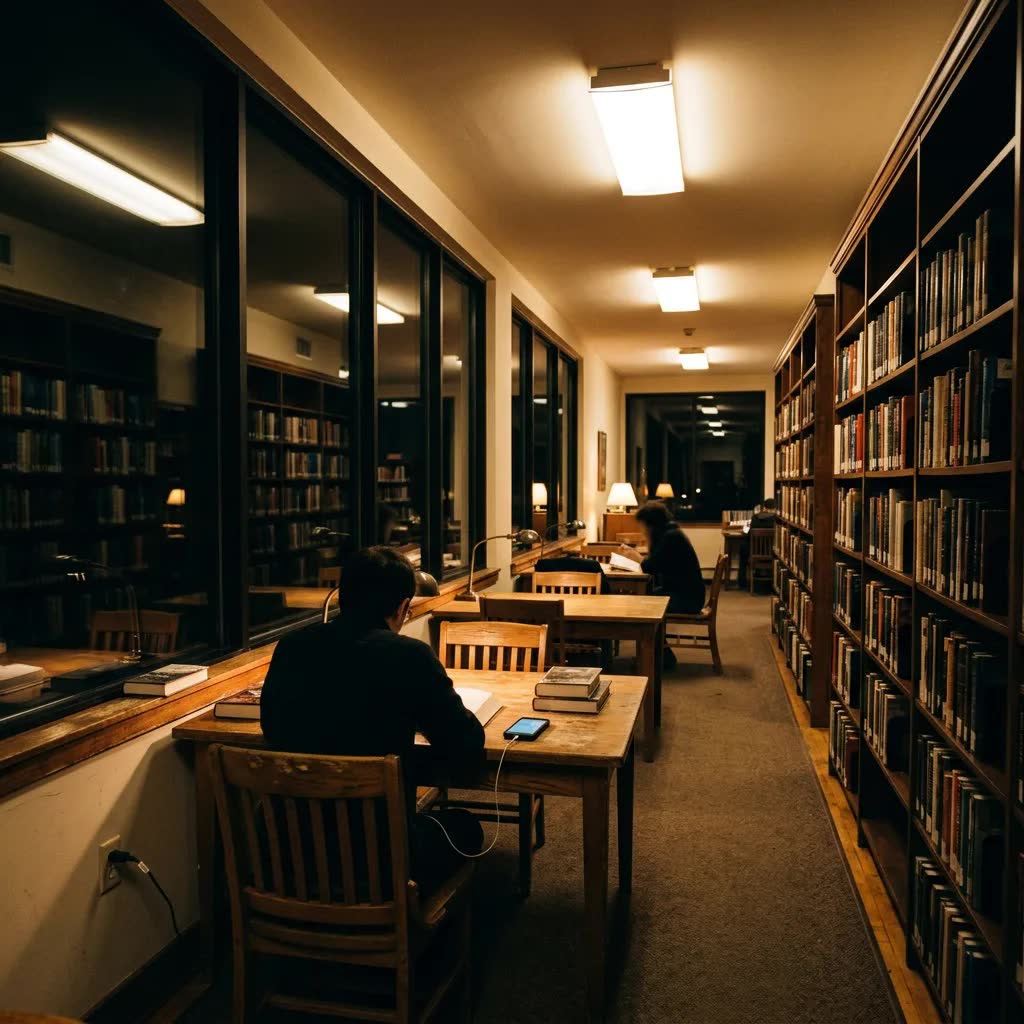
NEW YORK — At half past midnight on a Tuesday in Elmhurst, the reading room of a Queens Public Library branch looked much as it might at midday, except for the quality of the quiet. A hospital orderly still in scrubs paged through a paperback. Two teenagers hunched over a shared laptop, whispering about a physics problem set. A delivery cyclist charged his phone at an outlet by the window and dozed with his helmet still on. All of them were there because of a pilot program that, for six months, is keeping this branch open until 2 a.m. four nights a week.
The library system launched the overnight hours in late June after a survey of Queens residents found that a striking share worked schedules that left them shut out of ordinary business-hour services. Elmhurst was chosen in part because of its dense mix of overnight workers and its round-the-clock streetscape of restaurants, clinics, and transit connections. "We say New York never sleeps, and then every public building closes at eight," said a branch manager overseeing the trial. "We wanted to see what happens if one door stays open."
What happens, so far, is a steady but manageable trickle: on an average night the branch counts between thirty and sixty visitors after 10 p.m., according to internal tallies the system shared. Some come to use computers or the free Wi-Fi, some to apply for jobs on the branch's terminals, and a meaningful number simply to sit somewhere warm, lit, and free that isn't a subway car or a fast-food counter. Staff say the most common request after midnight is not for a book but for a quiet outlet and a chair.
The pilot has not been without friction. Security staffing costs more than doubled for the overnight window, and the branch has had to develop clear protocols for guests who arrive intoxicated or in evident distress, referring them where possible to nearby services. Librarians volunteering for the late shift receive extra training and a modest premium, and the system has been careful to frame the program as a service experiment rather than a shelter, even as it acknowledges that people without stable housing are among those it serves.
Advocates for expanded library hours point to Elmhurst as evidence that public institutions can flex around the lives people actually lead. "The library has always been the last truly public indoor space where nobody asks you to buy anything," said a spokesperson for a coalition of Queens civic groups backing the pilot. She argued that keeping one branch open overnight costs a fraction of what the city spends managing the consequences of having nowhere for people to be after dark.
Whether the experiment continues past its scheduled December end will depend on both usage data and next year's budget negotiations, library officials cautioned. For the orderly in the scrubs, though, the calculus was simpler. Her shift at a nearby hospital started at 3 a.m., and the two hours between her second job and her third were, until this summer, spent riding the 7 train back and forth to stay awake. "Now I read," she said. "It's better."