Queens Schoolyards Turn Murals into Mini Museums
Public-school art projects are becoming durable outdoor exhibits that teach neighborhood histories to students and passersby alike.
By Rashid Karim · January 17, 2026 · 4 min read
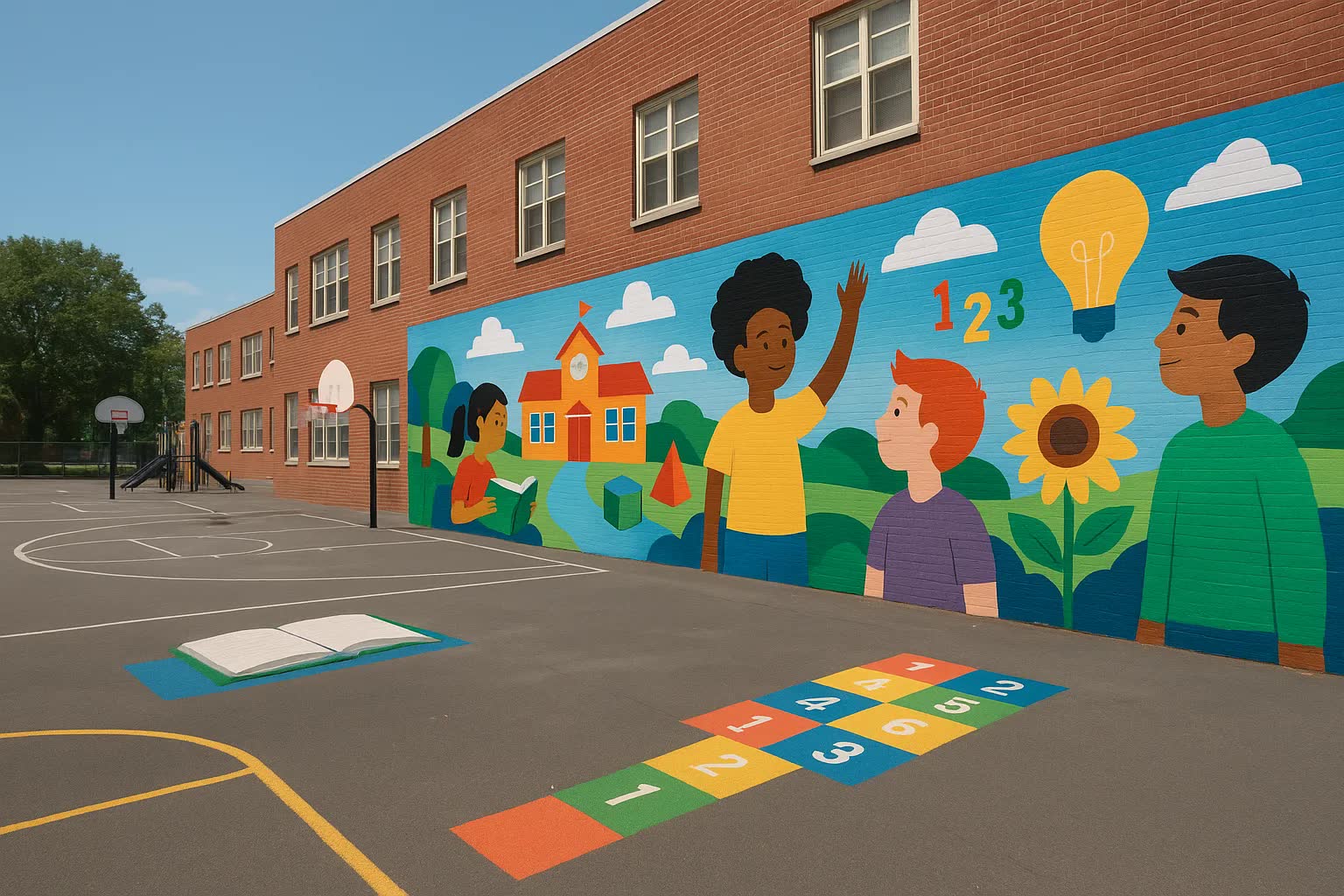
On a bright, blustery January afternoon, students at P.S. 122 in Jackson Heights huddled under a canopy of paintbrushes and spray-resistant varnish as their schoolyard mural — a sweeping history of neighborhood immigrant businesses and transit lines — took on the permanence of a small outdoor museum. Similar scenes have unfolded across Queens from Astoria’s 31st Street to Jamaica Avenue as classroom art projects, once ephemeral and vulnerable to weather and wear, are being remade into durable public exhibits that double as neighborhood history lessons for students and passersby alike.
The shift has been driven by a mix of new materials, community partnerships and curricular intent. Schools are mounting ceramic panels, aluminum dibond prints and weatherproof mosaics on fence lines and exterior walls, adding interpretive plaques and QR codes that link to audio histories. The Department of Education facilities office, local arts nonprofits and private foundations have collaborated with neighborhood historians to ensure the murals survive the borough’s harsh summers and salt-laden winters while remaining accessible as teaching tools during recess and afterschool programs.
“Kids aren’t just painting pretty pictures,” said Marisol Vega, art teacher at P.S. 122 in Jackson Heights, who led last spring’s mural on immigrant-owned storefronts along Roosevelt Avenue. “They’re interviewing grandmothers on Main Street, recording stories about the old piano factory on Steinway, and then seeing those stories become part of the schoolyard. When they scan a QR code and hear their own voice playing back, it changes how they think about history and who gets to tell it.”
The initiative has grown quickly: between fall 2024 and December 2025, city and private grants funded 74 schoolyard installations at 52 public schools across Queens, with an average mural measuring 12 by 20 feet and costing roughly $16,000 each to design, produce and install, according to figures supplied by the Queens Community Arts Coalition. Organizers say some 3,400 students participated in at least one research or fabrication phase; bilingual plaques have been installed at 18 sites and audio recordings are available in five languages. Maintenance contracts average $1,200 a year per site, a line item that schools are still learning to budget for.
The content of the murals is intensely local. In Astoria, a 40-foot ceramic frieze recounts the neighborhood’s shipyard and piano-making past near Steinway Street and 21st Avenue; in Corona, students collaborated with elders from the Dominican and Colombian communities on a mosaic that frames the walkways to Flushing Meadows–Corona Park; and in Jamaica, a sequence of aluminum panels along Jamaica Avenue maps the rise of Black and Caribbean-owned small businesses from the 1950s to the present. Teachers and artists routed students to local archives, barber shops on Hillside Avenue, and markets on Liberty Avenue to collect photographs, receipts and oral histories to inform the designs.
“We’re trying to create mini museums that are integrated into everyday life,” said Thomas Alvarez, executive director of the Queens Community Arts Coalition, which helped broker deals between schools and artists and pooled grant money for production. “These aren’t monuments to a single narrative; they’re layered, multilingual displays that tell the story of a block, not just a person. The goal is that someone waiting for a bus on Northern Boulevard, or a parent picking up a child on 46th Street, will learn something about the place they live from a mural made by students who live there.”
Reaction in neighborhoods has been broadly supportive, though not uncritical. At a luncheon held last month at a senior center near Broadway in Astoria, residents praised a mural that depicts early Greek and Italian grocers alongside newer Bangladeshi and Ecuadorian shopkeepers, saying it reflected the changing face of the block. A cafe owner on 30th Avenue said foot traffic near her shop increased after a mural installation, and a mother in Forest Hills said her daughter now wants to take history classes. At the same time, some parents and local activists have pressed schools to make selection processes for mural themes more transparent, arguing that competing narratives sometimes get short shrift.
There have been logistical headaches as well. Facilities managers at the Department of Education required liability insurance that delayed three projects in Elmhurst and Sunnyside for months; graffiti protection coatings add to upfront costs; and coordinating production windows around school calendars has proved tricky for artists used to summer-only work. Schools have adapted by establishing maintenance funds, signing memoranda of understanding with community partners, and scheduling installation during teacher professional days to minimize disruption to classrooms.
For students, the work has yielded measurable outcomes beyond paint and tile. Teachers report higher engagement with local history units, and principals say student attendance at afterschool clubs that support the murals rose by double digits at several sites. “When people from my block hear my story in the mural, it feels like I’m part of the neighborhood’s memory,” said Aisha Rahman, an eighth grader at I.S. 49 in Elmhurst who helped design a panel about Indo-Caribbean kitchens on Junction Boulevard. Her teacher said Aisha’s research project, which included interviewing a family friend who owns a roti shop, became the basis for a middle school literacy assignment.
City and school leaders are now discussing how to scale the model. The Queens Community Arts Coalition is piloting a borough-wide maintenance cooperative and is in talks with the Department of Education to formalize curriculum ties that would allow schoolyard exhibits to satisfy portions of local history and civics requirements. Long-term advocates envision a linked trail of schoolyard mini museums across Queens — mapped online and physically waymarked — that could be updated in rotating cycles so new cohorts of students can add their work. Organizers hope the next round of installations will debut before the 2026-27 school year, complete with expanded language access and a small traveling exhibition that takes student-made panels to neighborhood libraries and transit hubs.