Queens Startup Raises $18 Million to Bring Inventory AI to Corner Stores
Shelfwise Systems says its software can help independent grocers predict demand without replacing the judgment of store owners. The new financing will support a wider New York rollout and 42 planned hires.
By Nia Calder · August 24, 2026 · 5 min read
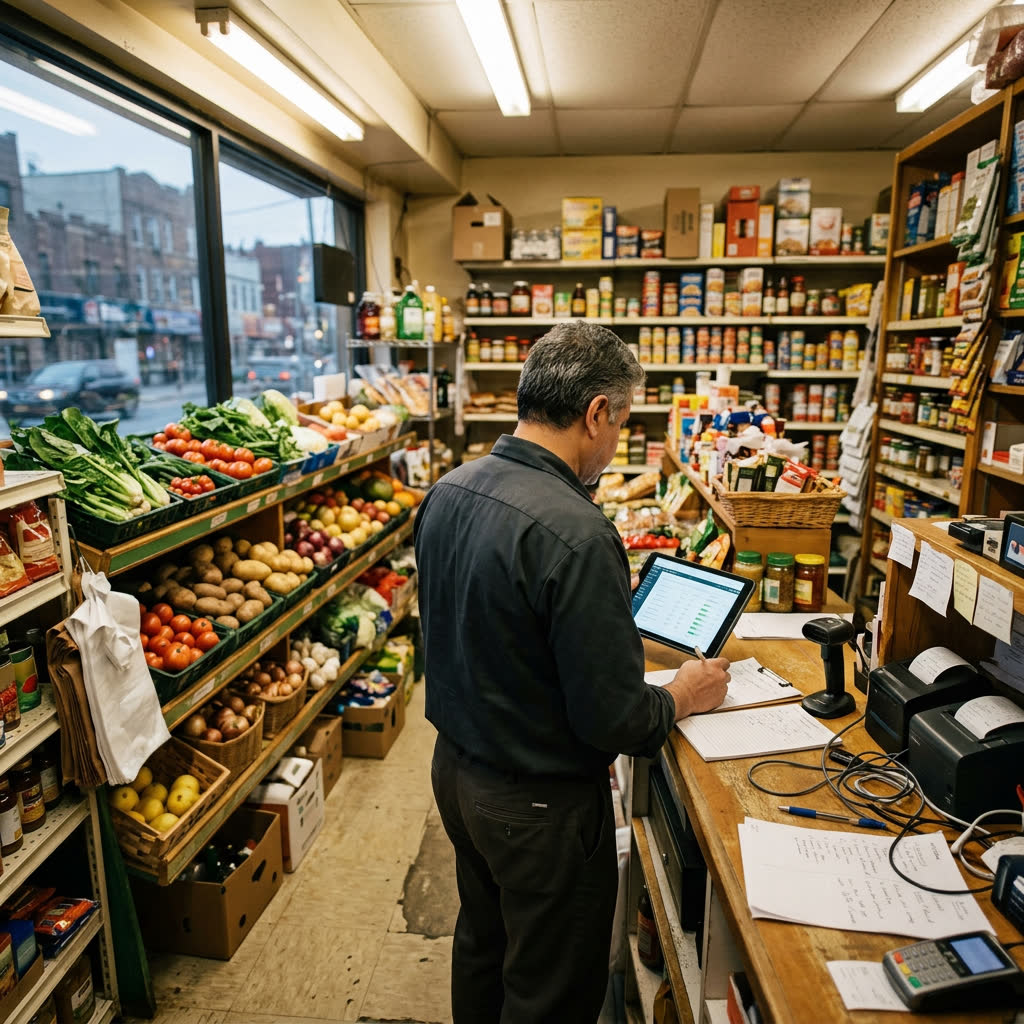
NEW YORK — A Queens software company that helps small food retailers decide what to order has raised $18 million, giving the three-year-old venture fresh capital to expand beyond a test group of neighborhood grocers. Shelfwise Systems announced the financing Monday evening from its Long Island City office, where engineers work alongside a mock store aisle used to test barcode scanners and shelf cameras. The company said it plans to add 42 employees over the next year, mostly in customer support, engineering and field installation.
Shelfwise combines sales records, wholesale prices, weather forecasts and a store owner's own notes to suggest daily order quantities. A dashboard flags products that may run out and items likely to sit too long, but the owner must approve every order. Chief executive Mira Patel, a fictional entrepreneur who previously managed her family's grocery in Jackson Heights, said that design is deliberate. "The shopkeeper knows when a school event or a block party will change the day," Patel said. "Our system should organize the clues, not pretend it knows the neighborhood better than the person behind the counter."
The funding round was led by Harbor Lantern Ventures, a fictional Manhattan investment firm, with participation from several existing backers. Shelfwise did not disclose a valuation. Patel said roughly two-thirds of the money will go toward hiring and product development, while the remainder will cover installation kits, multilingual training and expansion into additional neighborhoods. The company currently employs 31 people and operates in 86 stores across the five boroughs.
Independent grocers have long had access to point-of-sale reports, but many smaller shops still place orders through a mix of handwritten lists, text messages and calls to distributors. Shelfwise is betting that a simpler tool, priced for stores with only one or two locations, can find a market between a cash register and the complex planning systems used by large chains. Its basic subscription costs $149 a month, with hardware rented separately, according to the company.
At Orchard Basket, a fictional 1,400-square-foot market in Elmhurst, owner Luis Romero said a six-month trial changed how he stocks milk, berries and prepared sandwiches during hot spells. The recommendations did not eliminate waste, he said, but they prompted him to order smaller amounts more frequently when forecasts called for extreme heat. "It gives me a second set of eyes before I spend the week's cash," Romero said. He still overrides the system several times a week, especially before religious holidays and family events.
The technology also raises practical questions about who controls a small business's data. Shelfwise said stores retain ownership of their transaction records and can delete exported data when a contract ends. The company said it does not sell information about individual purchases and does not collect customer names. Nadia Flynn, a fictional technology policy researcher at the independent Center for Urban Digital Commerce, said owners should still ask whether aggregated sales patterns could be shared with wholesalers or lenders and should insist that those terms be written plainly.
Artificial intelligence adoption among the city's smallest businesses remains uneven, in part because owners have little time to evaluate new products. Shelfwise is organizing evening demonstrations through fictional merchant associations in Queens and Brooklyn and says training is available in English, Spanish, Bengali and Mandarin. Field staff spend two days mapping each store's product categories before the software begins making recommendations, a process the company says reduces mistakes caused by inconsistent item names.
Harbor Lantern partner Elise Warren said the investor was drawn to a product aimed at existing retailers rather than one seeking to displace them. She acknowledged that customer support will be costly as Shelfwise grows because every store carries a different assortment and buys from different suppliers. The startup says it will measure retention and documented reductions in spoiled inventory before entering markets outside New York, rather than racing immediately into a national launch.
Shelfwise plans to begin installing its next group of systems after Labor Day, with priority given to applicants that have fewer than five locations. Patel said the company will publish a plain-language model card this fall explaining the information its forecasts use and the circumstances in which store owners should disregard them. For New York's crowded market of small-business software, the financing is a notable wager that useful AI may look less like a robot clerk and more like a carefully edited shopping list.