Queens Station Gets a New Mural Program to Fight Graffiti and Boost Wayfinding
Local artists and transit officials have teamed up on a pilot at two Jamaica subway stops to replace tagging with color-coded murals that tell neighborhood histories.
By Caroline O'Neill · January 9, 2026 · 4 min read
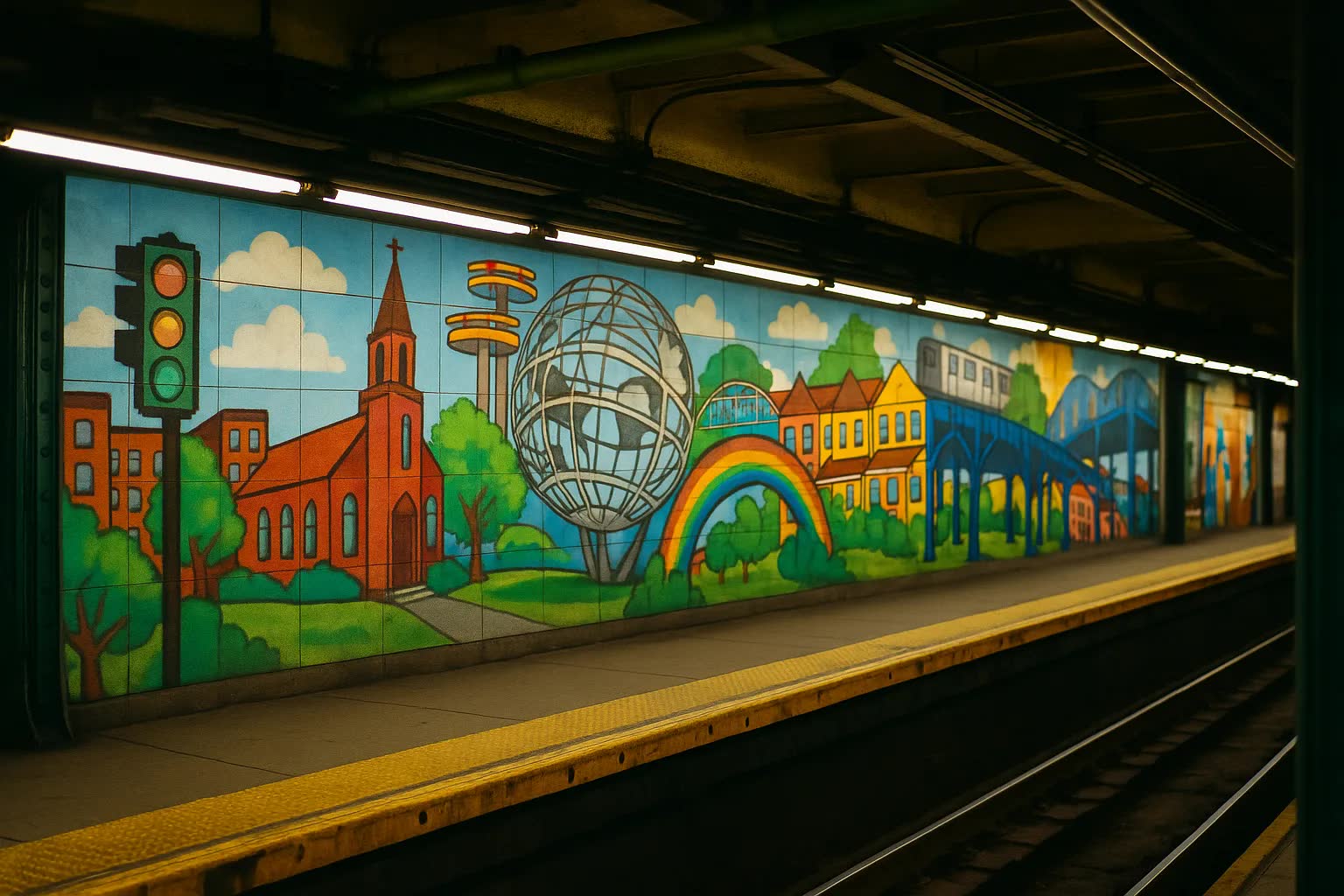
NEW YORK — On a gray January morning in Jamaica, Queens, a band of color is being used as an urban remedy: local artists and transit officials have launched a pilot mural program at two busy stations — Jamaica Center–Parsons/Archer and Sutphin Boulevard–Archer Avenue — aimed at replacing illegal tagging with color-coded murals that double as neighborhood wayfinding and oral history canvases for a rapidly changing borough.
Officials from the Metropolitan Transportation Authority and the city Department of Transportation announced the initiative after months of meetings with community groups and business owners along Parsons Boulevard, Jamaica Avenue and Hillside Avenue, saying painted surfaces are less likely to be re-tagged than blank concrete. The effort is being shepherded by the Jamaica Arts Collaborative, a nonprofit that has worked for a decade on public art and youth programs in southeast Queens.
The program, called Queens Station Mural Routes, commissions local artists to design panels that reflect the histories of Jamaica’s Caribbean, South Asian and African American communities, and to use a system of colors to orient riders: blue panels for transit connections, green for parks and public spaces, and amber for shopping corridors and food markets. Murals will occupy mezzanine walls, stairwells and portions of platform fascia where most tagging occurs and where riders look for cues on exits and neighborhood destinations.
Organizers put concrete numbers behind the pilot. Over the next six months, 12 artists will create 18 individual mural panels totaling roughly 3,200 square feet across the two stations, funded by a $275,000 pot drawn from MTA station improvement funds, a city cultural grant and corporate sponsorships. The MTA estimates the pilot could reduce re-tagging in treated areas by 60 percent, based on internal data from comparable programs, and expects maintenance and anti-graffiti coating to cost roughly $22,000 annually for the two stops.
“We wanted something that respects local stories while solving a practical problem,” said Maria Lopez, executive director of the Jamaica Arts Collaborative. “These murals are designed not to be a veneer, but a map — so residents can tell their neighbors’ stories in color and riders can find the 165th Street Mall or Rufus King Park without guessing.”
Evan Brecht, senior MTA planner for New York City Transit’s station programs, said the agency is tracking vandalism, maintenance costs and rider feedback as primary metrics. “This is not just paint,” Brecht said. “It’s an operational strategy that aims to reduce clean-up time, improve passenger experience and add wayfinding clarity in stations that serve tens of thousands of people a day.” Brecht declined to provide daily ridership breakdowns for the specific stations but noted that both are critical transfer points for several bus routes and for riders heading to JFK via the airtrain connection at Sutphin.
Local businesses and residents in downtown Jamaica have reacted with cautious optimism. “We get tags on our shutters all the time,” said Ibrahim Khan, manager of G&K Shoe Repair on Jamaica Avenue. “If these murals mean I don’t have to pay to have my metal gate repainted every month, that matters. But I hope there’s a plan to keep them clean and not let them get faded or covered.” Several small-business owners said they hoped the program would bring more foot traffic to corridors that have struggled since the pandemic.
Artists selected for the pilot say the work is research-driven. Lead muralist Anika Ramesh, whose studio is in Long Island City, described visits to the Jamaica YMCA, the 165th Street shopping strip and conversations with elders at Ebenezer Baptist Church to assemble motifs: sugarcane patterns nod to West Indian markets, embroidered saris and cricket bats recognize South Asian grocery owners, and stylized saxophones recall midcentury jazz venues that once dotted the neighborhood. “Color becomes a language,” Ramesh said. “When someone leaves Sutphin and sees blue panels, they should immediately feel they’re on a transit route; amber should tell them they are in a commercial zone.”
Not everyone welcomed the murals without reservations. Jorge Rivera, a neighborhood housing organizer, cautioned that public art can be co-opted to signal change to the detriment of longtime residents. “Art can beautify and it can also be used as a sign that a neighborhood is ripe for outside investment,” Rivera said. “We need guarantees that this program won’t be followed by displacement pressures, and that apprenticeships and hiring prioritize local youth.” Organizers said apprenticeship components are part of the pilot and that community review panels determined artist selections.
If the pilot proves effective, officials say the program could expand to additional stations in Queens and beyond. MTA and Jamaica Arts Collaborative representatives plan to convene evaluation meetings in July to review tagging statistics, maintenance costs and rider surveys; if the six-month pilot meets its targets, a phased rollout to up to 10 additional stations in the borough could begin as early as fall. For now, the painted panels at Parsons/Archer and Sutphin will offer a visible test of whether art can displace spray paint, improve navigation and, in the words of one organizer, help residents ‘read’ their neighborhood from the platform up.