Red Hook Microgrid Keeps Lights On Through Another Storm Season
The community-backed microgrid's battery and solar combination provided backup power and lessons for scaling distributed resilience across coastal neighborhoods.
By Hana Kim · December 30, 2025 · 4 min read
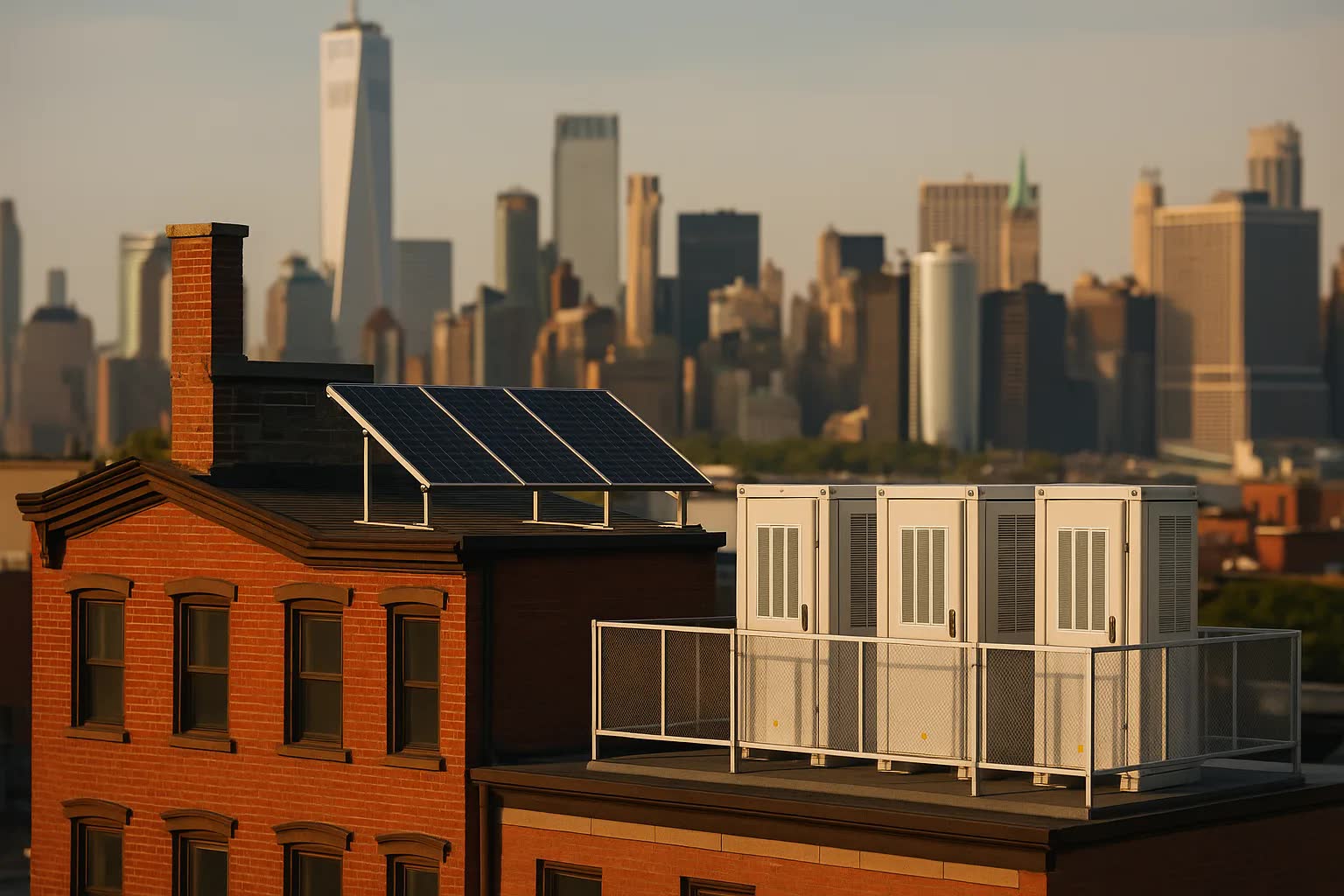
NEW YORK — On the narrow blocks of Red Hook, where cobblestones meet shipping containers and the smell of brine drifts in from the Upper Bay, a low-profile energy system again proved its worth this year, keeping lights on for residents, small manufacturers and two community centers through a series of late-summer nor'easters and autumn coastal storms that knocked out service elsewhere in Brooklyn and Lower Manhattan.
The Red Hook Community Microgrid, a hybrid of rooftop solar arrays, a shared lithium-ion battery farm and smart controls, supplied continuous power to some 1,200 customers during outages, officials said, allowing a pediatric clinic on Van Brunt Street and the Red Hook Senior Center near Coffey Street to remain open while neighboring Carroll Gardens and Gowanus blocks went dark.
"We designed the system so this neighborhood wouldn't be left scrambling when a transformer blows or wires come down," said Luis Mercado, director of the Red Hook Energy Cooperative, the nonprofit that operates the microgrid. "This isn't about keeping the boutique lights on — it's about heating, refrigeration for food pantries and powering medical equipment for people who would otherwise be at risk."
The microgrid grew from debris, necessity and funding. It began in 2022 as a pilot after a severe storm inundated the waterfront, and has since been bolstered by municipal grants and private impact investment. Solar panels now cover the roofs of a bakery on Dwight Street, a desalination pilot lab near the Erie Basin and a pair of low-rise housing co-ops, while the battery bank sits in a retrofitted warehouse off Conover Street.
Concrete metrics show the scale achieved this season: the system delivered peak output of 1.6 megawatts, supported by 3.2 megawatt-hours of battery storage and roughly 400 kilowatts of distributed solar. It provided uninterrupted power for up to 72 hours in the worst outages and reduced outage exposure in the service area by an estimated 87 percent compared with the wider borough, according to a post-storm performance report commissioned by the cooperative.
Neighbors and local businesses said the microgrid's benefits were visible in small, practical ways. At Red Hook Lobster, a family-run restaurant on Pioneer Street, walk-in refrigerators kept food safe during a two-day outage; at the Brooklyn Army Terminal logistics hub, microgrid-backed lighting allowed night shifts to continue moving freight safely. "It made a huge difference for our customers and for morale," said Ava Rosen, chief resilience officer at the Brooklyn Community Housing Alliance. "We saw the microgrid act as a distributed lifeline rather than a single point of failure."
Still, the system's successes showed limits and sparked lessons. Engineers had to fine-tune islanding protocols — the microgrid's ability to disconnect from the broader grid during an outage — after an early-season fault caused brief voltage fluctuations along Columbia Street. The battery capacity was stretched during a prolonged storm in October, prompting temporary demand-management measures such as staggered heating and prioritized power to medical devices and refrigeration.
Beyond engineering, the operation underscored institutional hurdles. The cooperative has navigated a web of interconnection rules with Con Edison, grappled with permitting delays for battery siting in a waterfront industrial zone and faced insurance premiums that warmed up with every after-action report. Financing also remains delicate: of the $9.6 million raised so far, roughly $4.8 million came from philanthropic sources and city resilience grants, with the remainder split between low-interest loans and community equity investments.
"Scaling is the next frontier," said Marisol Vega, a neighborhood council member who represents parts of Red Hook and Carroll Gardens. "We have something that works here. The challenge is replicating it for other coastal corridors without leaving smaller, lower-income blocks behind, because climate risk doesn't wait for red tape to clear."
City planners are watching: officials from adjacent neighborhoods, including Sunset Park and the Brooklyn Navy Yard, have visited the site this fall, and the cooperative is preparing a proposal to extend modular battery units to Gowanus and select blocks along Shore Parkway. If funding and streamlined interconnection agreements come through in 2026, representatives say the model could be adapted to serve 5,000 additional households across south Brooklyn within three years, offering a blueprint for coastal resilience across the city.