Rockaway Residents Challenge FEMA Flood-Relief Allocations as Recovery Lags
Local lawmakers accuse federal agencies of sending insufficient funds after recent storms, prompting calls for new oversight hearings.
By Mei Lin · December 4, 2025 · 4 min read
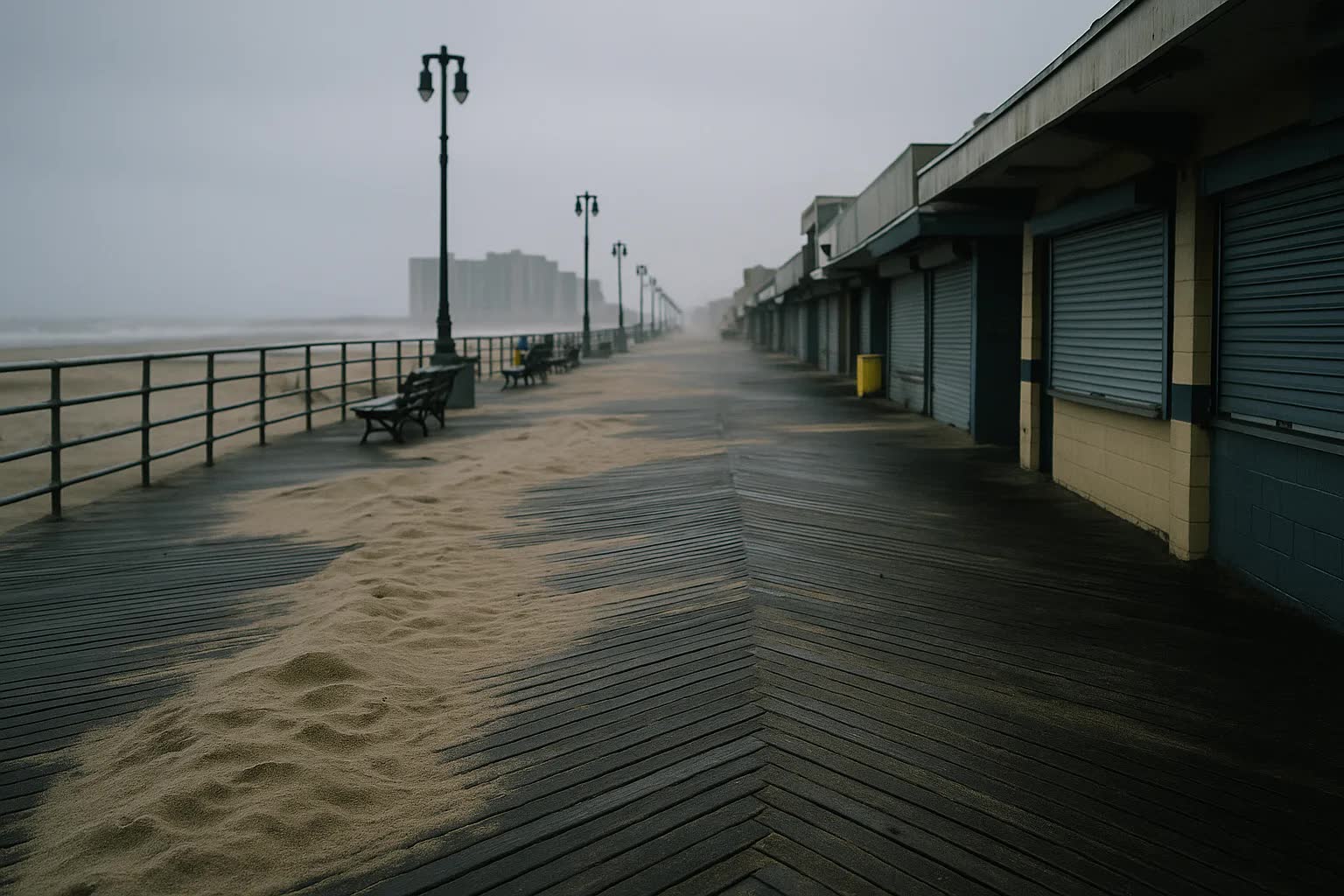
Weeks after heavy October storms battered the Rockaways, neighborhoods from Far Rockaway to Arverne still show the kind of damage New Yorkers here say should have been long since repaired, and residents are accusing federal agencies of sending too little money, too late. On a cold morning near the Rockaway Beach boardwalk, plywood-strewn storefronts and flooded basements tell a different story than the federal tally: small-business owners and homeowners say federal flood-relief allocations have not matched the scale of local need, and local lawmakers are pressing for new oversight hearings to determine why recovery has lagged in this corner of the city.
The storms that swept the peninsula in late October and again in mid-November dumped weeks of rain, toppled sections of the north-facing boardwalk and forced dozens of evacuations across Beach 90th Street, Mott Avenue and Seaside. Sandy-like surge and persistent groundwater left many basements unusable and weakened foundations on narrow streets where houses sit close together. For some residents, the work meant living in temporary housing while awaiting approvals that have taken months instead of weeks.
"We keep hearing about checks in the mail that never arrive," said Maria Delgado, owner of Delgado's Deli on Mott Avenue. "My deli is where people in Arverne get their groceries; I can't reopen fully without help, and the paperwork keeps getting bounced back. It feels like no one is counting the cost to the community."
Concrete numbers provided by local officials illustrate the gap residents and lawmakers point to: since the first storm in October, FEMA has approved $42.3 million in individual and public assistance for Rockaway-area ZIP codes, the City of New York reports, covering 1,280 households with an average grant of $4,890; the Small Business Administration has issued 78 disaster loans totaling $3.9 million; and the city has issued 420 emergency housing vouchers. Yet municipal damage assessments estimate unmet residential and small-business repair needs at roughly $95 million, with an estimated 1,500 units still lacking permanent repairs and nearly 3.2 miles of boardwalk classified as having major structural damage.
Local lawmakers blame bureaucratic red tape and what they say are capricious eligibility rules for the shortfall. Councilwoman Marisol Vega, whose district includes portions of the peninsula and coastal Queens, has led a letter signed by a bipartisan group of city and congressional members asking FEMA’s regional administrator for an explanation and demanding a public hearing. "We need transparency and immediate release of funds where need is clear," Vega said in a statement. "This is not about politics; it's about people who have lost their homes and livelihoods."
Residents at a community forum in Far Rockaway on Tuesday described long waits for damage inspectors and confusing denial letters. "The FEMA inspector came once and said my house was eligible, and then the letter said it wasn't," said Tyrone West, president of the Rockaway Civic Association. "We need an audit of the approvals and denials. Something in the pipeline is not working for ordinary people here."
A FEMA regional official, Peter Collins, defended the agency’s actions while acknowledging delays. "We have deployed multi-agency teams to the Rockaways and expedited hundreds of applications," Collins said. "But the scale of damage and the need for supporting documentation — deeds, insurance claims, contractor estimates — has created backlogs. We are increasing staff and prioritizing the most vulnerable households, including seniors and those with medical needs." Collins added that FEMA’s public assistance program also requires coordination with state and municipal partners, which can slow reimbursements for infrastructure repairs.
Nonprofit groups and local contractors say part of the problem has been inconsistent communication and fluctuating program guidance. The Rockaway United Relief Fund, a local nonprofit, has been operating a repair corridor out of a community center near Beach 116th Street, pairing volunteer carpenters with homeowners. Executive director Asha Kapoor said the organization has completed 246 emergency repairs but that lack of predictable funding has hindered plans to transition to full restorations. "We can mobilize people and muscle for basic needs, but for full home rehab, residents must rely on federal dollars that move like molasses," she said.
The dispute is spilling into the political realm as lawmakers prepare for hearings. Councilwoman Vega and Rep. Elena Cruz, who represents a nearby coastal district, have requested a joint oversight hearing in January to question FEMA officials and city emergency management staff about allocation formulas, inspection protocols and timelines. Community leaders are also pushing for a GAO-style audit of regional disaster spending and for Congress to consider legislative changes allowing quicker release of emergency funds for barrier island environments like the Rockaways.
As winter approaches and forecasters warn of more coastal storms, residents and local officials say time is tight. The hearings scheduled for January may produce policy fixes and new funding promises, but for many families the waiting continues. "We need a system that can respond to the urgency of a neighborhood, not just spreadsheets," Delgado said. "If the next storm comes before checks arrive, we'll be back at square one." Lawmakers say they will press for expedited relief, clearer documentation rules and stronger local coordination in the 2026 appropriations cycle, and residents say they will be watching closely.