Rockaway Vendors Adopt Low-Bandwidth App to Take Cashless Payments on the Beach
A simple offline-capable payment app helps seasonal sellers accept tap-and-go payments where cell service and Wi-Fi have been unreliable.
By Zoe Kaplan · December 31, 2025 · 4 min read
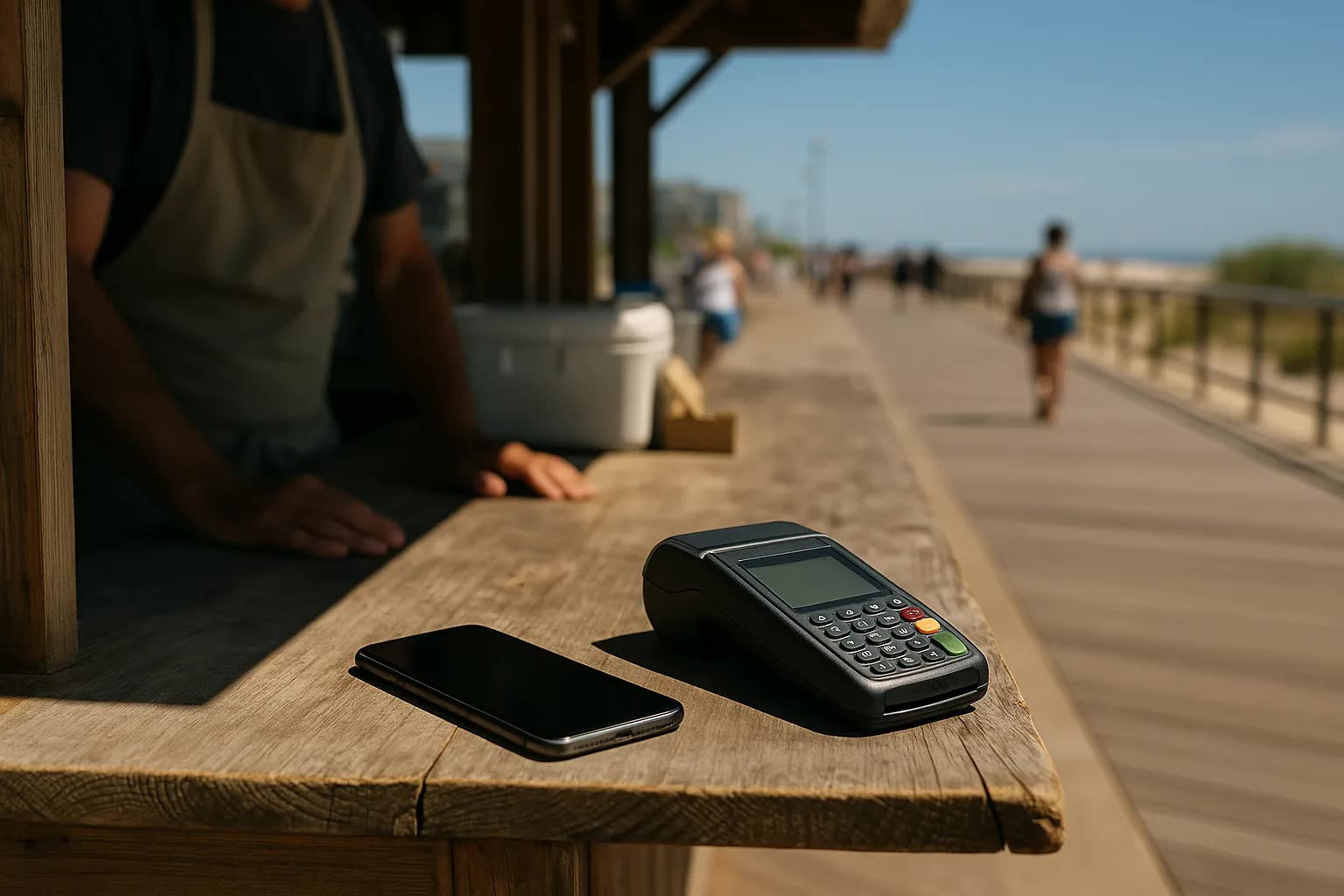
On a crowded Saturday last August, on the stretch of boardwalk between Beach 98th Street and the Rockaway Park ferry stop, a vendor named Marisol Diaz tapped a small black puck to a customer’s contactless credit card and completed a sale without a data signal, a paper receipt or a rolled-up stack of bills. The scene is becoming a routine one on Rockaway’s beaches, where merchants selling lobster rolls, cold drinks and handmade jewelry are turning to a new low-bandwidth payments app designed to work when cell service and Wi-Fi fail.
The app, called ShoreTap, was developed by a two-year-old Brooklyn startup, Coastline Labs, as an answer to a recurring summer problem: heavy crowds and shifting dune-topography that strain the island’s wireless networks and leave seasonal sellers unable to process card payments. Vendors who once relied on cash or cumbersome offline card readers say the simplicity of the phone-based app has cut lines, raised sales and reduced the need to close during sudden outages.
“I used to see customers walk away when my Square reader froze,” said Marisol Diaz, owner of Marisol’s Empanadas, whose cart sits near the Rockaway ferry terminal in Rockaway Park. “Now I tap, it beeps, and if the connection is bad it just stores the payment and finishes when a little signal comes back. I’ve also noticed tourists tip more when they can just use tap-and-go.”
Eli Navarro, founder and chief executive of Coastline Labs, said the app was intentionally engineered to use tiny packets of data, local Bluetooth handshakes and an encrypted store-and-forward method that completes transactions when devices briefly reconnect. “We built ShoreTap to assume no network,” Navarro said. “That lets sellers accept EMV contactless transactions in the middle of a crowded beach without the anxiety of a dropped payment.”
Local vendor organizations and micro-business advocates say the shift has been visible across neighborhoods. At the stretch of boardwalk by the Arverne Basin and under the shadow of the Rockaway Beach boardwalk stores near Beach 90th Street, at least a dozen carts and pop-ups are now equipped with ShoreTap pucks and free companion apps. Vendors in nearby Breezy Point and the parking lots near Jacob Riis Park have also tested the system on weekends and holiday surges.
The numbers underscore the rapid adoption. Coastline Labs says it signed up 72 vendors during its pilot this summer and on peak weekends processed roughly 1,400 transactions at an average sale of $18.50, with 62 percent of those transactions initiated in offline mode and later synchronized. The company charges a flat 1.2 percent processing fee on offline transactions and 0.9 percent when a device is online; the hardware puck retails for $79 and comes with a seasonal software plan that ranges from $29 to $99 depending on features.
Some vendors have been skeptical of relying on a private app for what used to be simple cash exchanges. “You still need cash for the guy selling sunscreen in the sand,” said Rafael Gomez, president of the Rockaway Vendors Association. “But for food and larger purchases, ShoreTap has been a game changer. It’s lowered theft risk and made bookkeeping easier, and that matters when you run a family business between Beach 116th and Beach 126th.”
City officials say they are watching the technology but have not endorsed any single provider. A spokesperson for the Department of Small Business Services, who asked to remain unnamed to discuss informal conversations, said the city is exploring small grants and training sessions to help seasonal sellers adopt low-cost payments tools, particularly in neighborhoods where tourism spikes strain infrastructure. Meanwhile, the U.S. Coast Guard and local parks managers have flagged concerns about electronic waste and lost devices after heavy storms, prompting calls for better durability standards.
Payment-industry analysts say the Rockaway example points to a broader trend in the post-pandemic economy: tools designed for unreliable networks and distributed commerce. “Retail is moving to the edge,” said Anika Bell, a payments analyst at Shoreline Insights, who spoke via email. “You’re not going to solve connectivity overnight in places with temporary, high-density crowds. Offline-capable EMV solutions and low-bandwidth synchronization are a practical middle path that reduces friction and lowers barriers for micro-merchants.”
Back on the boardwalk, vendors are already thinking about next season. Coastline Labs plans to roll out firmware updates in spring that add multi-device syncing and better receipt printing for small kiosks, and local vendors are organizing training sessions in January at the Rockaway YMCA and a rented storefront near the ferry terminal. “We’re trying to make this durable,” said Navarro. “If we can give a vendor confidence that they can take a tap on a packed July day and get paid by dinner, that changes how they do business.” The promise of that reliability is what many sellers say will keep them from reverting to cash when the 2026 season begins.