Rooftop Yoga Studios Find a Foothold in Queens
Rising demand for outdoor classes has turned underused rooftops above neighborhood garages and storefronts into year-round practice spaces.
By Evelyn Torres · March 7, 2026 · 4 min read
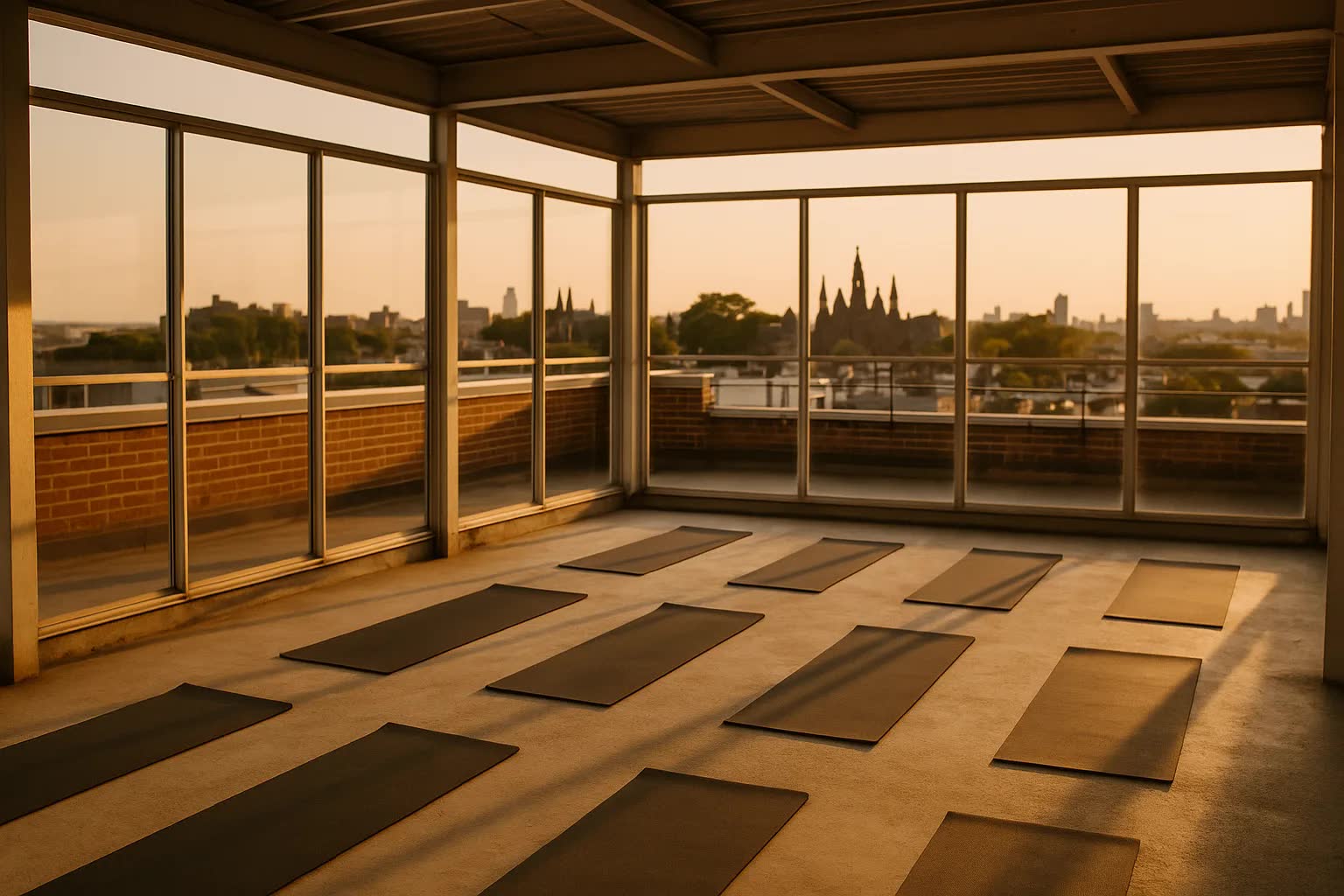
NEW YORK — When morning light hits the corrugated rooftops above a string of auto shops on 34th Avenue in Astoria, the usual rumble of the borough’s service economy gives way to the muted cadence of breath and instruction as rooftop yoga studios have begun to stake a year-round claim across Queens, turning underused garage and storefront roofs into an unlikely new frontier for wellness.
The trend has taken hold in blocks that once felt purely industrial: a chiropractor’s storage roof in Jackson Heights now hosts sunrise vinyasa, a hardware store on Queens Boulevard unrolled synthetic turf for evening restorative classes, and a car-repair garage off Skillman Avenue in Sunnyside bills weekend power-flow sessions with a skyline view. 'We saw an empty, safe space with good airflow and a view — it was a natural fit,' said Marta Alvarez, owner of Sunflower Garage Yoga, which opened a 600-square-foot rooftop studio above her sister’s repair shop on 34th Avenue in late 2024. 'People want to be outside but protected, and we can offer that without the overhead of a storefront.'
Converting these rough-hewn spaces has required improvisation and a new set of small-business tools. Teachers and landlords are buying portable decking, roll-out turf, retractable canopies and propane-safe heaters; many install lockable storage and battery-powered speaker systems to avoid drilling into roof membranes. 'We spent about $12,000 upfront on decking, windbreaks and a canopy, and then another $4,500 on a winterization kit,' said Luis Ramos, director of operations at Ridgecrest Properties, which leases two small roofs in Ridgewood to local instructors. 'It’s a capital investment, but the rent premium we can charge for a rooftop slot covers that in six to nine months.'
The growth has been measurable. Citywide permit filings for temporary assembly on rooftops in Queens rose from an estimated 6 applications in 2022 to 28 in 2025, according to a tally of DOB-facing filings by local compliance consultants; average class sizes have stayed small, typically 12 to 18 participants, and the standard occupancy cap set by most building owners ranges from 15 to 30 people. Average hourly rental for a rooftop class slot in Queens runs between $50 and $85, instructors reported, while monthly lease arrangements for sustained pop-up studios fetch $700 to $3,000, depending on location and access to amenities.
Instructors say the clientele spans long-time neighborhood residents and newcomers drawn by the novelty and relative safety of outdoor practice. 'Our evening sunset flows in Long Island City started as a pandemic pivot and are now our most popular classes — you can see the Manhattan skyline and the sun dip behind Gantry Plaza State Park,' said Aisha Patel, lead teacher with Queens Rising Yoga, which runs a weekly schedule atop a former deli near Vernon Boulevard. 'We have retirees, parents pushing strollers, tech workers and students; it’s the kind of mixed community class that indoor studios rarely capture.'
Not everyone has welcomed the new uses without question. Neighbors and small-business owners have raised concerns about noise, privacy and liability at community meetings in Astoria and Elmhurst, prompting several back-and-forths before approvals. 'We support small businesses, but we also have to think about early-morning noise for residents above these shops and the safety of putting 20 people on a roof that wasn’t built for gatherings,' said Jorge Menendez, president of the Astoria Neighborhood Association. 'There’s also the matter of insurance and who is responsible if something goes wrong.'
The economics of rooftop leasing are a clear incentive for property owners navigating steep Queens tax bills and rising maintenance costs. Owners reported net monthly gains of roughly $1,200 to $2,800 from rooftop leases, depending on how often classes meet and whether instructors share revenue. For several mom-and-pop storefront proprietors, that extra income is helping pay for roof repairs, new HVAC units and pandemic-era debt, while independent instructors find they can run classes with lower studio costs and pass savings along to students.
Compliance remains a tangle of rules that varies by building type and roof construction. Fire safety measures, egress plans and non-penetrating ballast systems for canopies are frequent sticking points during DOB and FDNY inspections, and many operators hire consultants to prepare filings. 'Rooftop wellness is new enough that inspectors and owners are learning in real time,' said Marina Gupta, an independent code consultant who has shepherded five Queens rooftops through the approval process. 'Insurers will ask for event- and capacity-specific language, and in some cases new railings or reinforced access points are necessary.' A senior DOB planner who requested anonymity added, 'We’re seeing creative reuse but also the need for clear documentation; permits help establish who is accountable.'
The rooftop movement has also produced an equity layer: several studios offer sliding-scale pricing, donation-based classes and free slots for seniors through partnerships with local nonprofits. Queens Care Collective, an East Elmhurst nonprofit that runs wellness outreach for older adults, booked weekend gentle-yoga classes last winter at a subsidized rooftop in Woodside. 'Being outdoors made a huge difference for our participants’ mobility and mood,' said Selena Ortiz, program director at Queens Care Collective. 'We’re working to make sure access isn’t just for those who can afford boutique prices.'
As rooftops become a more visible part of the borough’s wellness ecosystem, operators and regulators say the model will keep evolving with weather-ready infrastructure, clearer permitting pathways and new neighborhood clusters beyond Astoria and Long Island City into Flushing and Ridgewood. For now, patchwork studios are laying the groundwork for what could become permanent fixtures in Queens’ streetscape, marrying small-business resilience with a borough-wide appetite for healthier, open-air community spaces.