Saffron and Silk: Jackson Heights' South Asian Fashion Houses Go Digital
Longstanding tailors and boutique ateliers are pivoting to online platforms and livestreamed fittings to reach diasporic customers across the tri-state area.
By Omar Haddad · April 23, 2026 · 4 min read
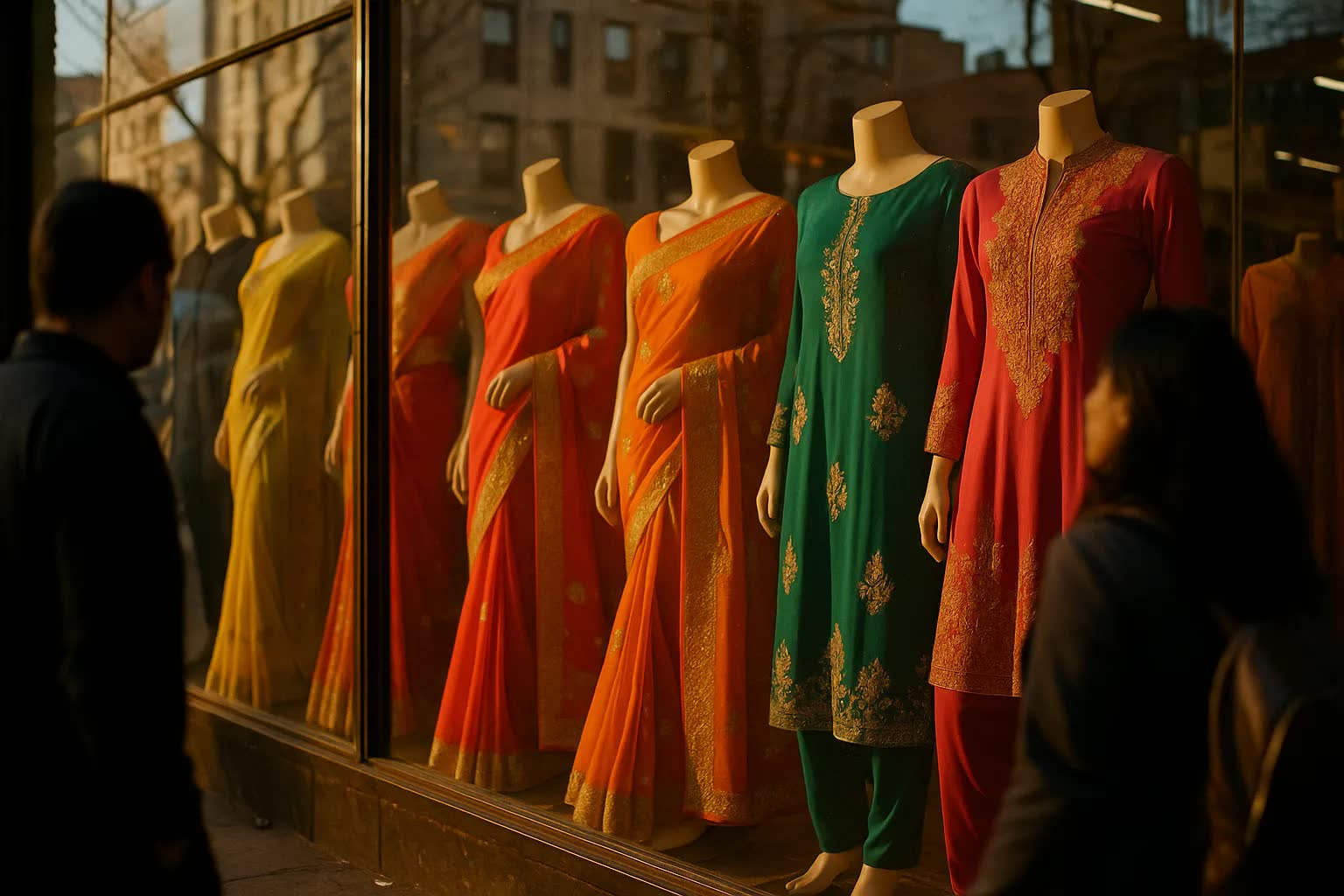
NEW YORK — On a damp Thursday morning in Jackson Heights, the air still carried the faint scent of turmeric from a nearby grocery stall as tailors on 74th Street clicked through customer lists on tablets and adjusted the lighting for a livestreamed fitting scheduled for customers in Edison, N.J., and Murray Hill in Manhattan; what once fit into back rooms and cramped ateliers has been refitted for a digital diaspora, and the neighborhood’s century‑old sartorial trade is scrambling, innovating and, in many cases, prospering online.
For generations, storefronts along Roosevelt Avenue and the 37th Avenue corridor housed small-scale tailors and sari boutiques that processed orders in person, draped customers on wooden mannequins and trusted word-of-mouth referrals from block parties and temple gatherings. The post-1990s wave of South Asian immigration turned Jackson Heights into a regional hub for wedding trousseaux, everyday kurtas and hand-embroidered lehengas; today those same businesses are learning to sell through Instagram storefronts, WhatsApp catalogs and bespoke livestreams that reach a customer base scattered across the tri-state area.
Saffron & Silk Atelier, a family operation on 82nd Street NW from what owner Rina Desai calls “the old sari row,” built a makeshift studio last spring beneath a second‑floor window and began scheduling hourly fittings on Zoom and Instagram Live. "We learned to show fabric swatches in high resolution, to pin virtually and, in time, to explain the difference between hand-zari and machine tilla on camera," Desai said. "If a mother in Staten Island can’t come in for her daughter’s wedding, we have to make sure she still feels the weight of the fabric through the screen."
The mechanics vary. Some ateliers send sample swatches via an overnight courier to a customer’s address, then host a short live session in which the client holds swatches up to the light while an in-house stylist shows matching borders and blouse linings. Others use tailored apps that overlay measurements on a smartphone photo, and a handful of boutiques have begun experimenting with augmented-reality filters that show a sarong or sherwani on a user’s frame. For alterations, tailors from Jackson Heights and nearby Elmhurst coordinate with drop-off points in Jackson Heights' community lockers or trusted dry-cleaners in Astoria to reduce cross-borough transit.
The digital shift has produced measurable results. In a December survey of 34 Jackson Heights apparel businesses conducted by the Jackson Heights Merchants Coalition, 26 reported launching an online sales channel since 2023; among those, the median increase in revenue attributed to digital sales was 37 percent. Saffron & Silk reported that 48 percent of its 2025 bridal orders came through livestream consultations, up from 9 percent in 2022, and one storefront, Zia Tailors on 74th Street, recorded peak livestream viewership of 3,100 unique viewers during a weekend sample‑sale presentation in October.
Customers in the suburbs and farther afield say the online transition has changed how they shop. "I used to coordinate fittings during a weekend visit to Queens; now I do them from my kitchen table in Jersey City between work calls," said Amina Qureshi, president of the Jackson Heights Merchants Coalition, who has relied on neighborhood tailors for two decades. "There’s a comfort in the continuity — familiar names, familiar craftsmanship — even if the interaction is through a screen."
Yet the pivot has not been seamless. Smaller shops face higher per‑order shipping costs when sending hand-stitched garments and swatch packets; fragile embellishments can arrive damaged, prompting expensive remakes. Some older tailors say the speed and scale of e-commerce has challenged an artisanal rhythm. "A good fitting used to take empathy and time; online, there’s pressure to close the sale in 30 minutes," said Sunil Bhatt, a master tailor who has worked behind the same Singer machine for 28 years and who asked that his job title be used when he described how younger staff juggle streaming with handwork.
There is also a generational tug. Younger shop managers are eager to automate inventory and integrate with marketplaces that promise larger reach, while veteran stitchers insist on preserving hand techniques, embroidery apprenticeships and the in-person ritual of a bridal fitting. Nonprofit sewing schools and two neighborhood ateliers have started weekend apprenticeship programs at Travers Park to teach a new cohort of seamstresses traditional embroidery and block-printing; organizers say the classes are meant to translate into digital content as much as into finished garments, producing Instagram reels that spotlight the craftsmanship behind each order.
Local commerce advocates are watching for scalability. The Jackson Heights Merchants Coalition is in talks with a Queens-based logistics firm to create a pooled-swatches program that would reduce individual shipping costs and ensure temperature-controlled handling of zari threads and delicate beads. "If we can standardize a few backend systems — pooled shipping, shared photography standards, a calendar for livestream slots on festival weekends — small businesses can compete with larger platforms without losing what makes them unique," Qureshi said.
Beyond numbers and tech, neighborhood tailors say the shift is altering the cultural topography of Jackson Heights for the better and the more complicated: boutiques once known only to local brides are now virtual ambassadors for a diasporic taste that blends tradition with city pragmatism. As Diwali and wedding season approach, the next few months will test whether Jackson Heights’ sartorial community can scale humane, high-quality craftsmanship into a thriving digital model; for many in these storefronts, the goal is not just survival but a future where a silken lehenga made on 37th Avenue can arrive at a Brooklyn brownstone with the same care as it would in person.