“You Have a Document Waiting”: The Scam Calls Targeting Chinese Students Before Fall Term
Callers posing as consulates and delivery services rotate through numbers until someone answers, then escalate to fake police, forged warrants, and demands for silence — a script that has cost individual students tens of thousands of dollars.
By Aspen Yang · August 10, 2026 · 4 min read

Callers posing as consulates and delivery services rotate through numbers until someone answers, then escalate to fake police, forged warrants and demands for silence — a script that has cost individual students tens of thousands of dollars.
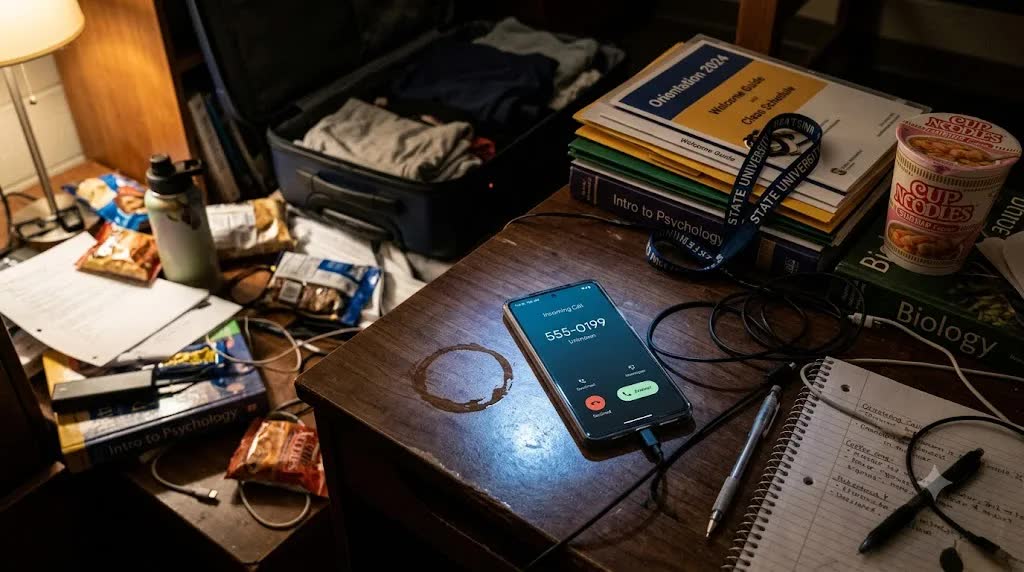
It usually begins with a recorded voice in Mandarin: you have an important document waiting to be collected. Press 9 to speak to a representative. If nobody picks up, the call comes again an hour later from a different number, then a different one after that.
That pattern, the same message rotating through a churn of numbers, is the tell. Consulates do not cold-call people about paperwork. The Chinese Consulate General in New York has said flatly that it never issues package or delivery notifications by phone, never asks for bank account or Social Security numbers on unsolicited calls, and never routes anyone into a "police inquiry" over the line. Every such call, the consulate says, is fraudulent.
The warning lands as roughly a million international students prepare for the start of the fall term, and as the first arrivals, jet-lagged, without a local bank account, unsure who is allowed to call them, become the easiest people in the country to frighten.
The four-step script
Federal investigators have mapped the scheme with unusual precision. The FBI's Philadelphia Field Office, which has tracked a rise in these cases since 2022, describes a scheme that unfolds in four phases.
Step 1: The number on the screen appears to belong to a mobile carrier, a large retailer, a delivery company, or a Chinese embassy or consulate. The caller tells the student their personal information has surfaced in a financial fraud investigation.
Step 2: The call is passed to someone posing as an officer at a provincial public security bureau in China. He recites details of an alleged crime, threatens arrest, and sometimes presses the student to return to China for trial. Investigators say these callers often produce realistic-looking arrest warrants and documents, and display just enough real information about the victim to seem credible.
Step 3: This is the phase that does the lasting damage. Students are told to consent to round-the-clock video and audio monitoring — framed as proof of their innocence, or as a security requirement given the sensitivity of the case. They are instructed not to discuss the case with anyone, not to search the internet about it, and to report their daily movements.
Step 4: A wire to a Chinese bank account, presented as bail or as a demonstration of good faith.
The sums are not small. Police in West Lafayette, Indiana, said a 22-year-old Chinese student wired $69,800 across two transfers after a caller told him his identity was being used for crimes in China; he only learned the truth after asking his parents to check with police at home. Overseas cases run higher still. A student in Northern Ireland lost £200,000 to men in fake "Beijing Police" uniforms who contacted her online after an initial call about suspected money laundering.
Why freshmen
The script is built for people who have just landed. New students do not yet know which agencies can contact them or how. They are acutely aware that their visa status depends on staying out of trouble. And many are reluctant to call home about a problem in their first month, which is precisely the reflex the isolation phase is designed to exploit.
That same isolation makes the currency-exchange trap work. In WeChat groups and on Xiaohongshu, accounts posing as fellow alumni or upperclassmen from the same hometown offer exchange rates better than any bank. Some are simply laundering: they pay a student's tuition using stolen credit cards, the student sees the balance clear and sends over the yuan, and weeks later the charge is reversed. Others feed the same account details back into the impersonation pipeline. Private exchange arrangements can also expose students to legal exposure on both sides of the border.
Three rules
Rule 1. Do not press 9, do not confirm your name, do not call the number back. Rotating numbers and pressure to stay on the line are the signature.
Rule 2. Look up the number yourself. The Chinese Consulate General in New York lists 212-244-9392 and 212-244-9456, staffed weekdays 9 a.m. to 3 p.m. No legitimate agency will object to being called back on a published line.
Rule 3. Any instruction not to tell anyone, not to search online, or to submit to video monitoring is the scam confirming itself. Tell a roommate, a parent, or your international student office immediately.
Report losses to the NYPD by calling 911, or 311 for your local precinct; the NYPD does not ask crime victims about immigration status, and services are available in Chinese. File a complaint with the FBI at ic3.gov and with the Federal Trade Commission at 1-877-382-4357. Contact your bank the same day — a wire can sometimes be recalled if the request moves fast enough.