Small Builders Warn Material Shortages Could Undermine New Housing Rules
Updated city affordability mandates are increasing demand for modular and specialty materials, straining already thin supply chains.
By Omar Haddad · December 23, 2025 · 4 min read
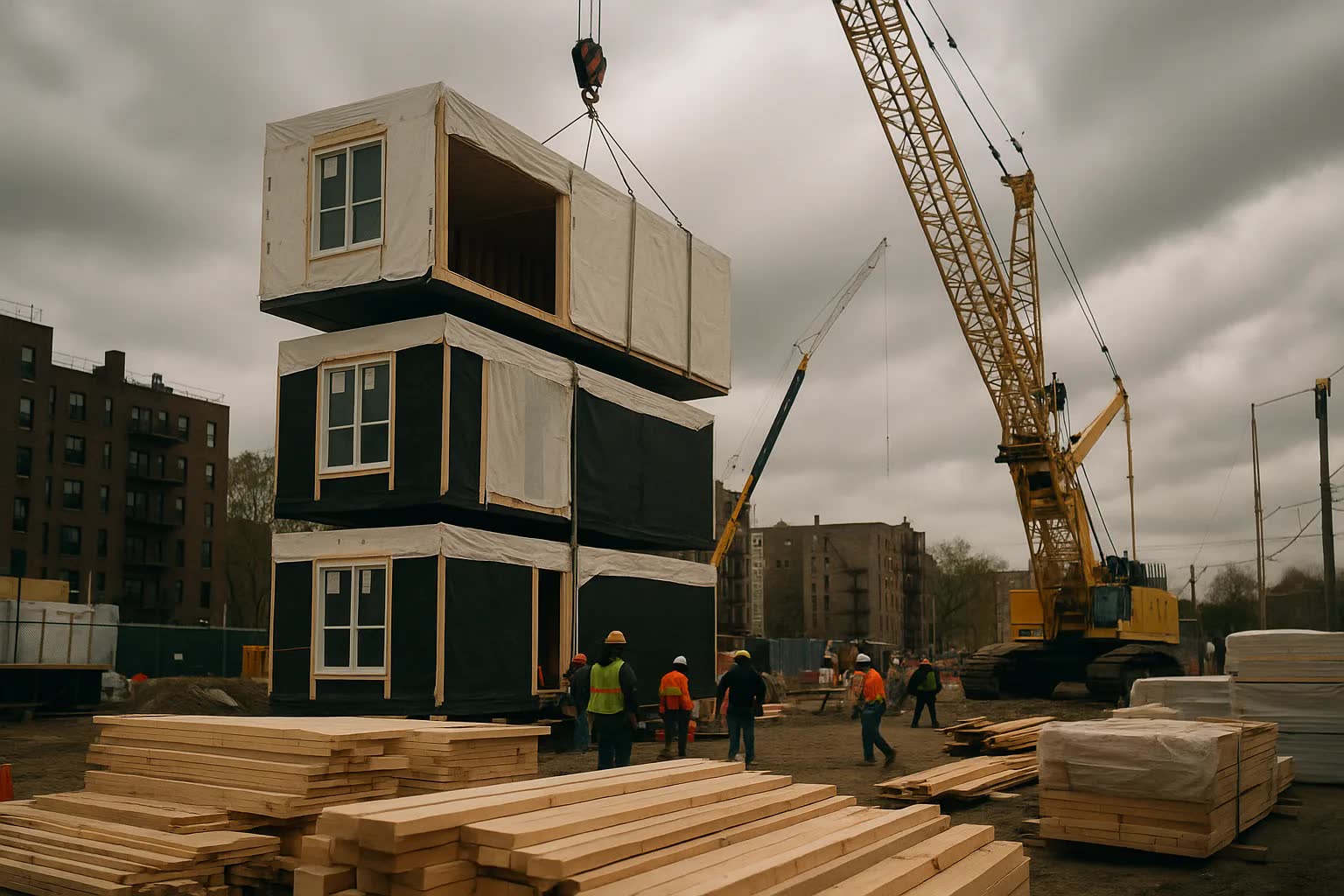
New York City’s updated affordability mandates, designed to steer thousands of new units toward lower rents and higher sustainability standards, are colliding with a less visible reality: a strained supply chain for modular and specialty building materials that small developers say could delay — and in some cases derail — projects across neighborhoods from Gowanus to the South Bronx.
The rules, adopted by the city earlier this year under a package officials call the New Housing Affordability Standards, require that a growing share of new affordable units include factory-built components such as modular bathroom pods, preassembled MEP (mechanical, electrical and plumbing) stacks and cross-laminated timber (CLT) floor panels to meet emissions and speed targets. City planners say the components reduce onsite waste and accelerate timelines, but small builders argue the mandate shifts supply risk onto contractors and the cost of scarce materials into narrow margins that define neighborhood-scale developments.
“We can’t bid projects anymore with certainty,” said Rosa Delgado, principal of Delgado & Sons Construction, a family-run general contractor that has built townhouses and low-rise apartments in Williamsburg and Bushwick for two decades. “Our supplier for bathroom pods has a 10-month backlog; our banks won’t extend cash until the pods are staged on site. That’s not how small contractors survive.”
Trade suppliers and fabricators say the crunch is real and multifaceted. Several East Coast modular plants that serve New York City report capacity constraints after a national surge in orders, while CLT producers in the Pacific Northwest and Canada are prioritizing larger institutional contracts. “There’s a mismatch between the city’s timeline and the industry’s current throughput,” said Mei Chen, procurement manager at Harbor Modular in Red Hook, which supplies prefabricated units to contractors throughout Brooklyn and Manhattan. “We need more local manufacturing and faster permit turnarounds to staff more shifts without ballooning costs.”
Concrete, industry-level numbers illustrate the pressure: builders in the city filed roughly 3,400 permits this year that specified some form of factory-built component, a 37 percent increase from 2024, according to internal estimates circulated among builders and lenders. Average lead times for modular bathroom pods have stretched from 12 weeks in 2023 to between six and 14 months in 2025; CLT panel prices have climbed about 22 percent since 2023. Small firms, which account for an estimated 42 percent of new affordable-housing permits citywide, report that their working capital requirements have increased by an average of 18 percent due to longer staging schedules and extended payment cycles.
City officials acknowledge the bottlenecks and say they are pursuing short-term and structural fixes. “We are expanding procurement partnerships, expediting local factory certifications and offering conditional waivers for small projects while we scale up capacity,” said Deputy Commissioner Elena Park of the fictional Department of Housing and Urban Renewal, which oversees implementation of the standards. The agency has proposed offering reduced-cost city-owned lots for small modular factories in Staten Island and the South Bronx and is drafting incentive packages to attract domestic CLT production lines.
Financial institutions serving the niche also describe tightening terms. Community lenders and smaller banks that traditionally underwrite neighborhood-scale housing are increasing reserves against extended construction timelines, which can push loan costs higher for builders. “Our underwriting models didn’t account for a yearlong wait for a pod,” said Aaron Weiss, head of commercial lending at Borough Bank of Queens, which finances rehab projects in Astoria and Jackson Heights. “We’re seeing an uptick in requests for interest reserves and performance guarantees; small contractors don’t always have the balance-sheet depth to absorb those requirements.”
The squeeze is already tangible at the jobsite level. A 40-unit mixed-income project slated for 3rd Avenue in the Lower East Side saw its occupancy date moved from late 2026 to mid-2027 after a supplier in Ohio reprioritized shipments toward larger national developers. At the same time, a three-building affordable complex in Morrisania in the Bronx paused work for six weeks awaiting CLT floor deliveries, forcing subcontractors to reschedule and in some cases lay off workers temporarily, according to project managers and neighborhood residents who requested anonymity to discuss contractual disputes.
Small builders and trade groups are pushing for pragmatic changes: phased compliance schedules that give smaller projects more time to source components, a municipal cooperative to aggregate orders and secure bulk pricing, and interim exemptions for projects under a certain unit threshold. “We support the city’s goals on affordability and climate performance,” said Maya Singh, executive director of the New York Small Builders Coalition. “But policy must match market capacity. Without staged implementation and public investment in local fabrication, the rules risk privileging large developers who can command supply and capital, while eroding neighborhood developers who actually deliver the bulk of smaller affordable projects.”
As the city moves into a new year of hearings and potential regulatory tweaks, stakeholders are watching whether municipal incentives and private investment will fill the manufacturing gaps or whether the mandates will be softened to reflect market realities. For many small builders who have staked reputations and savings on neighborhood projects from Flushing to Gowanus, the coming months will determine whether the new rules deliver the promised wave of affordable, sustainable housing — or whether they will force a costly retreat to conventional, on-site construction that undercuts the city’s climate and affordability goals.