Small Businesses in Sunset Park Back Citywide Delivery-Scooter Ban
Local merchants argue that e-scooters and delivery bikes undermine sidewalk access and customer safety as legislative momentum grows.
By Dominic Russo · May 3, 2026 · 4 min read
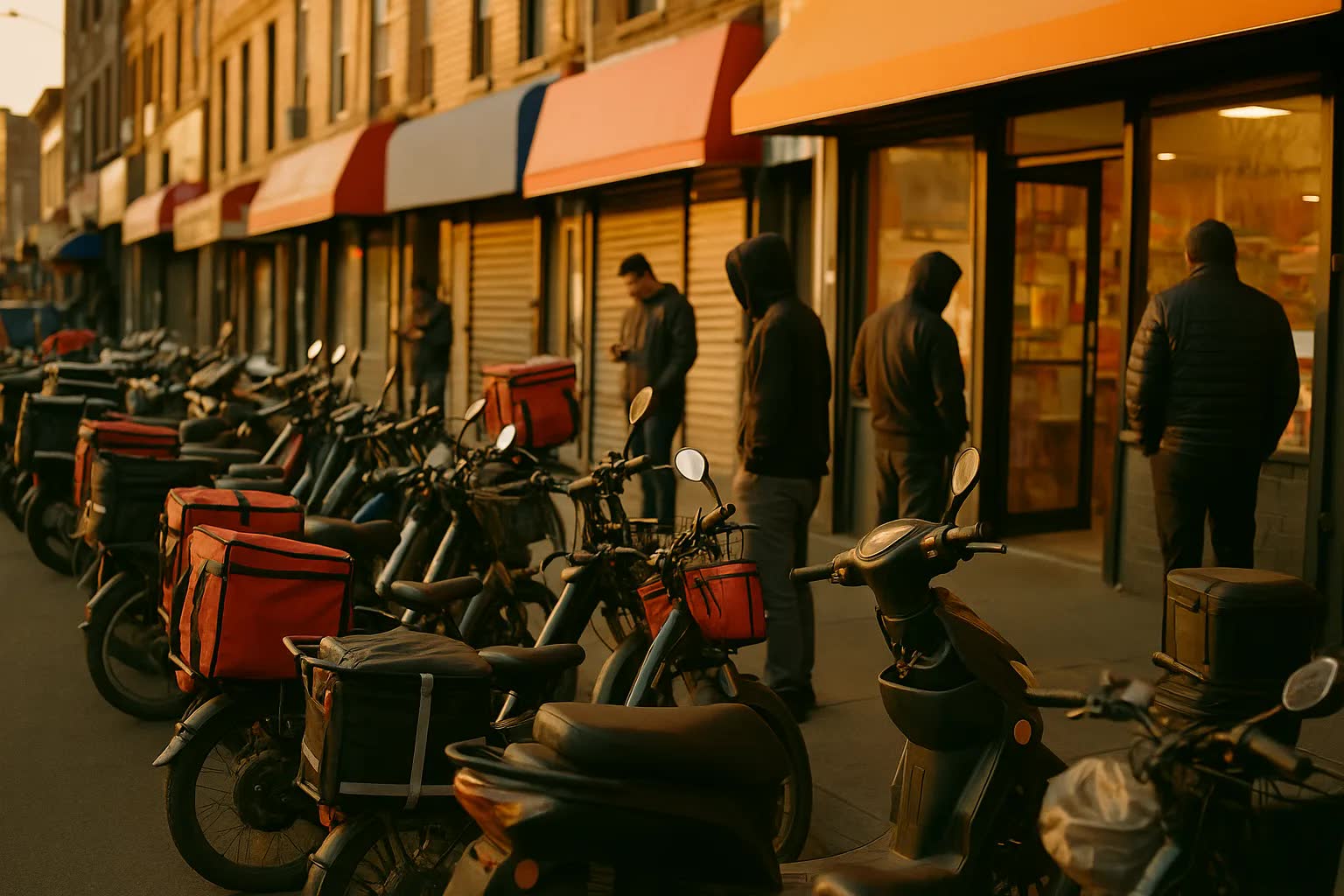
On a bustling stretch of Fifth Avenue in Sunset Park, delivery scooters and electric bikes have become as routine as produce stands and cup-of-noodle lines — and local merchants say enough is enough. Owners of bodegas, bakeries and family-run restaurants are backing a proposed citywide ban on motorized delivery scooters, arguing that the vehicles crowd narrow sidewalks, threaten the safety of elderly customers and shoppers with strollers, and undercut the ordinary rhythms of neighborhood commerce as lawmakers in City Hall weigh new limits.
"We have people stepping into the street because the sidewalk is full of stacked delivery bikes," said Maria Alvarez, owner of La Central Bakery on 38th Street, pointing to a line of parked e-bikes outside a Chinese takeout at the corner. "I had a customer trip last winter; she broke her wrist. I want my customers to feel safe coming through my door. The city has to act." Alvarez said her lunch rush has thinned as foot traffic diverts to clearer routes a block over.
Merchants formed a loose coalition last month, the Sunset Park Merchant Alliance, to press the case for a ban and to share footage of near-misses and blocked storefronts. "We are not anti-technology — we are anti-chaos," said Jamal Reed, the alliance president and owner of a neighborhood hardware store on Fifth Avenue. "When a delivery rider leaves a scooter leaning against our sandwich board or chained to a lamppost, it displaces customers and creates liability for us. We need rules that preserve the right to a safe sidewalk."
Supporters of a ban point to data they say shows a rising pattern of nuisance and danger. In an informal survey of 186 neighborhood businesses from Sunset Park through Bay Ridge conducted by the alliance in April, 74 percent said delivery scooters had reduced pedestrian access outside their storefronts; 61 percent reported at least one customer collision or near-miss in the past 18 months. Citywide, merchants and community groups counted 312 complaints about sidewalk obstruction tied to commercial e-scooters in Brooklyn last year, and police records obtained by the alliance showed 1,258 incidents involving scooters and pedal‑assist deliveries in the five boroughs between 2023 and 2025, including 47 reports of injuries requiring emergency medical attention.
The legislative effort — a bill introduced last month by Councilmember Ana Vega, who represents parts of southwest Brooklyn — would prohibit commercial motorized scooters and e-bikes from making deliveries within city limits, while preserving personal mobility devices for private use under existing rules. Vega's office framed the measure as an equity and safety intervention, saying narrow sidewalks in older neighborhoods put seniors and people with disabilities at disproportionate risk. The bill has drawn rapid attention at a time when council committees are reopening hearings on street safety and accessibility.
Not everyone in the delivery ecosystem supports a ban. Riders and some independent courier groups warn of job losses and slower service for small restaurants that rely on rapid, low-cost deliveries. "Banning commercial scooters will force us onto the subway or into cars, which is more dangerous and less efficient," said Sofia Park, a coordinator at Sunset Pedal, a local cooperative of bicycle couriers. "There are solutions like loading zones, enforcement against sidewalk parking, and rider training that don't eliminate livelihoods."
City officials acknowledge the tensions. A senior Department of Transportation planner who requested anonymity said enforcement of existing parking and safety rules has been inconsistent, particularly in outer-borough corridors with high delivery volumes. "Our challenge is twofold: how to enforce rules without pushing workers into riskier behavior, and how to design curbs and sidewalks in older parts of the city that were not built for today's delivery density," the planner said. DOT installations of designated curb micro-depots and delivery corrals are in pilot phases in parts of Manhattan and Brooklyn, the planner added, but scaling them will require investment and coordination with private platforms.
On Sunset Park's commercial corridors, small business owners say pilots and piecemeal enforcement have rarely reached them. "They painted a box on Ninth Street once and put two bike racks near Industry City, but the riders don't use them," said Ernesto Castillo, owner of El Fogón Taqueria on 39th Street. "We need a rule that changes incentives. Right now, it is cheaper for a driver to leave a scooter on the sidewalk and make the next run than to spend time finding legal parking. Customers lose patience and we lose sales."
Community organizations are lining up on both sides. The Sunset Park Community Board 10 held an emergency meeting this week where members voted to back the proposed ban and asked the city for clearer enforcement plans and exemptions for medical delivery. "Our walkways should be safe for people of all ages," said Lucia Mendes, chair of the community board. "We are asking for a policy that balances jobs and safety, but the current status quo is untenable for street-level businesses and seniors who depend on unobstructed sidewalks to do basic shopping."
As the bill moves through hearings, advocates say the debate will focus on the practicalities of enforcement, economic impacts and the availability of alternatives such as designated loading zones, micro-distribution hubs and expanded off-hour delivery. City Council staff have scheduled a public hearing in late May, and coalition leaders in Sunset Park say they will bring dozens of business owners and residents to testify. "We want to be part of designing the solution," Reed said. "If the city is serious about safe streets, then it must align policy with the realities on 5th Avenue and beyond. Otherwise, we will have only more scooters, more hazards and fewer customers for the small businesses that knit our neighborhoods together."