Small Food Trucks Navigate New Midtown Regulations
Operators complain the permit overhaul and tighter parking rules are squeezing itinerant vendors who rely on office crowds.
By Diego Alvarez · March 16, 2026 · 5 min read
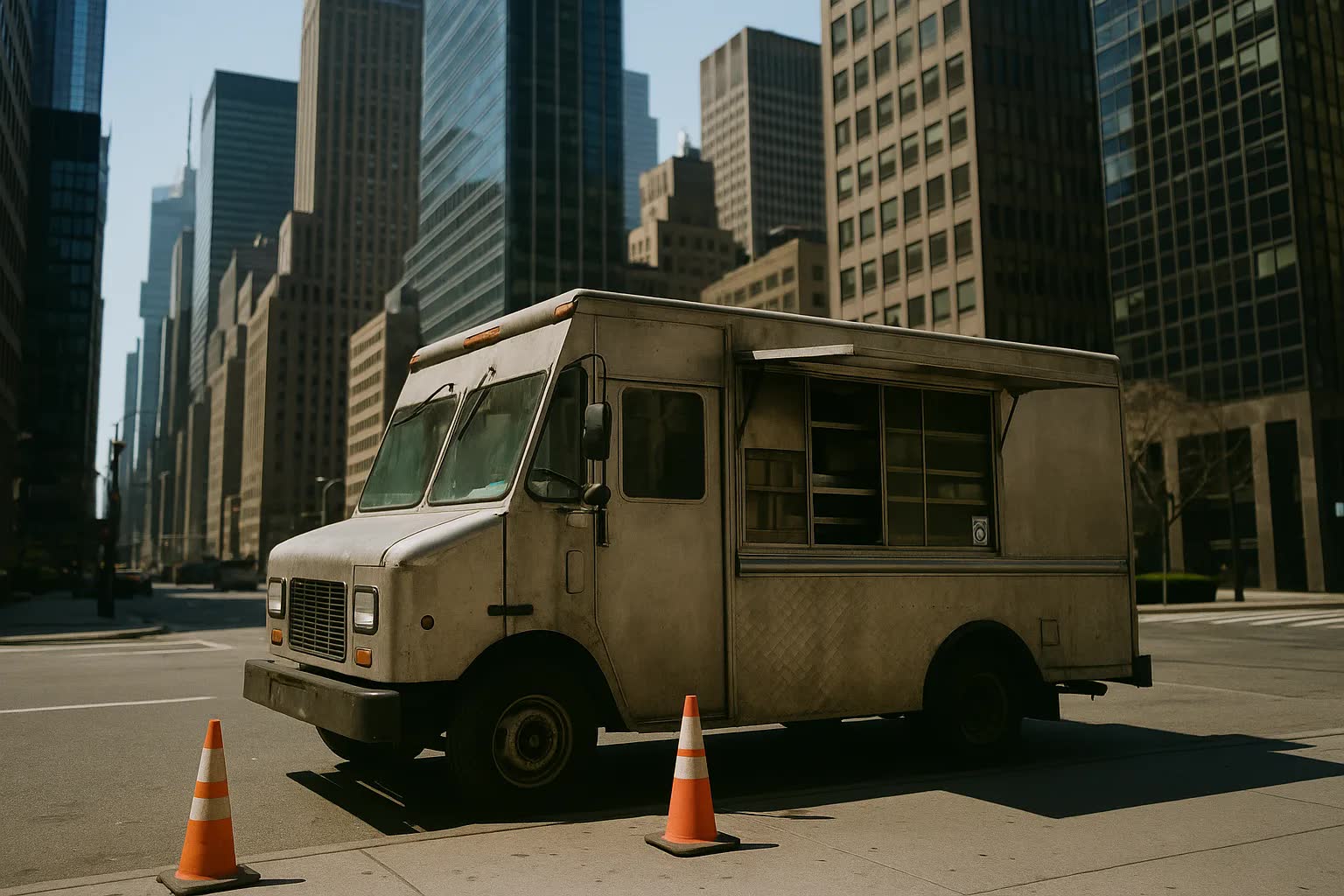
On a gray Monday morning at Bryant Park, a line of food trucks that once drew office workers from nearby law firms and media companies sat silent, their generators off and shiny service windows closed as new Midtown rules reshaped where and how itinerant vendors can operate. The permit overhaul and a tightening of curbside parking rules announced by the city this winter have left owners scrambling for legal spaces and reliable customers, and many say the changes amount to a squeeze on the small, mobile businesses that depend on the late-morning and lunchtime office rush that is returning in fits and starts to Midtown Manhattan.
City officials framed the changes as a curb-management response to rising pedestrian volumes and delivery congestion in Midtown, particularly along corridors like Sixth Avenue, between West 33rd and West 42nd streets, and near transit hubs such as Grand Central Terminal. Under the new plan administered jointly by the Department of Transportation and the Department of Small Business Services, vendors must now apply for consolidated mobile-vendor permits tied to specific commercial corridors, observe new two-hour parking caps in formerly unrestricted metered lanes, and display scannable permits linked to GPS coordinates.
Operators said the combined effect has been immediate and severe. "We're getting squeezed out of the places that pay the bills," said Miguel Santos, owner-operator of Big Apple Arepas, who has parked on West 39th Street near Bryant Park for six years. Santos said his weekday lunch customer count has dropped as much as half since enforcement patrols began citing trucks that linger past the two-hour limit, and that his staff of three has been reduced to one. "There used to be a line from the park entrance to the light post. Now people walk right by because their desks are on a deadline and there's nowhere to stand and eat."
Advocates for street vendors say the rules pay insufficient attention to the economic role of mobile food businesses and to patterns of post-pandemic commuting. "The new zoning strips itinerant vendors of flexibility at a time when many have yet to fully recover their pre-pandemic revenues," said Leah Kim, director of the Street Vendor Alliance, a citywide advocacy group. "These are predominantly small, immigrant-owned operations that rely on the ability to follow foot traffic. Fixing curb access for trucks should not require a four-page legal brief and a $1,000 permit renewal fee every year."
The numerical impact is stark on paper. Under the new ordinance, the city consolidated 1,200 separate neighborhood vendor permits into 800 corridor-based permits for Midtown, a 33 percent reduction in slots available for mobile service between 34th and 42nd streets. Annual administrative fees were raised from $375 to $1,150 for a corridor permit, and fines for overstaying a permitted curb space rose to $500 per violation from $150. Enforcement patrols issued roughly 1,240 citations in the first month after the rules took effect, and city officials estimate a 28 percent average drop in foot-traffic sales reported by registered vendors on impacted blocks.
City officials say the program prioritizes pedestrian safety and predictable curb access for deliveries and mass transit. "What we heard from building operators and transit agencies was that curb space had become chaotic and unsafe during peak hours," said a senior DOT traffic planner who requested anonymity to discuss the internal rollout. The planner added that deployment of designated loading bays, timed parking, and real-time permit scanners should eventually reduce double-parking and conflicts with buses and bike lanes, especially around Herald Square and the edges of Times Square, where pedestrian flows are dense and unpredictable.
For some operators, the math of relocation is already untenable. "I tested Union Square for two weeks and didn't cover my fuel and commissary costs," said Asha Patel, owner of Maple & Spice, a halal cart turned boxed-lunch truck that previously made steady lunch runs up to 49th Street outside several advertising agencies. Patel said her average daily gross fell from about $880 to $520 on the new regulated corners, and that the $50-a-day commissary fee for indoor food prep eats into thin margins. "I can either park legally in Queens and subway into Midtown, or find a corner in midtown and risk a $500 ticket every other day. Neither is a sustainable business plan."
Commercial property managers and some brick-and-mortar restaurateurs offered tempered support for the regulations, saying they answered long-standing concerns about sidewalk crowding and blocked delivery zones outside large office towers such as the cluster around 7th Avenue and West 42nd Street. "We've long advocated for rational use of curb lanes so that suppliers can make timely deliveries and office employees can access the sidewalk without obstruction," said Eleanor Vargas, manager of a Midtown office tower for a regional real estate firm. Still, Vargas acknowledged that enforcement outcomes have been uneven and that a better balance between serving storefront deliveries and supporting the small mobile vendors is needed.
Vendors' legal advocates have already signaled challenges to the ordinance, and several groups are pushing for a phased implementation that would preserve a set number of itinerant slots for trucks that can prove historical patterns of service. The Department of Small Business Services said it will open a vendor help desk at an outreach office on West 34th Street next week to assist with reapplication and GPS registration, and the DOT has promised to evaluate the two-hour cap in high-demand blocks after a 90-day pilot. Meanwhile, some operators reported exploring shifts to earlier breakfast routes, catering contracts with nearby fitness studios, or relocation to neighborhood clusters in Chelsea and Long Island City where permit pressure is lower.
City councilmembers have scheduled an oversight hearing in mid-April to review early enforcement data and vendor complaints, and advocates on both sides say the hearing will be pivotal. For now, vendors like Santos are trying to adapt, adjusting menus for quicker takeaway and scouting legal curb slots near Grand Central and the east side lunch corridors. "We want to work with the city, not fight it," Santos said, standing by his closed truck and watching the office buildings fill with commuters. "But unless there are practical corridors where we can park and serve people who are actually at work, a lot of us won't be around to come to that hearing."