Solar Retrofit Trends Catch On in Historic Brownstones
Architects and preservationists are collaborating on low-visibility solar installations tailored to landmarked facades and roofs.
By Daniel Rodriguez · March 7, 2026 · 4 min read
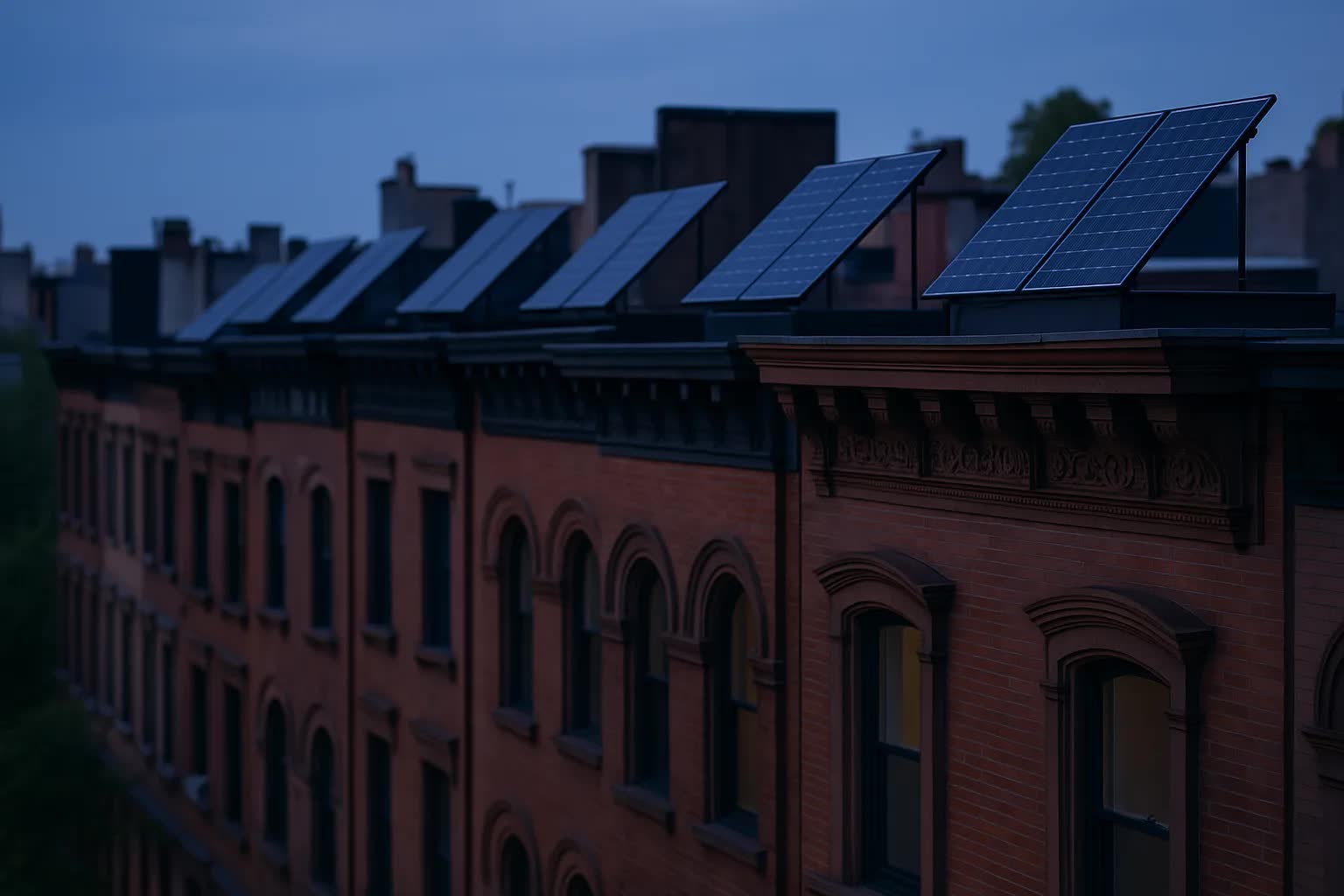
NEW YORK — A new wave of low-visibility solar retrofits is spreading through the city's historic brownstone neighborhoods as architects, preservationists and small contractors find ways to marry clean energy with landmarked facades and corniced roofs, offering a model for climate action that both respects the city's architectural character and cuts household energy bills, particularly in Park Slope, Fort Greene, Harlem and the West Village where classic stoops meet modern climate urgency.
Design firms say the shift is as much about technique as technology. SolarCraft Architects, a Brooklyn firm that has worked on retrofit pilots near Prospect Park and along St. Luke's Place, favors flush-mounted photovoltaic shingles, microinverters hidden behind parapets and south-facing dormer optimizations that avoid altering cornices. “We learned early on that homeowners won't compromise on the streetscape,” said Lena Ortiz, principal at SolarCraft Architects. “So we made the panels part of the architectural seam rather than an add-on.”
Preservation groups have responded with a mix of cautious openness and strict standards. The Brooklyn Brownstone Conservancy has drafted a voluntary guideline for visual impact that emphasizes reversibility and color matching. “Our goal is to preserve sight lines and the human scale of historic blocks,” said James Callahan, director of preservation at the Brooklyn Brownstone Conservancy. “That means sometimes saying yes to rooftop installations that are invisible from the sidewalk and no to panels that break a continuous cornice or align with a primary façade.”
On Hoyt Street in Cobble Hill, an owner-managed retrofit completed last fall tucked slimline modules behind a 10-foot parapet, leaving the brownstone's stoop and bay windows unchanged while shaving about 30 percent off annual electricity use. Contractors from GreenRow Solar, a Fort Greene company founded by former Con Edison technicians, handled the install with a five-person crew over four days. The work is small-business labor intensive and has created a niche market for carpenters and roofers trained to blend solar mounts with historic masonry.
Citywide numbers suggest the trend is measurable. A survey this month by the Landmarks Retrofit Lab, a new research group based in Brooklyn Heights, found that permits for solar work on properties within designated historic districts rose 38 percent between 2022 and 2025, with 1,520 permits filed in 2025 alone. The typical project installed 2.8 kilowatts of capacity at a median cost of $38,000 after incentives, delivering an average reduction of 25 to 35 percent in annual electricity spending. The lab estimates that converting just 10 percent of qualifying brownstones could add roughly 4.5 megawatts of distributed solar to the city's grid.
Regulatory change has been incremental. The Landmarks Preservation Commission adopted a set of nonbinding guidance in 2024 that allowed low-visibility rooftop solar in many historic districts, but permits still require individual review and community-board input. “We are trying to balance aesthetic integrity with climate needs,” said Maya Singh, deputy director of the Landmarks Retrofit Lab, who consults with neighborhood boards across Manhattan and Brooklyn. “The practical step is clear standards for setback, color and mounting that speed approvals while protecting views from the street.”
Financing and workforce development are emerging as decisive factors. Local lenders and energy marketplaces now offer bundled contracts that pair installation with roof repair and a five- to eight-year repayment plan tied to expected energy savings. Community organizations such as the Northern Manhattan Retrofit Collective are training unemployed residents in solar mounting and masonry repair. “This is a place-based jobs program as much as an environmental one,” said Carlos Menendez, director of workforce programs at the Collective, which has graduated 48 trainees since 2023 and placed 32 with small contractors in Harlem and Washington Heights.
The movement has not been without disputes. Some homeowners and preservationists worry that small changes will add up to a new aesthetic that strays from district character. In a recent community board hearing on a proposed retrofit on Waverly Place near Washington Square Park, board members denied a certificate of appropriateness for panels visible from the pedestrian thoroughfare, citing cumulative visual impact. “We are not against solar in principle,” said Evelyn Torres, a resident and member of the Greenwich Village Preservation Coalition, “but we want strict rules so every block doesn't slowly morph into something unrecognizable.”
Citywide climate targets add urgency to the debate. Under Local Law 97, buildings are required to cut emissions or face fines, and energy advocates say rooftop solar on historic houses could be a key compliance tool for many small property owners. State and federal incentives, including New York State tax credits and a streamlined rebate program administered by NYSERDA, reduce upfront costs, while pilot programs in Community Districts 6 and 9 are testing expedited review processes for low-visibility systems. Municipal planners say scaling these pilots could accelerate adoption without sacrificing preservation standards.
If the recent momentum holds, the next few years will see more nuanced retrofits that blur the line between conservation and modernization, with new materials designed to mimic slate and cornice profiles and more neighborhood-level training for crews skilled in both masonry and photovoltaics. Architects and preservationists say the key will be continued collaboration, clear technical standards and funding mechanisms that keep the work accessible to the small owners who make New York's brownstone neighborhoods unique. The balance struck now will determine whether these blocks can meet 2030 climate goals while keeping the stoops and skylines that define them.