Spain Wins the World Cup as Messi's Era Ends in Tears
A substitute's extra time strike gives Spain a second title over ten man Argentina in New Jersey, sealing a champion's record for defense, a historic double for Spanish football, and a farewell that broke a global fandom's heart.
By Siyu Xiang · July 21, 2026 · 8 min read
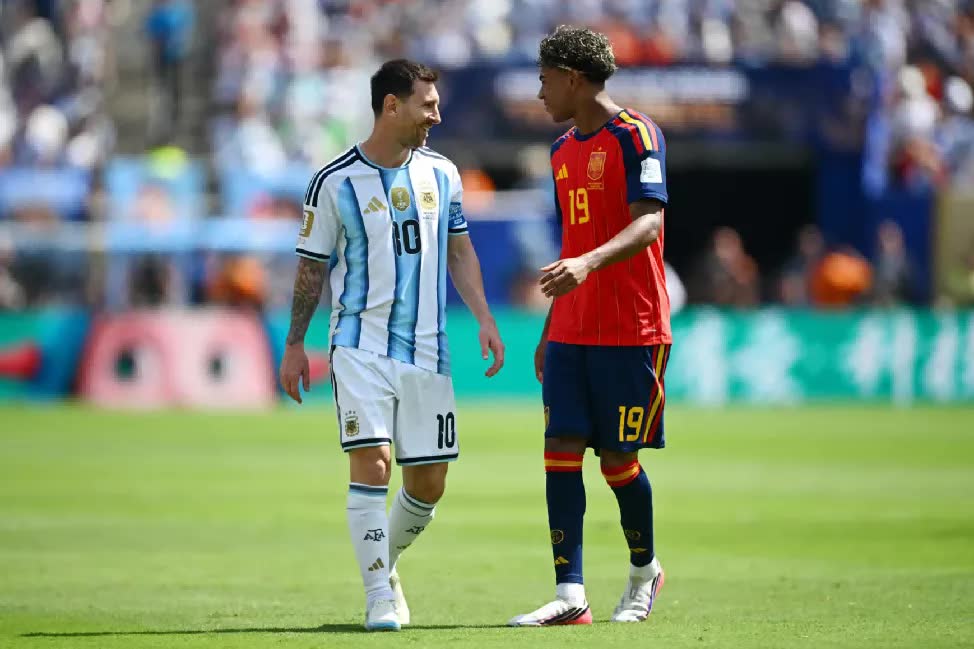
Spain is a world champion again, and it won the way it had all summer, by refusing to be scored on. On a hot Sunday afternoon at New York New Jersey Stadium, in the last of the expanded tournament's 104 matches, substitute Ferran Torres struck in the 106th minute to beat defending champion Argentina by a single goal, denying Lionel Messi a final storybook chapter and closing North America's first men's World Cup in more than three decades. It is Spain's second title, sixteen years after its first, and that 2010 triumph was won the same way, by one goal in extra time. When the captain Rodri lifted the trophy, Spanish football completed something no country had ever done: with its women already the reigning Women's World Cup champions, Spain now holds both titles at once.
The match data reads almost like a training exercise. Spain held 68 percent of possession and produced 20 shots, 11 of them on target, while Argentina managed 3 shots in total and none on target across the full 120 minutes, an attacking output measured at roughly a fifth of an expected goal. Argentina's clearest moment came in the fifth minute, when Julián Álvarez slipped Messi through on goal only for goalkeeper Unai Simón to beat him to the ball. From there the game became a duel between Spain's patience and Emiliano Martínez's reflexes: the Argentine goalkeeper made 11 saves, holding the score level through 90 minutes even as his team offered nothing going forward. The pivot came when midfielder Enzo Fernández collected a second yellow card in the second half, reducing Argentina to ten men. Spain kept probing, and in the 106th minute Torres, on as a substitute, finally beat Martínez from close range. Even then Argentina nearly forced a shootout, with Giuliano Simeone lifting a late chance from Messi's corner over the bar in the dying minutes.
Coach Luis de la Fuente had sent out the same starting eleven that had already eliminated a corridor of elite opponents: Portugal by one goal, Belgium two to one, and a France side whose attack had looked irresistible until Spain shut it out two to nil in the semifinal. The champions finished having conceded a single goal in eight matches, a defensive record no previous winner had matched, achieved across the longest path any champion has been required to run under the new format. With the win, Spain also displaced Argentina atop the world ranking. The individual honors underscored the dominance: Rodri took the Golden Ball as the tournament's best player, Unai Simón the Golden Glove, and 19 year old defender Pau Cubarsí the best young player award, while France's Kylian Mbappé claimed a second straight Golden Boot with 10 goals, a haul that made him the tournament's all time leading scorer with 22.
For all of Spain's brilliance, much of the world watched one man. Messi, now 39, had carried Argentina to the final with 8 goals and 4 assists, finishing second for the Golden Boot, and stood one win from becoming the first player in 64 years to lead a repeat champion. Crossing the ceremonial dais, past FIFA president Gianni Infantino, the heads of state of the three host nations, and Spain's King Felipe VI, he kept his composure as US President Donald Trump placed the runner up medal around his neck. It broke moments later. Facing the stands, Messi wept openly, and the image traveled around the planet within minutes. The setting supplied its own cruel poetry: it was at this same stadium in 2016 that a younger Messi, after another final lost, announced an international retirement he would later reverse. Whether this was truly the last match of his Argentina career remained unconfirmed, with coach Lionel Scaloni offering only a smile and a shrug when asked before the game.
The occasion itself showed how completely football's showpiece has merged with global fan culture. The halftime interlude ran 11 minutes and played like a pop festival compressed: Shakira performed the tournament's official anthem with Burna Boy, BTS and Justin Bieber took the stage, the actors of the television comedy Ted Lasso appeared in character to make an introduction, and Coldplay's Chris Martin closed alongside a Staten Island public school choir. The stands and the watch parties beyond them behaved like the fandoms they are: in Buenos Aires, the crowd at Plaza Seeber fell into a hush after Spain's goal, murmuring hope whenever Messi touched the ball, while celebrations erupted across Madrid at the same instant. This tournament repeatedly demonstrated the machinery of modern football stardom, never more vividly than when Cape Verde's 40 year old goalkeeper Vozinha saw his social media following explode from around fifty thousand into the tens of millions within days of one heroic match. The final simply completed the pattern on the grandest scale, with Messi's tears becoming, instantly, both a shared global moment and raw material for the internet's endless contest of tribute and taunt.
It is worth pausing on what the fandom spectacle gives football and what it takes. The devotion is real and often beautiful: a plaza in Buenos Aires holding its breath, a journeyman keeper adopted overnight by millions, a school choir sharing a stage with global superstars. But the same machinery that produces those moments also flattens athletes into characters in a permanent online drama. Messi's defeat will be replayed less as a match outcome than as an episode in the decade long partisan war between his admirers and those of his great rival, a contest neither man asked for and neither can end. Young stars like Spain's Lamine Yamal, a world champion while still a teenager, will now live their entire careers inside that apparatus, where every touch is content and every failure is ammunition. The healthiest reading of Sunday is the simplest one, and it belongs on the pitch: a superbly coached team defended better than any champion in history and deserved its trophy, and a great player lost a football match, which is not a humiliation but the sport working as designed.
Looking forward, Spain's position is enviable in a way no federation has ever known, holding both world titles with a core young enough, from Cubarsí to Yamal to Pedri, to contend for years. The larger question the tournament leaves behind is about scale. A 48 team, 104 match World Cup delivered genuine wonders, a tiny island nation in the knockout rounds, a final of real tension, record audiences for the fan circus around it. It also stretched a single summer to its limit and asked its champion to play eight matches in five weeks. Whether the sport can keep growing the spectacle without exhausting the athletes who supply it is the debate the next cycle will inherit. For now, the sky over this tournament belongs to Spain, and the last image belongs, as it so often has, to Messi.