Startups on the Hackensack Waterfront Build Drones for Industrial Inspections
Engineers in northern New Jersey are testing drones to inspect tank farms and bridges, targeting regional infrastructure contracts.
By Keisha Brown · January 1, 2026 · 4 min read
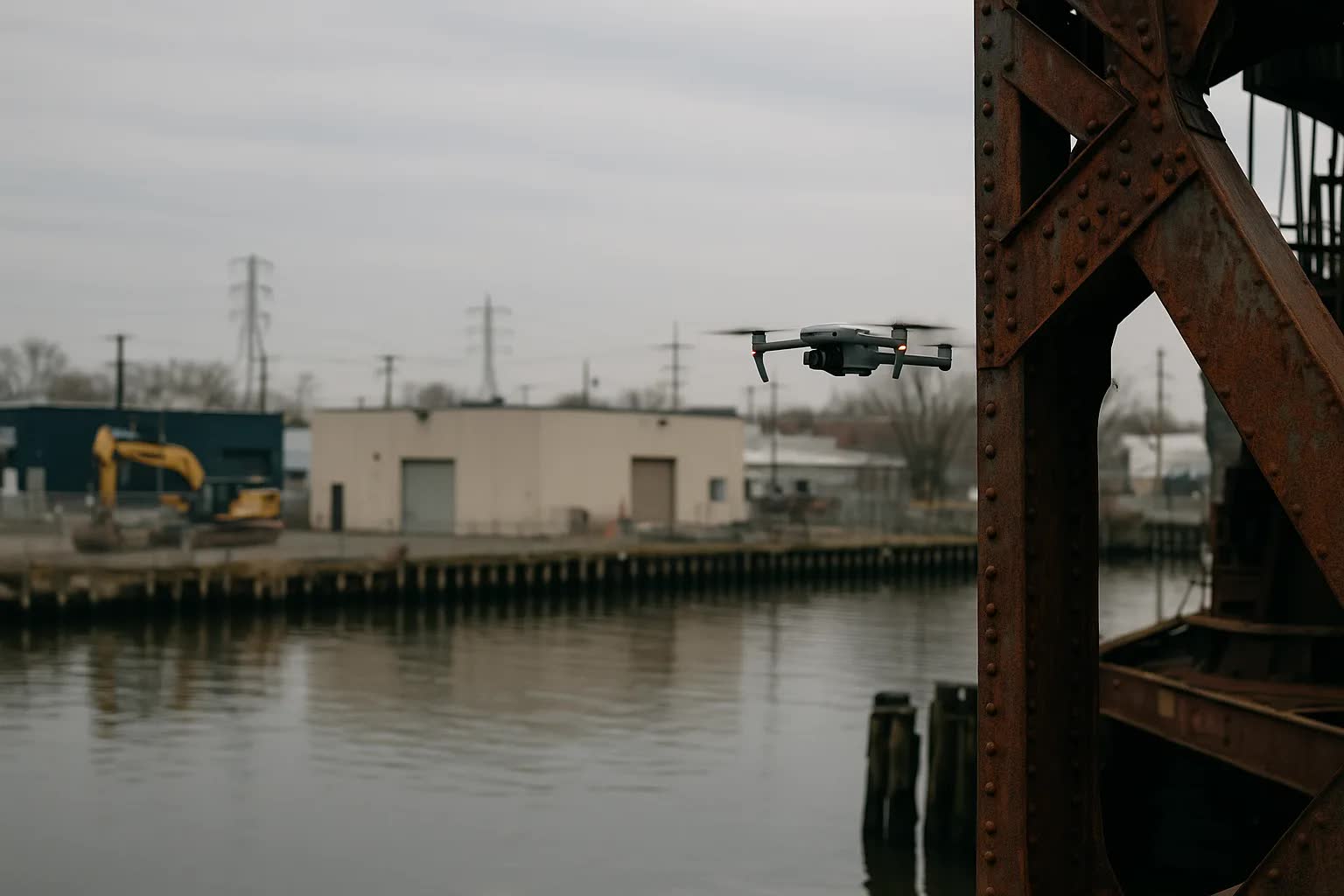
From the High Line in Chelsea to the rust-streaked bulkheads of the Hackensack waterfront, a handful of startups in northern New Jersey are pitching themselves as a new line of defense for the region’s aging infrastructure by building drones that inspect tank farms, piers and bridges that serve New York City. Engineers based in warehouses a short ferry ride from Hoboken and a 20-minute drive from Midtown are testing autonomous aircraft designed to climb façades, peer under spans and scan storage tanks for hairline fractures, aiming to win inspection contracts across the metropolitan area.
On a cold morning under a gray sky, a prototype with a matte-black fuselage rose from a loading dock behind HarborScan Labs, a converted shipping warehouse along Western Avenue on the Hackensack waterfront. Nearby, RiverGuard Robotics unfolded a tethered copter on a pallet marked with an old freight company logo. The companies operate in a loose cluster of former manufacturing spaces that local officials hope will become a tech corridor linking Kearny, Jersey City and the western reaches of Hoboken, where industrial work is still woven into residential neighborhoods.
"We build the tools we wished we had when we were elbow-deep in scaffolding on the Pulaski Skyway," said Maya Alvarez, chief engineer at RiverGuard Robotics, who previously oversaw structural monitoring projects in Queens and Long Island City. "What we’re trying to do is shrink inspection time from days to hours and reduce the risk to workers who now have to rope down or run lane closures in Manhattan and Brooklyn. Drones can do some of that work more safely and at a fraction of the cost."
The machines combine off-the-shelf multirotor airframes with custom software and a pallet of sensors. Lidar and photogrammetry packages create detailed 3D models of a bridge’s underside; thermal cameras highlight leaking insulation or failing seals on tank roofs; acoustic sensors listen for corrosion-related anomalies inside steel hulls. Some firms favor tethered systems that can operate for multiple hours without landing; others are developing swarms of smaller drones meant to cover a complex site quickly and return data to cloud platforms for automated analysis.
The numbers behind the nascent cluster are concrete. Collectively the Hackensack waterfront startups have attracted $27.4 million in venture and grant funding since 2023, according to company statements; five companies are operating out of two industrial blocks along Western Avenue and Meadow Street; teams have conducted more than 1,200 test flights in New Jersey since the beginning of 2024. Typical inspection drones weigh 8 to 12 pounds, have flight endurance between 25 and 75 minutes depending on payload, and shave inspection costs by an estimated 30 to 50 percent in pilot contracts offered so far.
"There’s eagerness on the agency side, but airspace and data are always tricky," said a senior MTA planner who requested anonymity because of internal procurement rules. "We want tools that reduce lane closures and get us eyes where scaffolding can't reach, but we also need to be sure the systems can operate safely over trains and dense parts of the city without creating new hazards." The planner said the authority is monitoring local tests and hopes to issue a pilot task order for tunnel and bridge inspections next year.
That combination of promise and caution has pushed entrepreneurs into lengthy regulatory work. Companies have applied for and received multiple Part 107 waivers from the Federal Aviation Administration for operations beyond visual line of sight near water and high-tension lines, and they coordinate daily with state police, the Port Authority of New York and New Jersey, and utilities to set no-fly corridors near the Goethals Bridge and the Bayonne Bridge. Firms say redundant flight control and automatic return-to-home systems reduce risk but add weight and cost, and the process of winning access to secure sites like oil terminals can extend months beyond a successful technical demonstration.
Local industry players are already sharpening bids around a potential market. Utilities in northern New Jersey and contractors that maintain the region’s hundreds of steel storage tanks and river crossings are said to be soliciting proposals for annual inspections that include drone-based imaging and data analytics. Hudson Tank Services, an invented regional contractor that is partnering with HarborScan on pilot work, expects to use drone surveys to complement human inspectors during the spring maintenance season and to produce compliance-ready reports for insurance carriers and municipal regulators in Jersey City and Hoboken.
Community groups and workers have mixed reactions. The Kearny Waterfront Neighbors Association welcomes the return of manufacturing jobs to the shoreline but questions the noise and privacy implications of more frequent flights over mixed-use neighborhoods, said Evelyn Torres, the group's president. "We want the jobs," she said, "but we also want assurances about how the data will be stored and whether flights will be limited to daylight hours, especially near schools in nearby Belleville and the western edges of Bayonne." Companies say flight patterns are planned to avoid residential streets and that imagery is limited to infrastructure surfaces rather than private property.
Looking ahead, the startups on the Hackensack waterfront expect a busy year. Several are preparing to bid on state and municipal contracts to inspect more than 150 bridge spans and nearly 200 storage tanks in a two-year window, and engineers say advances in onboard processing and 5G links to Manhattan data centers will speed turnarounds for reports so agencies can prioritize repairs. If the pilots translate into wider procurement, the quiet warehouses near the river could supply a steady stream of flying inspectors to the region’s bridges, piers and tank farms while carving a new industrial niche for the area.