Staten Island Firm Pilots Autonomous Shuttle on Mixed Traffic Streets
A neighborhood loop is testing driverless shuttles on arterial roads to evaluate safety and ridership patterns.
By Leo Wang · January 18, 2026 · 4 min read
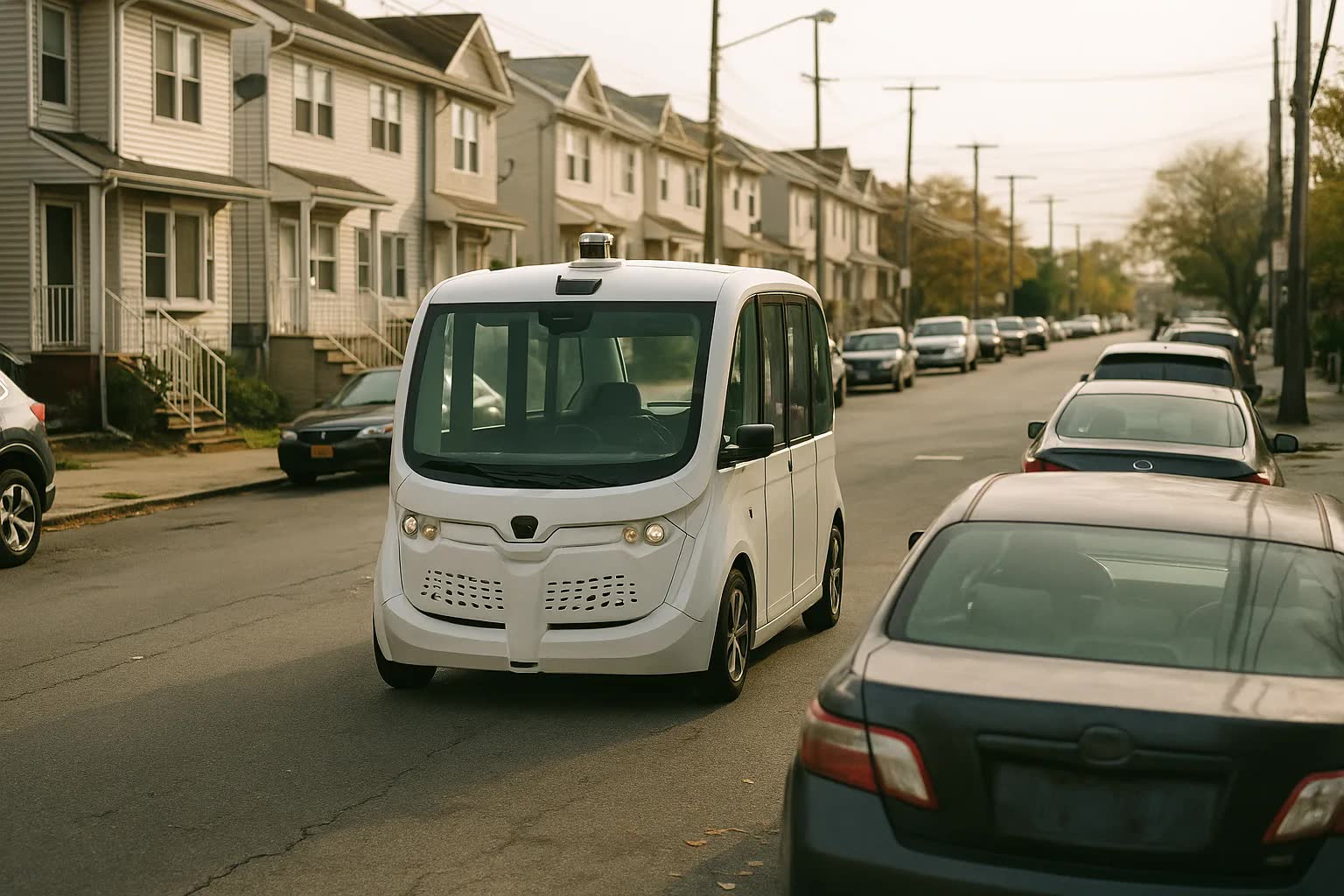
Staten Island drivers and pedestrians along Bay Street and Richmond Terrace are getting an unusual new neighbor: a three-vehicle pilot of low-speed, driverless shuttles that will run a neighborhood loop through St. George and Tompkinsville in mixed traffic, part of an experiment to test safety systems and observe ridership patterns on arterial streets rather than closed campuses or dedicated lanes.
The trial, launched this month by HarborLoop Mobility, a local autonomous vehicle startup headquartered on Canal Street in Stapleton, will operate a roughly 2.6-mile route linking the Staten Island Ferry terminal to the St. George neighborhood and the Tompkinsville commercial strip, stopping at major nodes including Borough Hall, the St. George Theatre and the Tompkinsville Metropark entrance.
Company executives say the choice to run in mixed traffic — sharing lanes with cars, buses and bicycles, and negotiating curbside loading at busy intersections — is deliberate, aimed at gathering urban operational data that has been scarce in New York compared with campus pilots in Silicon Valley and closed-course trials in Phoenix and Austin.
“We designed the loop to mirror the complexities Staten Islanders encounter every day: double-parked delivery vans, school traffic, bicycle lanes and heavy pedestrian flows near the ferry,” said Maya Chen, HarborLoop Mobility’s founder and chief executive officer. “Our goal in this phase is not to replace buses but to learn where autonomous shuttles can safely complement the existing transit network.”
The pilot is being conducted under a research permit from the city’s Department of Transportation and with an information-sharing agreement with the Metropolitan Transportation Authority, officials said, and HarborLoop has posted detailed routing and sensor logs with local community boards to maintain transparency around operations and safety events.
A DOT official, Aisha Greenwood, deputy commissioner for smart mobility, described the agency’s criteria for allowing mixed-traffic testing: “We look for comprehensive safety cases, on-street signage, explicit pedestrian engagement plans and clear contingency protocols with local traffic enforcement. HarborLoop met those standards for this limited deployment,” Greenwood said.
The data package the company will collect during the six-month pilot is specific: three autonomous shuttles, each outfitted with four LIDAR units, eight cameras and redundant braking controls, will operate weekdays from 7 a.m. to 9 p.m. at a maximum speed of 25 miles per hour; HarborLoop expects to log about 60,000 vehicle-miles and project approximately 15,000 to 20,000 passenger rides in the first three months, with preliminary safety metrics including a target of fewer than one disengagement per 5,000 miles driven.
Community reaction has been mixed. Luis Ramirez, chair of Staten Island Community Board 1, praised the company’s outreach but urged caution: “We’re encouraged that they’re listening to merchants on Bay Street who worry about curb access and delivery windows, but residents want guarantees about data privacy and what happens if there’s a software failure,” Ramirez said. Local small-business owners have raised questions about loading zones and whether shuttles might exacerbate midday congestion near the ferry terminal.
Behind the scenes, HarborLoop officials are coordinating with a union-affiliated mobility operations group that will place trained safety ambassadors on board during the pilot; the ambassadors are not drivers in the traditional sense but are there to take manual control if necessary and to assist passengers with accessibility needs. “We believe a human presence during the research phase builds community trust and gives us a live safety layer while we collect real-world performance data,” said Dr. Ravi Menon, HarborLoop’s head of safety engineering.
City transit officials, speaking on background, said the MTA will use the pilot’s ridership and route data to decide whether driverless shuttles could be integrated as first-mile/last-mile feeders for bus and ferry services, though an MTA planner who requested anonymity warned that mixed-traffic autonomous operations present significant regulatory and enforcement questions that the agency is still resolving. Looking ahead, HarborLoop says it will publish a public report after the six-month period detailing incidents, passenger demographics and recommended changes to city curb regulations, with the company and city officials hopeful that the findings will inform whether similar loops can be tested in other outer-borough neighborhoods with complex street patterns.