Suburban Commuter Cafes on the NJ-NY Line Become Pop-Up Poetry Stages
Baristas and proprietors are turning lulls into spoken-word nights that bridge commuter schedules and local arts scenes.
By Dominic Russo · December 18, 2025 · 4 min read
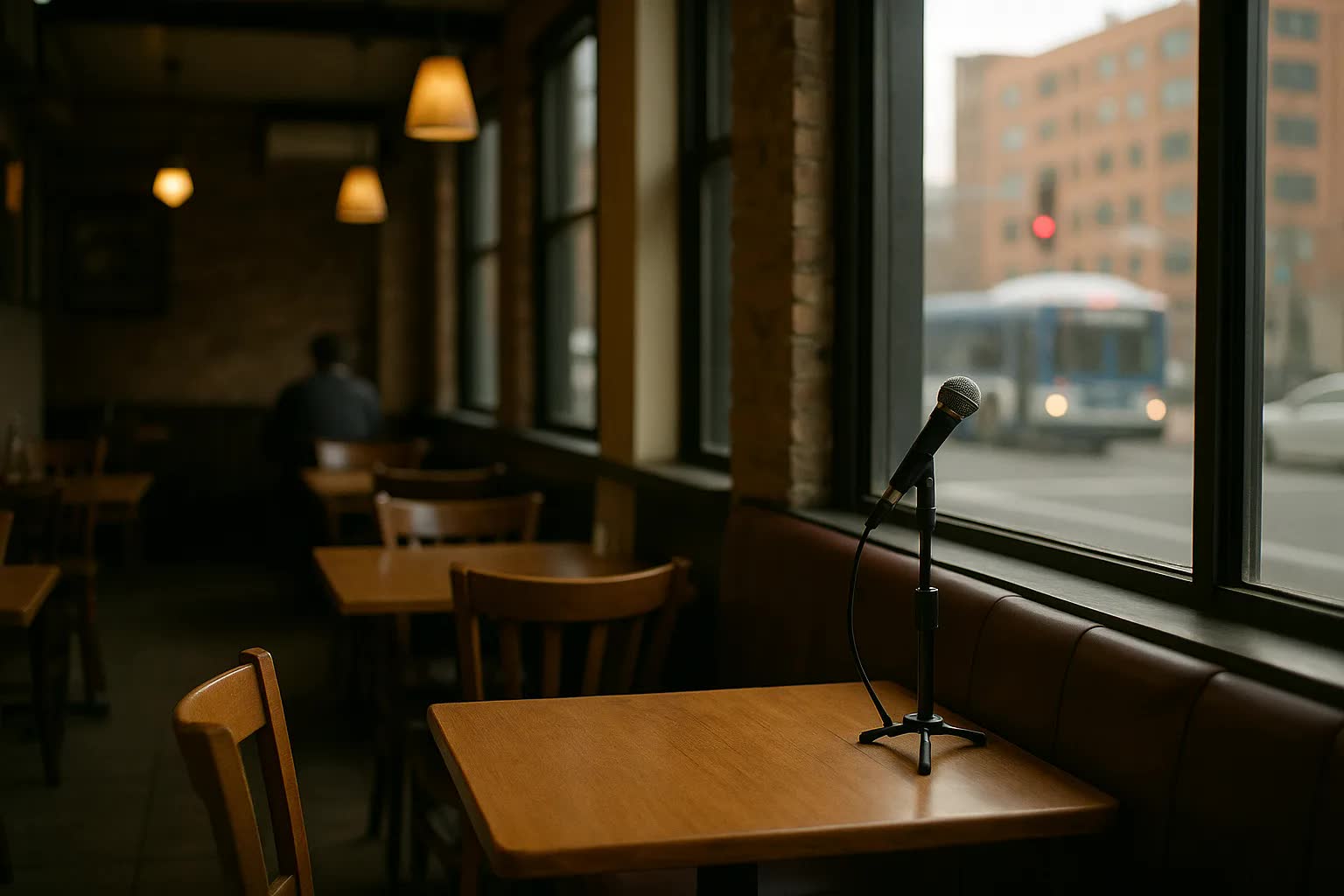
On evenings when the PATH and NJ Transit trains disgorge wave after wave of Midtown-bound commuters, a quieter migration has begun: riders are stepping off at Hoboken, Journal Square and Montclair not just to change trains but to crowd into neighborhood cafés that have turned slow hours into pop-up poetry stages, folding suburban vernacular into the rhythms of New York’s cultural life and sending Manhattan commuters back across the Hudson with new lines in their heads.
Platform & Prose, a single-room café on Hoboken’s Washington Street, schedules its open-mic to match the 7:18 and 7:47 p.m. PATH departures to 33rd Street, advertising “two short sets, one connecting train” on a chalkboard by the door. Proprietor Maya Delgado said she began the experiment last spring to fill a lull rather than chase a trend. “We wanted something that respected the commute,” said Delgado, who until 2023 ran a pop-up gallery in Jersey City. “People can get a coffee, hear six poems, and still make it to the office in Manhattan if they need to — but often they don’t.”
The idea has spread from Hoboken to pockets along the commuter lines: Terminal Grounds at the foot of Montclair’s Bloomfield Avenue hosts a Friday night “express series,” while Shoreline Roasters near Journal Square stages bilingual readings between the 8:12 and 8:34 p.m. Newark-bound locals skew younger, operators say, and many nights end with informal collaborations among poets who met on the platform. Lena Park, arts coordinator for the Jersey City Cultural Council, said the micro-stages have become a practical outlet for local writers. “It’s not a headline festival,” Park said. “It’s community-making on the schedule that people actually keep.”
Organizers and café owners point to concrete growth: since March, 34 cafés along the NJ–NY commuter corridor have hosted at least one night of spoken-word programming; those venues put on a combined 176 poetry nights through November, averaging 42 attendees per event. Weeknight shows typically draw 25 to 50 people, weekend events 60 to 90. Proprietors report a median revenue increase of 8 percent on event nights and stipends for performers range from $25 to $75, depending on ticketing arrangements and sponsorships from small arts grants.
For commuters the nights offer an alternative to earbuds. Ethan Cole, a freelance copy editor who commutes from Hoboken to an editorial office in Chelsea, performs short sets under the name Ethan Rue and said the pop-ups have altered how he measures his evenings. “I used to write on the train; now I write for the train,” Cole said. “It’s sharpened my timing. A poem has to land before the announcements.” He said the crowd mixes Jersey regulars with Manhattan professionals who linger after work, creating an audience that is both local and transient.
Baristas and staff have become ad hoc curators, using train timetables to program quick sets that fit between peak departures. At Terminal Grounds, co-owner Harpreet Singh described a typical Tuesday: poets rotate in 10- to 12-minute slots, the house lights dim for the first set and come back up for the last call before the 8:05 p.m. train. “It’s logistical theater,” Singh said. “You have to be mindful of sound levels, of the café’s capacity, and of last call for the coffee cart. But the foot traffic after the event — people stop on Bloomfield Avenue — that’s the real return.”
The pop-ups have also shifted neighborhood dynamics. In Montclair Center, local bookstores report increased evening sales tied to reading nights; in Jersey City’s Grove Street, restaurants see later dinner reservations from Manhattan patrons who make a pre-theater detour. Smaller arts organizations are tapping the corridor to cast wider nets: musicians, visual artists and short-fiction readers have been bookended into the same time windows, creating cross-disciplinary nights that local funders describe as low-cost cultural development. “We’re seeing cultural capital move along the rails,” Park said. “That’s good for municipalities that have been trying to retain creative talent.”
Not all responses have been positive. Noise complaints and permit questions have cropped up where a café in a denser block converts tables into a standing-room audience. Some poets and regular customers complain that the compressed format favors punchy, short pieces over more meditative work. “You risk turning a poem into a subway announcement,” said Lena Morales, a spoken-word artist who has declined two bookings that required back-to-back three-minute pieces. Municipal clerks in several towns say they are reviewing whether existing zoning and small-venue permits adequately cover scheduled performance nights.
Technology has smoothed some frictions: several cafés stream performances to partner spaces in the West Village and Midtown, allowing a Manhattan audience to tune in without crossing the river, and recorded sets have been compiled into monthly playlists that raise modest licensing funds for performers. A handful of venues now operate hybrid models — a small in-person audience with a paywalled livestream — and several poets have reported that online tipping compensates for the shorter physical stage time. Observers say the hybrid format could make the pop-ups sustainable even in winter, when outdoor lines typically shrink.
Organizers plan to keep tinkering. Delgado and other proprietors are coordinating a winter “Transit Read” festival that would link six stops on the PATH and NJ Transit lines with staggered reading times to create a single evening of continuous performance across the corridor. “We’re not trying to replace Manhattan’s stages,” Delgado said. “We want to fold our own rhythms into the larger ecosystem — and give people something to look forward to on the ride home.” If the next few months go as planned, the commuter cafés that began as economical uses of slow hours will be testing whether low-cost, transit-minded arts programming can become a durable part of an increasingly regional cultural map.