Sunset Park's Industrial Waterfront Gets a Climate-Resilient Makeover
A new city proposal integrates flood barriers with green infrastructure to protect manufacturing jobs and waterfront housing.
By Noah Fitzgerald · December 9, 2025 · 4 min read
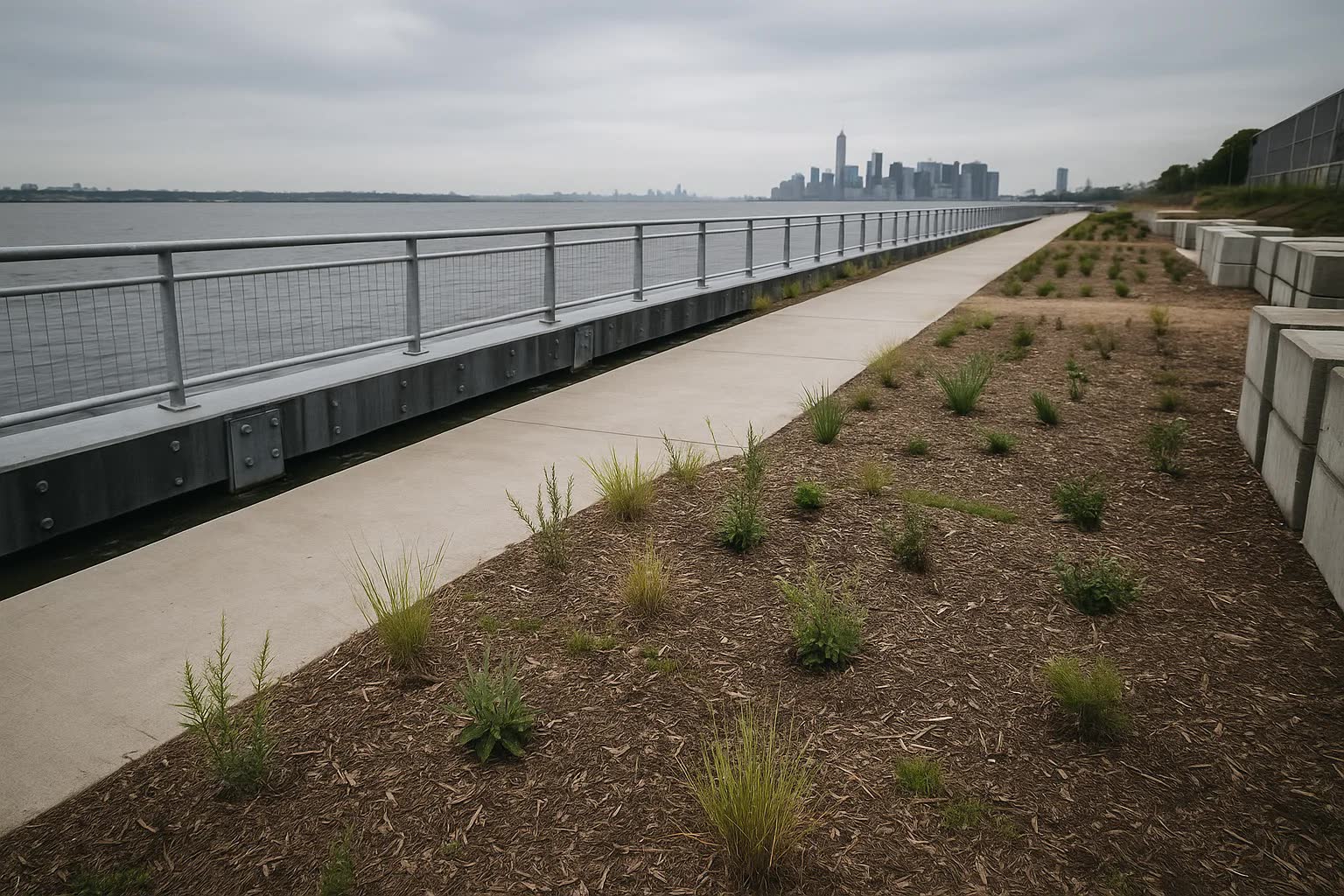
Sunset Park’s industrial waterfront, long defined by rusting piers, low-slung factories and the hulking red-brick warehouses of Industry City, is poised for a major climate-resilience overhaul under a city proposal that blends hard flood barriers with green infrastructure to shield manufacturing jobs and thousands of waterfront residents from rising seas and stronger storms.
The plan, developed by the fictional Sunset Park Resilience Initiative in coordination with the city’s climate office, targets a narrow strip of Brooklyn shoreline from the Brooklyn Army Terminal at 58th Street south through Industry City to the mouth of Gowanus Inlet, where low-lying docks and electrical substations have been repeatedly tested by high tides and storm surge since Superstorm Sandy.
City officials and engineers say the proposal can protect both heavy industry and nearby housing — including blocks of walk-up apartments on 4th Avenue and public housing along 39th Street — by combining deployable steel floodwalls at the water’s edge with living shorelines, raised promenades, permeable industrial yards and elevated utility corridors that keep critical services above projected surge heights.
“This is about more than a wall,” said Carlos Medina, director of the Sunset Park Waterfront Coalition, a community group that has advocated for industrial jobs and shoreline access. “We need a system that lets manufacturers keep shipping in and out, keeps seniors in their apartments on 40th Street dry during storms, and gives our kids safe green space where there was only concrete.”
The proposal calls for a 2.1-mile network of defenses including 10- to 12-foot deployable barriers at the tideline, a 20-foot-wide elevated promenade that can absorb wave energy, three engineered tidal wetlands to slow storm surge, and new subsurface stormwater retention tanks beneath open lots near 3rd Avenue and 36th Street. Freight access would be preserved through raised truck corridors and reinforced pier caps designed to handle Class 8 tractor-trailers.
In concrete terms, the city estimates the project would cost roughly $215 million in its first phase, protect approximately 3,200 manufacturing jobs clustered in and around Industry City and the Brooklyn Army Terminal, safeguard about 4,800 housing units including 1,150 units designated as affordable, and avoid an estimated $680 million in flood damages over the next 30 years. The design team projects that the combined green and grey measures would reduce peak storm surge levels at key points along the waterfront by an average of 1.8 feet during a 100-year storm event.
Local manufacturers gave a cautious welcome to the plan. “We build HVAC systems and custom machinery for the city,” said Anjali Rao, chief operations officer at Harborline Fabrication, a midsize plant on 37th Street. “If a storm can’t get to our shop floor, our workers keep their paychecks and the city keeps these businesses that make our neighborhood tick. But we need guarantees about access during construction and a local hiring plan for the retrofits.”
Funding is expected to be a patchwork of municipal capital, state coastal resiliency grants and federal climate-program dollars, with private contributions from waterfront property owners and a proposed community benefits fund administered by a Sunset Park advisory board. City planners acknowledge political hurdles: some property owners worry about long-term maintenance costs and rising land values, while neighborhood activists press for enforceable commitments to preserve industrial rents and to prevent displacement.
Engineers on the project say the design is deliberately modular to allow adaptation as sea level projections change. The system uses 12-foot steel bulkheads that sit behind newly planted marsh terraces, pump stations partly powered by rooftop solar arrays and elevated utility spines that keep electrical and telecom lines above flood levels. The planners also built in freight-resilience features such as reinforced curb cuts and short-term loading bays lifted above the predicted flood plain, designed to maintain supply chains from the BQE and the Sunset Park freight corridors.
The city plans a three-year public engagement and permitting phase, with construction on the first segment along the 36th to 39th Street corridor slated to begin in late 2027 if funding is secured. Community leaders say they will push for apprenticeship programs and workforce guarantees so residents of Sunset Park, Bay Ridge and Borough Park can take part in the retrofits. “This can be a model for how an industrial waterfront adapts to a changing climate while keeping jobs and homes in place,” said Maya Rivera, deputy commissioner for coastal projects at the NYC Office of Climate Resilience. “But it will only work if every phase of construction is measured against equity and durability goals.”
If the proposal moves forward, Sunset Park’s shoreline could look very different within a decade: a stitched-together sequence of engineered wetlands and sculpted promenades buffering active loading docks, with solar arrays on warehouse roofs, pump stations humming under park benches and sectional barriers that close during hurricane warnings. City officials say the neighborhood lessons will be exported to other vulnerable industrial shorelines across New York, but residents and business owners will watch permitting, procurement and early construction closely to see whether the city’s promise of protection also delivers jobs, affordable housing protections and long-term stewardship.