The Nets Spent the Summer Building Scaffolding Around Their Young Core
Brooklyn's rebuild enters its most legible phase yet. Training camp opens next month with a roster that finally has some shape to it.
By Nathalie Richard · August 6, 2026 · 5 min read
NEW YORK, August 6, 2026 — The Brooklyn Nets will open training camp next month with something they have not had since Kevin Durant and Kyrie Irving left in February 2023: a reasonably clear picture of who the team is being built around.
That clarity was expensive to acquire, and it arrived partly by subtraction. A year ago, Brooklyn went into camp with Cam Thomas playing on a one-year, $6 million qualifying offer he signed only after negotiations collapsed. He had turned down two years and $30 million, and a one-year deal worth up to $11 million that would have required him to waive his no-trade rights. The arrangement satisfied nobody. It ended in February, when the Nets — unable to trade a player holding a full no-trade clause — waived him outright. He signed with Milwaukee, was waived again in March, and remains unsigned.
Nothing comparable is hanging over this roster, which is a modest thing to celebrate and still an improvement.
What the Nets are moving on from is a season that went exactly as designed and looked terrible anyway. Brooklyn finished 20-62, thirteenth in the Eastern Conference, with the youngest roster in the NBA and a league-record five players selected in the first round of the 2025 draft. The Nets gave an NBA-high 6,716 minutes to rookies. The basketball was, predictably, difficult: a 108.2 offensive rating and a 118.2 defensive rating, both near the bottom of the league. That was the cost of the plan, not evidence against it.
The reward came in June, when the Nets used the sixth overall selection on Louisville point guard Mikel Brown Jr. Brown averaged 18.2 points, 4.7 assists and 3.3 rebounds as a freshman on 41/34/84 shooting splits. In February he scored 45 points against NC State — ten of them from behind the arc — breaking Cooper Flagg's ACC record for points by a freshman in a single game and tying Wes Unseld's 59-year-old Louisville mark. He was named AP National Player of the Week.
He also missed 14 games with a back injury that flared again in March, costing him the ACC and NCAA tournaments. He still made the ACC All-Rookie Team and All-ACC Third Team. Both halves of that record followed him into the draft, and both will follow him into his rookie season: the ceiling, and the availability question.
Brown is expected to share a backcourt with Egor Dëmin, the No. 8 pick in 2025, whose size and passing feel should complement Brown's downhill pressure rather than duplicate it. That pairing is the actual center of this rebuild, and it is also the reason the rest of the summer looked the way it did.
Because the new part of this roster is the old part. Sean Marks acquired Julius Randle and the No. 28 pick from Minnesota in a multi-team trade that sent Nic Claxton to Chicago and the No. 33 pick to the Timberwolves. For the Wolves it was a salary dump. For Brooklyn — one of only three teams operating with cap room this summer — it was a chance to buy a first-round pick with cap space while absorbing Randle's $33.3 million salary. He has two years left on his deal, including a $35.8 million player option for 2027-28.
Randle, a three-time All-Star, averaged 21.1 points, 6.7 rebounds and 5.0 assists in 79 games for Minnesota last season. He does not fit the roster's timeline in any conventional sense. He is not supposed to. He is supposed to make the nights when the young guards are learning something expensive look less like a loss and more like a game.
Michael Porter Jr. returns after a career year — 24.2 points, 7.1 rebounds and 3.0 assists — interrupted by injury; he appeared in 52 games. His situation is the season's quietest subplot. Porter enters the final year of his contract, is extension-eligible this offseason, and has said publicly that he wants to stay, comparing Brooklyn's position to Oklahoma City's early rebuilding years. Marks has left both doors open.
Around them, Day'Ron Sharpe, re-signed on a two-year, $20 million deal, is in line to open the season at center after five seasons behind Claxton on the depth chart. Brooklyn also re-signed Josh Minott and added Keon Ellis and Moritz Wagner, each on two-year deals. Joshua Jefferson, the pick acquired in the Randle trade, arrives from Iowa State. The rest of the young group — Nolan Traoré, Drake Powell, Ben Saraf, Danny Wolf, Noah Clowney — is still learning on the job.
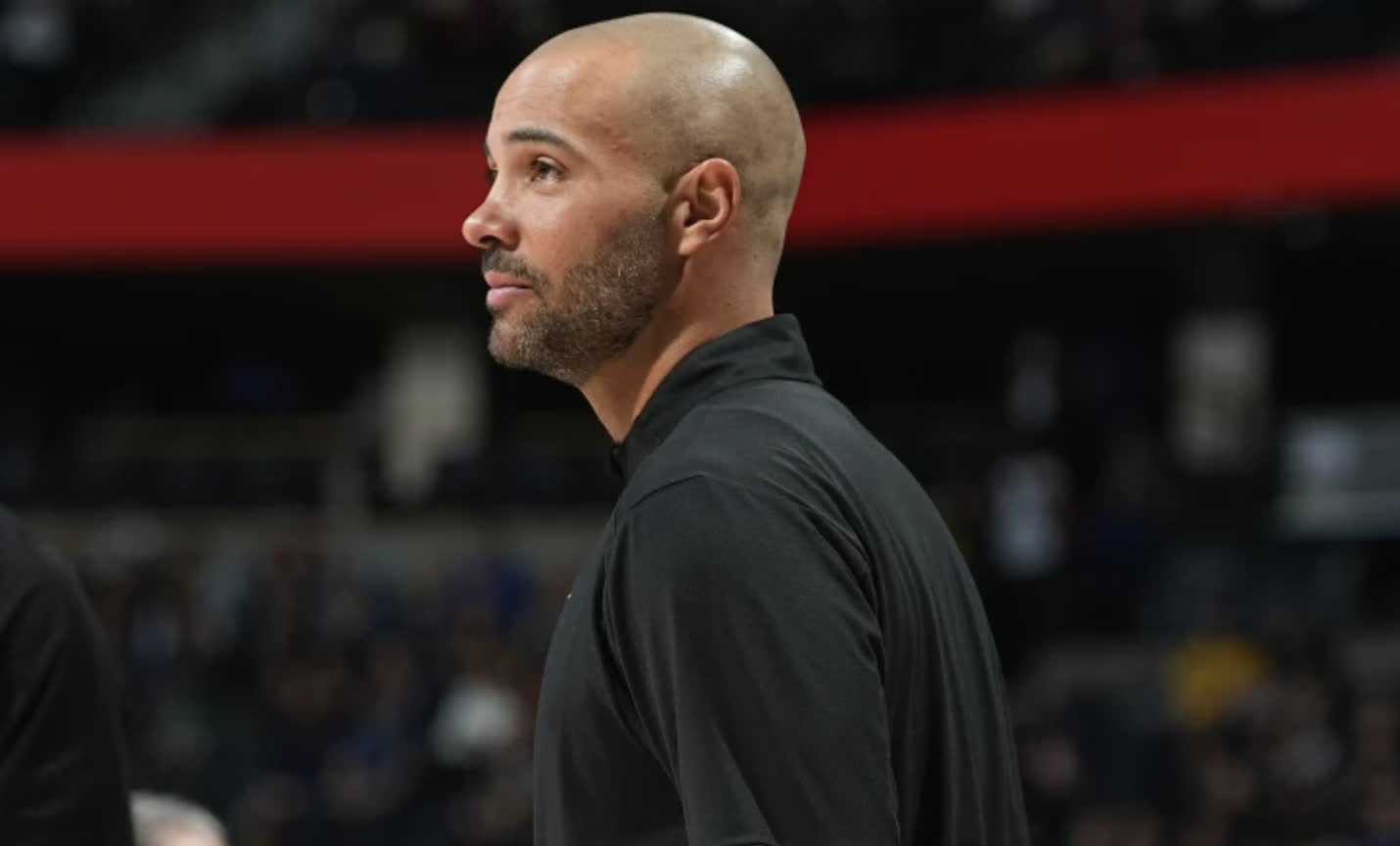
Holding all of it together is a coaching staff the organization has gone out of its way to protect. Jordi Fernández enters his third season, and in April the Nets signed him and his entire staff to multiyear extensions — an unusually broad commitment for a team coming off 20 wins, and a clearer statement of institutional patience than anything said at a podium.
That patience extends to the asset base. Brooklyn holds nine tradable first-round picks along with a deep stock of second-rounders, and the front office has been praised for resisting the temptation to package them prematurely. Marks says that is deliberate.
"Something we've always done and sort of prided ourselves on with how we've built is not using up all your flexibility," he said this summer. "Just making sure you have that, whether it's going into the season or throughout the summer."
None of which adds up to a playoff berth. The Eastern Conference got heavier at the top this offseason — Giannis Antetokounmpo to Miami, LeBron James to Philadelphia, the champion Knicks returning intact — and Brooklyn's defense carries more unanswered questions than its offense does.
But for the first time in this rebuild, the roster is legible. There is a lead guard, a scorer, a veteran to absorb the hard minutes, a coach signed through the development window, and enough draft capital to change direction if any of it goes wrong. The Nets open the season October 20.