The Staten Island Ferry's Unofficial Art Program
Local artists and volunteers have installed ephemeral sculptures and performances that commuters now encounter on the short ride between boroughs.
By Julian Alvarez · April 5, 2026 · 5 min read
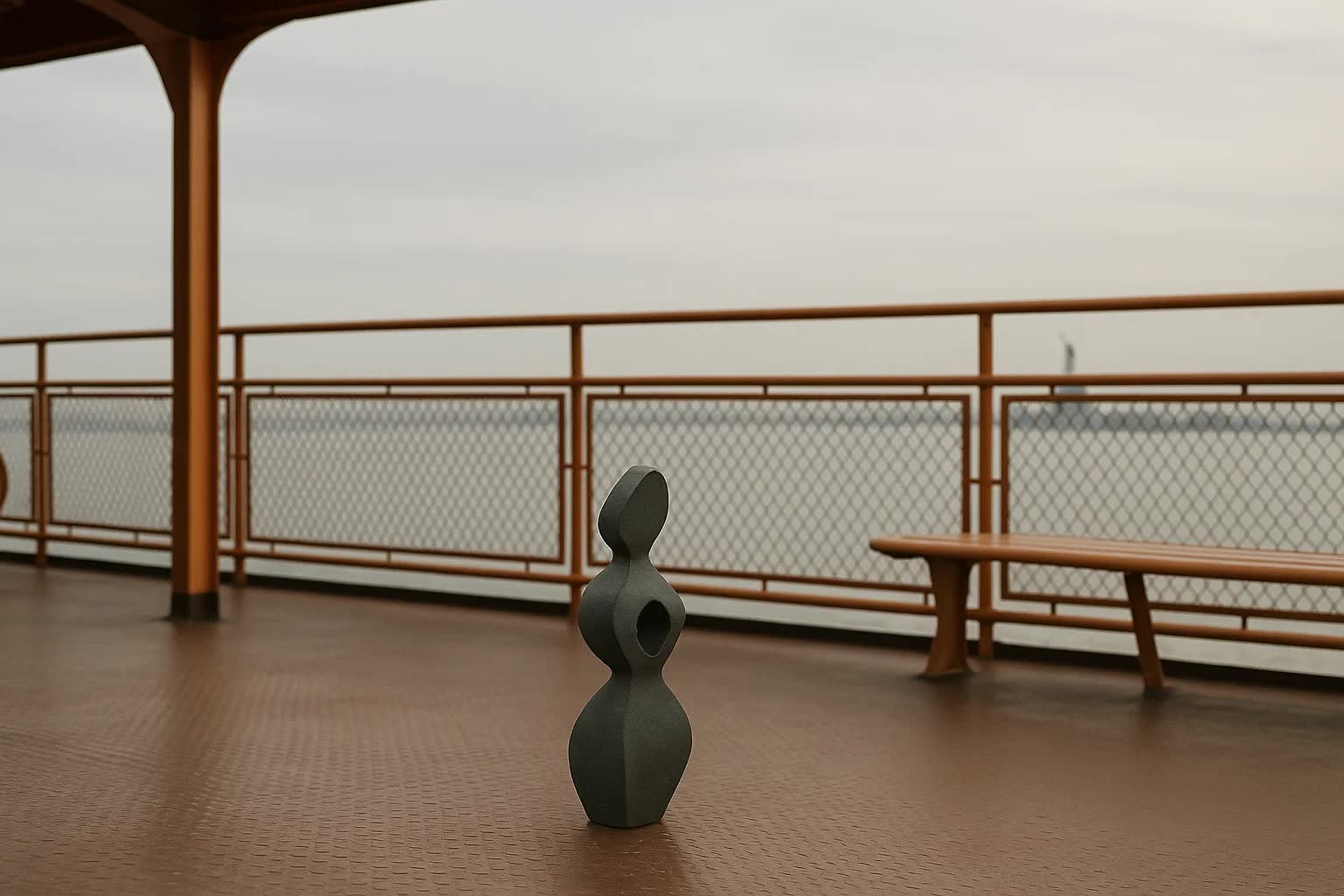
On weekday mornings and weekend afternoons, riders boarding the Staten Island Ferry at Whitehall Terminal now step into a curious middle ground between commuting and gallery-going: handrails festooned with tiny kinetic sculptures, a chorus of brass and spoken-word performances near the bow, and ephemeral paper lanterns that cling to the bulkhead like seaweed. The informal installations, conceived and installed by artists living in St. George, Stapleton and neighborhoods across Brooklyn and Manhattan, have transformed the 25-minute crossing to Staten Island into a moving museum that commuters encounter between Lower Manhattan and Richmond Terrace.
The works are deliberately small and portable — weatherproof mobiles that hang from lifeline posts, sculpted panels that adhere to ferry benches with suction cups, sound pieces that loop for a single voyage — and they arrive and disappear in the same day. Volunteers meet before dawn on Bay Street and in a parking lot on Castleton Avenue, load up hand trucks and toolcases, and secure pieces to interior bulkheads and outdoor rails. Performers set up near the snack counter or on the rear deck, staging five- to 12-minute sets that fold away before the boat docks at St. George Terminal.
Lena Morales, director of the Ferry Arts Collective, the loose coalition that coordinates many of the installations, said the program grew out of neighborhood arts nights and the ferry’s raw potential as a shared public space. “We wanted work that could breathe with the harbor — pieces that respond to the wind, the wake and the short attention span of a commute,” Morales said. “It’s about creating brief encounters that interrupt the daily friction of getting across the city, and giving local artists a stage that literally moves people between boroughs.”
Not everyone sees the activities as harmless improvisation. “Our top concerns are safety, liability and ensuring that nothing interferes with emergency equipment or passenger movement,” said “a senior MTA planner who requested anonymity” in an interview, a phrasing the source used because the planner is not authorized to speak publicly. “We have to balance the civic value of art with the operational imperative to keep ferries running safely and on schedule.” The planner said the agency has removed work deemed to pose a hazard and is testing a notification system that would let crews know when pieces are installed.
The movement has scale. Since an organized push in October 2024, Ferry Arts Collective members say more than 137 site-specific pieces and roughly 63 pop-up performances have appeared on the boats, staged by a network of about 46 volunteer artists and 28 neighborhood partners in Staten Island and Brooklyn. The Staten Island Ferry carries roughly 65,000 riders on an average weekday under current estimates provided by local transit monitors contracted by community groups; peak weekend ridership skews higher in summer. Small grants from two local foundations — totaling $14,500 so far — have covered materials, while volunteers estimate that crews spend an average of 120 collective hours per month installing and documenting the work.
Commuters have a range of reactions. Terrence Bell, a bartender who lives in South Ferry and takes the 8:12 a.m. from St. George twice a week, said the performances feel like a net gain. “I used to scroll on my phone and miss the view,” Bell said. “Now I’ll stand on the deck and listen to a poet or watch a tiny sculpture turn in the wind. It’s brief, but it’s a better prelude to my day.” Other riders, particularly those traveling with strollers or luggage across crowded afternoons, have complained to ferry customer service about congestion and unexpected noise, according to emails obtained by a local civic group.
MTA security staff have had intermittent run-ins with volunteers over installations that obscure signage or climb too close to emergency gear; in late February, two sculptures were removed after an on-board engine inspection found a dangling wire within arm’s reach of a maintenance panel. That incident prompted a new set of informal rules circulated by volunteer organizers: no installations within three feet of safety equipment, marine-grade fasteners only, and nightly dismantling of any exterior pieces. Harbor Arts Lab, a small nonprofit in Tompkinsville that supplies materials and liability waivers, has begun training sessions for artists on maritime safety and boat etiquette.
Artists say the limitations have hardened a deliberately ephemeral aesthetic. Works are designed to tolerate salt spray and a slammed stairwell but not to outstay their welcome; many are meant to be photographed and archived online, then recycled into new pieces. Several artists who began on the ferry with no commercial ambitions have been invited to show in neighborhood spaces — a group of ferry sculptors opened a small exhibition this February at an upstairs gallery on Bay Street in St. George, and spoken-word performers have been booked into a series at a community arts space in Cobble Hill.
There are persistent questions about equity, access and who gets to claim the ferry as a creative commons. Stapleton residents who organized a clean-up this winter say they want a role in choosing which artists perform and where pieces are installed, while riders who depend on the ferry’s punctuality argue that even well-intentioned interruptions can ripple through a tight schedule that hundreds of workers rely on. Morales said the Ferry Arts Collective is working on a set of community liaisons and a conflict-resolution protocol to address those concerns, and Harbor Arts Lab has offered to act as a clearinghouse for safe, accessible programming.
City officials and community groups say they will watch the next season closely, as discussions shift from unsanctioned experiments to potential official pilots that could formalize itinerant art on the harbor. Conversations between neighborhood organizations, the MTA and Ferry Arts Collective are underway about a trial program this summer that would designate a single boat for scheduled, safety-vetted performances and set aside a small maintenance fund paid for by grants and private donations. “This has become an unexpected cultural corridor,” Morales said. “The question now is whether we can embed that creative energy in a way that protects riders and amplifies neighborhood voices — and do it without turning the ferry into a staged theme park.”