Voice Studios Bloom Along Jersey City's Waterfront
Affordable lessons and weekend workshops are attracting commuter performers training for musicals, podcasts and corporate speaking gigs.
By Omar Haddad · December 5, 2025 · 5 min read
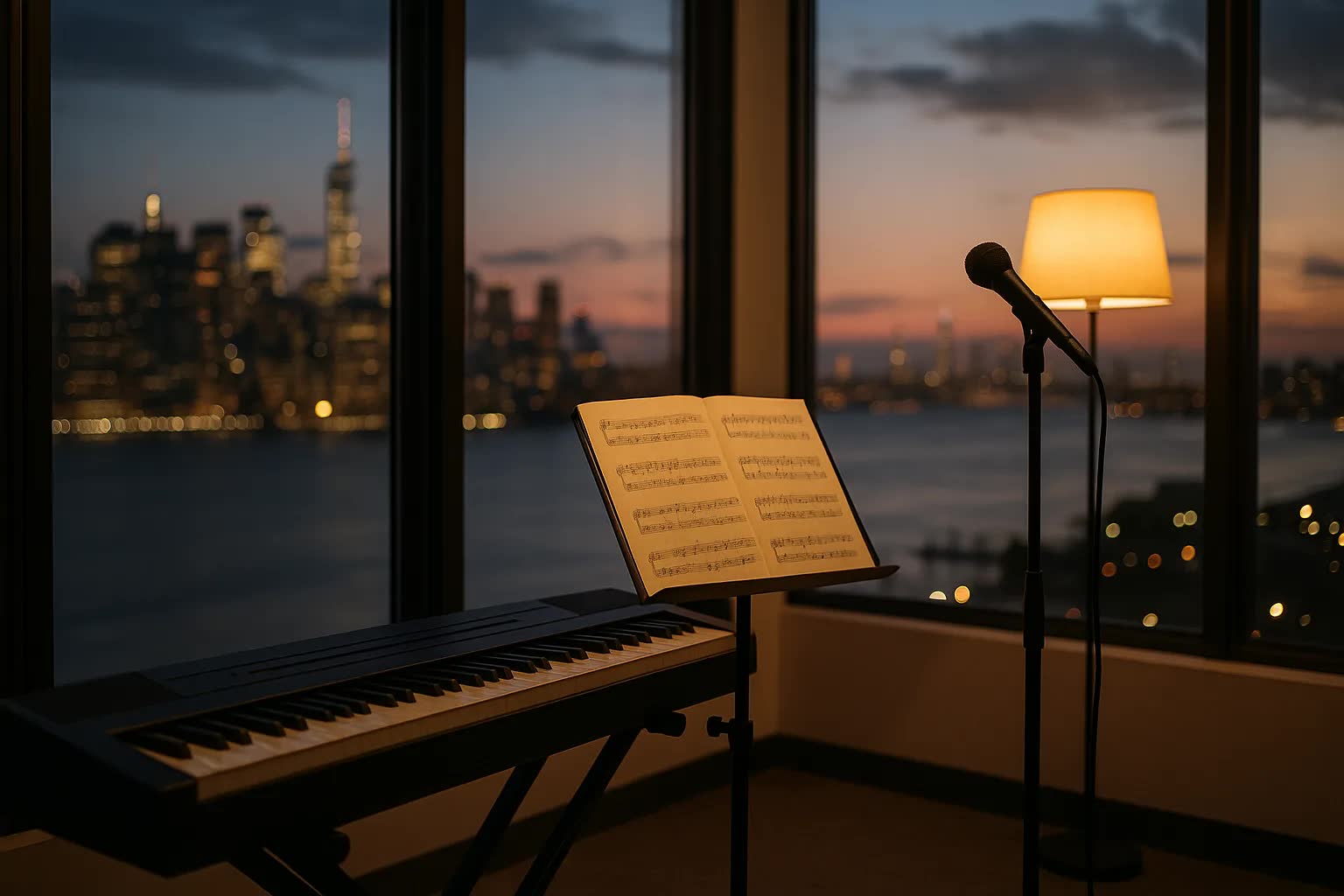
NEW YORK — Along the sun-glinted stretch of Jersey City’s waterfront, a cluster of modest storefront studios and converted lofts has become an unlikely commuter magnet for New York performers seeking affordable vocal training for everything from Broadway callbacks to podcast hosting and corporate presentations, drawing Manhattan residents off the PATH and ferries in a way that is reshaping the cultural geography between Hoboken and Journal Square.
What began a few years ago as a handful of private teachers renting rehearsal rooms near Exchange Place has evolved into a visible scene: Hudson Vocal Lab on Marin Boulevard, Harbor Voice Collective in Paulus Hook, Pier 9 Studios at the foot of Grove Street, and a dozen smaller operators offering hourly lessons, evening cohorts and weekend intensives. “We built the studio to be an alternative to cramped Manhattan spaces,” said Elias Moreno, founder of Hudson Vocal Lab. “Commuters can get here from Chelsea or Midtown faster than many can walk across town to a cheap Midtown room.”
Affordability is the main draw, studio directors say. Weekly private lessons run $40 to $75 an hour at many Jersey City sites, compared with typical Manhattan rates above $100; sliding-scale community classes and fully equipped recording booths for podcast pilots make the waterfront a one-stop shop for vocational voice work. “Our corporate programs started because clients in finance and ad agencies needed public-speaking training at a lower cost and on the weekend,” said Dr. Simone Hart, speech coach and director of corporate programs at Pier 9 Studios. “Executives from Midtown and the West Village are finding it more practical to commute here on a Saturday than to book expensive Manhattan time.”
The geography matters. Exchange Place, with its ferry access and PATH station, has become a hub where commuters arriving from the World Trade Center, Hoboken and Newark can step right into a 7 p.m. master class. Residents of Chelsea, the East Village and the Upper West Side routinely make the 20- to 30-minute trip, and actors coming from Brooklyn’s DUMBO and Williamsburg are increasingly drawn to the studios for weekend workshops that run longer than typical city rental slots. “I can do a two-hour scene study on Saturday and still make the 10:30 train back to Manhattan,” said Ava Tran, 28, a baritone who takes weekly lessons at Harbor Voice Collective while auditioning for regional musicals in New Jersey and Connecticut.
The growth can be sketched with numbers: at least 14 dedicated voice or vocal media studios have opened along Jersey City’s waterfront since 2022, according to an inventory compiled by the Hudson Arts Network, an independent nonprofit that tracks arts businesses; average hourly student enrollment at those studios has risen 62 percent year-over-year, their weekend workshop attendance is up roughly 48 percent, and studio rents are reported to be 20 to 35 percent lower than comparable Manhattan storefronts. Private lesson fees average $58 an hour on the waterfront versus $125 in Manhattan, while shared recording-suite time runs about $40 an hour here compared with $90 across the river.
Teachers on the waterfront offer a wide mix of skills and backgrounds: conservatory-trained musical-theater coaches, speech pathologists who work on breath and projection, podcast producers teaching mic technique and editors, and veterans of corporate communications who run anxiety-management modules for presenters. Studios often advertise rehearsal rooms with grand pianos, small black-box stages and miniature Foley setups for narrative audio work. “We do everything from belting to breath retraining to sound design for a true-crime pilot,” said Marina Costa, artistic director of Harbor Voice Collective. “Our students include teenagers prepping for conservatory auditions, podcasters from Brooklyn, and mid-career professionals polishing TED-style talks.”
The local spillover has helped neighborhood businesses too. Dockside Coffee, a narrow specialty cafe three blocks from Exchange Place, now schedules its slowest hours to match studio drop-off times and reports a steady uptick in daytime traffic. “When the 11 a.m. vocal class lets out, we see groups of students with sheet music and microphones,” said Leah Patel, the cafe’s owner. “They linger, they buy pastries, and they book the small meeting room when they need a quiet place to edit.” Other beneficiaries include costume shops along Greene Street in the Paulus Hook area, a freelance sound-engineer collective that rents time at Pier 9, and a local printing shop that does headshots and resume packages for performers.
The expansion has not been friction-free. Landlords have been known to convert retail spaces into short-term rentals, squeezing rehearsal studios after a year or two; parking remains scarce; and some long-standing residents say noise has increased on weekend evenings. “The PATH is handling slightly more late-evening trips for arts commuters, but capacity limits at peak hours can make scheduling tricky,” said a senior PATH operations planner who requested anonymity because of agency policy. Studios have responded with staggered schedules, hybrid online modules and partnerships with ferry services that provide late returns to Manhattan neighborhoods.
Institutional partnerships are forming too: the Jersey City Playhouse has started a residency program that places student actors in exchange for workshop space, and Hudson County Community Conservatory offers continuing-education credits for some weekend intensives. Regional producers — facing Manhattan theater rental crunches and high rehearsal costs — have begun auditioning and holding casting calls in Jersey City studios, where a full day’s rehearsal can be booked at a fraction of downtown prices. “We’re seeing a practical reorientation,” said Moreno. “The art follows where the infrastructure — affordable rooms, recording booths, supportive cafés — can sustain it.”
Looking ahead, studio owners and local arts organizers say the waterfront is likely to deepen as a vocal-arts corridor in 2026, with plans already in motion for an inaugural Hudson Vocal Festival next spring that would bring master classes, panels and pop-up recitals to Exchange Place and Paulus Hook; at the same time operators are watching downtown Manhattan’s commercial-rental market for signs of change that could either redouble the waterfront’s pull or create fresh competition. Whether the area becomes a long-term creative second stage for New York will depend on rent stability, transit capacity and the ability of these small businesses to convert short-term momentum into sustainable cultural infrastructure.