Yonkers Highway Work Forces Distribution Centers to Reroute Goods
Long-term lane closures and ramp reductions on I-95 near Yonkers are increasing transit times and fuel costs for regional warehouses.
By Luisa Pereira · March 15, 2026 · 4 min read
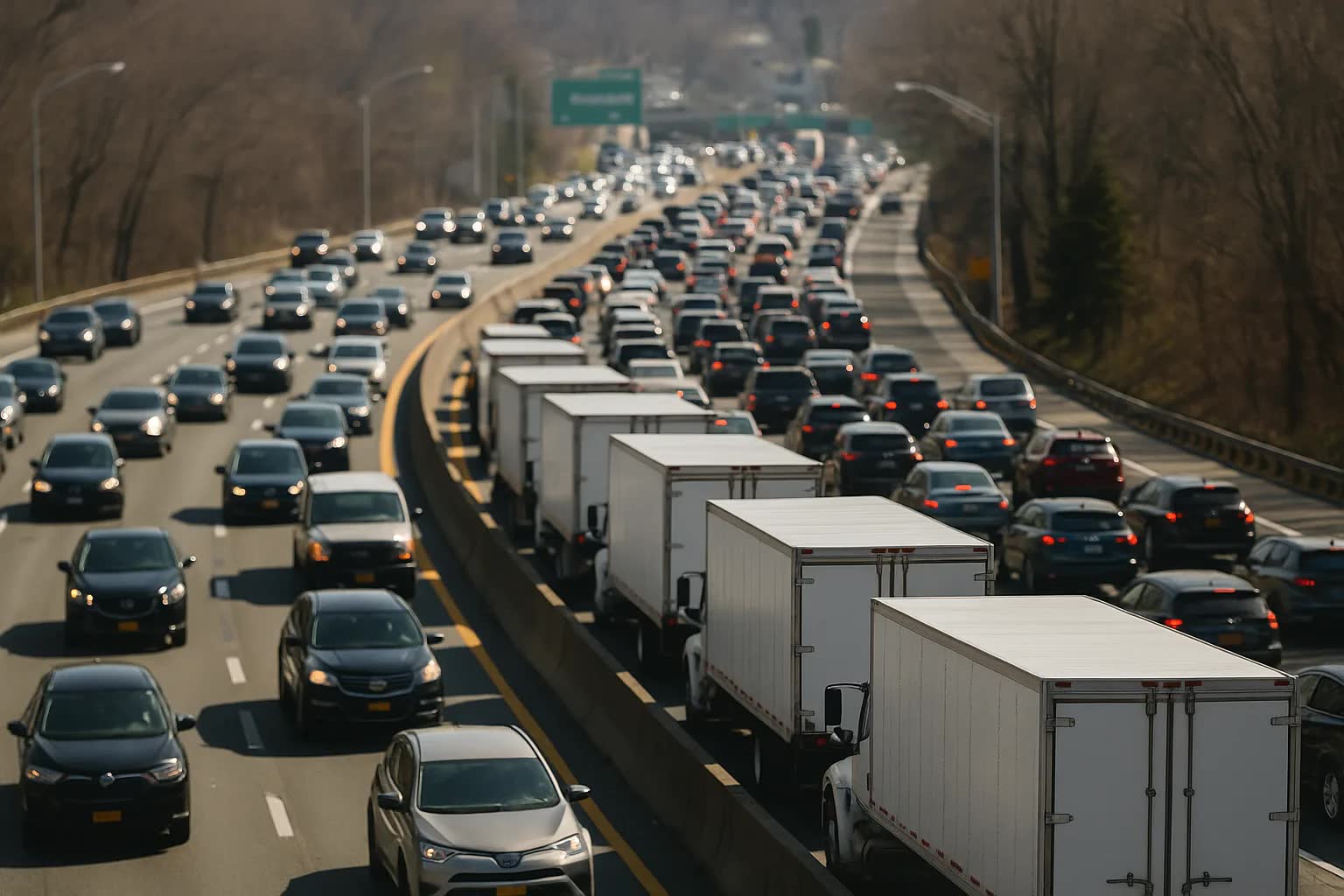
NEW YORK — Long-term lane closures and reduced ramps on Interstate 95 north of Yonkers are forcing a steady stream of regional distribution centers to reroute goods into the city, slowing deliveries to Manhattan bodegas, restaurant suppliers in the East Village and warehouse customers in Long Island City and Red Hook. The construction has turned what were once predictable dray routes along the Westchester waterfront into a patchwork of detours that add time, fuel and complexity to supply chains that feed the five boroughs.
The work, a state Department of Transportation project to rehabilitate several aging spans and reconfigure ramps near the Nepperhan Avenue and Cross County Parkway interchanges, began last fall and is expected to continue with rolling closures into late 2028. Contractors have reduced the number of lanes on I-95 at peak points and replaced three full-access ramps with partial ramps that limit turning movements for heavy trucks, according to project notices circulated to local municipalities and trucking firms.
Distribution operators say the changes compel automated routing systems to avoid I-95 and push trucks onto I-287, the Bronx River Parkway and local arteries such as Midland and Yonkers avenues, adding miles and urban driving time. Warehouses in Getty Square, north Yonkers and the industrial corridors along the Hudson are now staging across wider areas, breaking larger loads into smaller shipments so trucks can navigate tighter urban routes into Hunts Point and Manhattan markets.
"We used to do one 9,000-pound drop in Hunts Point a morning with a straight shot down I-95," said Maria Alvarez, director of logistics at Hudson Freight Solutions in Yonkers. "Now that same run is two hours longer on our routing software and often involves extra stop restrictions in Mott Haven. That eats into driver hours and raises our per-trip cost by about 15 to 20 percent." She said the company has added weekend shifts and increased pay for same-day drivers to meet customer windows.
State and private estimates compiled by industry analysts show detailed effects: roughly 2,600 heavy commercial trucks that normally use the impacted section of I-95 each weekday are being rerouted; average trip distances for regional deliveries have increased by 8 to 12 miles; and average transit times have risen from 42 minutes to 54 minutes for a typical mid-day run, a 29 percent increase. Fuel usage for rerouted trucks has climbed by an estimated 0.6 gallons per trip, translating to an extra $1.20 to $2.40 per trip at current pump prices, and early season projections put incremental monthly operating costs for affected distribution centers in the Lower Hudson at more than $1.1 million collectively.
The pressure is showing up in city neighborhoods. Hunts Point, home to the Bronx Terminal Market and New York City’s largest wholesale produce center, is receiving trucks that arrive later and in more variable windowed deliveries, disrupting dock schedules and the tight processing rhythm that perishable goods require. On the Brooklyn waterfront, Red Hook distributors report substituting smaller box trucks for larger semis to navigate narrower streets and to comply with new partial-ramp restrictions imposed at certain I-95 exits that make large trucks untenable.
"We are juggling customer expectations every day," said Daniel Chen, operations manager at Westchester Distribution Center, which ships refrigerated goods across the metropolitan area. "Drivers are logging more urban miles, we’re seeing increased spoilage risk when delays hit rush hour, and our labor costs for handling and split deliveries have climbed. Some customers are demanding price protection; others are shifting to vendors closer to Manhattan." Chen said his center has leased two additional cross-dock bays in the Bronx to break loads earlier in the route.
City officials and industry groups are pressing state transportation agencies for mitigation, proposing measures from temporary truck-only lanes on parallel parkways to expanded off-peak delivery windows in Manhattan and Staten Island. Yonkers municipal leaders have sought greater coordination on signage and enforcement to prevent heavy vehicles from using narrow neighborhood streets like Warburton and Ashburton avenues as shortcuts, saying those residential corridors are not built for sustained freight traffic.
A senior MTA planner who requested anonymity said the transit authority is coordinating traffic signal timing and studying freight-friendly signal phases for key approaches into Hunts Point and the Sheridan Expressway to help reduce idle times for trucks diverted off I-95, but stressed that large-scale civil work limits the speed with which fixes can be implemented. "We can smooth flows where we have jurisdiction, but the geometric constraints at several interchange points force some detours that aren't fixable without major reconstruction," the planner said.
The economic ripple extends beyond immediate delivery headaches; retailers and restaurants in neighborhoods from Chelsea to the Upper West Side are already seeing narrower delivery windows and higher procurement costs that could be passed to consumers. Smaller warehouses faced with rising operating expenses are reconsidering lease renewals near Yonkers and are exploring sites in northern New Jersey and Long Island that, while farther, promise fewer regulatory surprises. At the same time, some logistics firms are testing river barge options from Yonkers docks to reduce roadway dependence during peak construction phases.
Project managers say the lane reductions and ramp reconfigurations are designed to extend the life of bridges and reduce long-term maintenance interruptions, and the state DOT has signaled intent to accelerate certain phases if additional funds and shifts in contractor scheduling can be arranged. Distribution executives say that until those changes materialize, they will continue to split loads, bump up driver pay and explore micro-fulfillment centers nearer to key Manhattan markets to insulate perishable supply chains from the construction squeeze. With the next construction season set to expand closures, operators and city planners expect another busy summer of adjustments before any measurable relief arrives.